Tuesday, April 29, 2025

Wet, Cold, and Exhilarated

Before we left for Europe, I’d checked the weather in England and was dismayed to see reports of rain for pretty much every day we’d be there. Sigh. Dave and I both needed new raincoats. I have my mother-in-law’s old yellow slicker, but I wanted something vaguely chic, and Dave turned to Amazon to purchase a padded black jacket that would serve for rain as well as cold. A practical choice since Lisa had told us to pack hats, gloves, and warm coats for our excursion up to the Jungfrau where it would be bitter cold. Continuing my tradition of wearing inherited clothes, I was content to bring my mother’s long, black parka for that jaunt.  

Truth is, in the flurry of last-minute preparations and election activities and worries, I was content to hand over all Swiss plans to Lisa and Tucker. I wasn’t even sure what the Jungfrau was, and never got around to Googling it. So, we’d done as Lisa asked, but from the warm days of September to the mild weather we encountered throughout our trip, it was hard to imagine needing the winter clothes tucked in the bottom of our suitcases. 

Our lovely trail walk of paragliders and rainbows ended at the bus stop for the Trummelbachfalle, a series of waterfalls inside the mountain open to visitors by way of an elevator, tunnels, and stairs. We couldn’t miss that, but it would have to wait; hunger and the allure of creamy cheese fondue and crusty bread demanded return to the village. 

The next day was overcast and drizzly, the perfect maiden voyage for our new raincoats. We took a local bus back to the Trummelbachfalle, bought tickets, and opted for the elevator for the first leg of the climb. 

Raincoats. It was a good thing we’d worn them. Ten waterfalls draining from the glaciers of the Eiger thundered past us, over 5,000 gallons per second, in a wild rush to the river below, dousing us as we clung to iron railings and navigated the steep, wet stairs cut into the rock. 

In Europe, I am ever amazed by the trust placed in travelers. Yes, there are signs urging caution and consideration of others. And yes, there was that iron railing to keep us from plummeting into the falls, but basically, our safety was left to our good judgment. 

Tucker, Lisa, Lexi, and Paul wore yellow, magenta, pink and royal blue raincoats, vivid in the dim light of the tunnels or while snaking between the cliff and surging water. They were game for the adventure, but it tested my heart to watch those butterfly-bright colors inching between unyielding rock and the water’s force. 

                                                            *  

What’s with these birds? We are atop the Jungfrau, at 13,642 feet, the highest train station in Europe.  It is frostbite-cold, and we are buffeted by wind, slipping on icy snow, and surrounded by gleeful tourists throwing snowballs. There’s not a tree to harbor grubs, shrubs to shelter creatures, nor carcasses to scavenge. What do these birds eat? Where do they sleep? What draws them to this freezing, barren height? 

We are drawn by stunning views, the prospect of visiting an ice palace, and the joy of accompanying our kids on another adventure.  

First surmounted in 1811 and now accessible by a delightful ride on a train the color of Christmas, “Jungfrau” means  young woman or virgin.

I don’t get the connection. There is no blush of the rose, no wisp of springtime green up here, that’s for sure. All is glacial white, or that icy blue that colors the river and waterfalls below. In fact, beyond the crags, glaciers, and this snowy plateau, I glimpse a distant blue sea. Or is it sky?
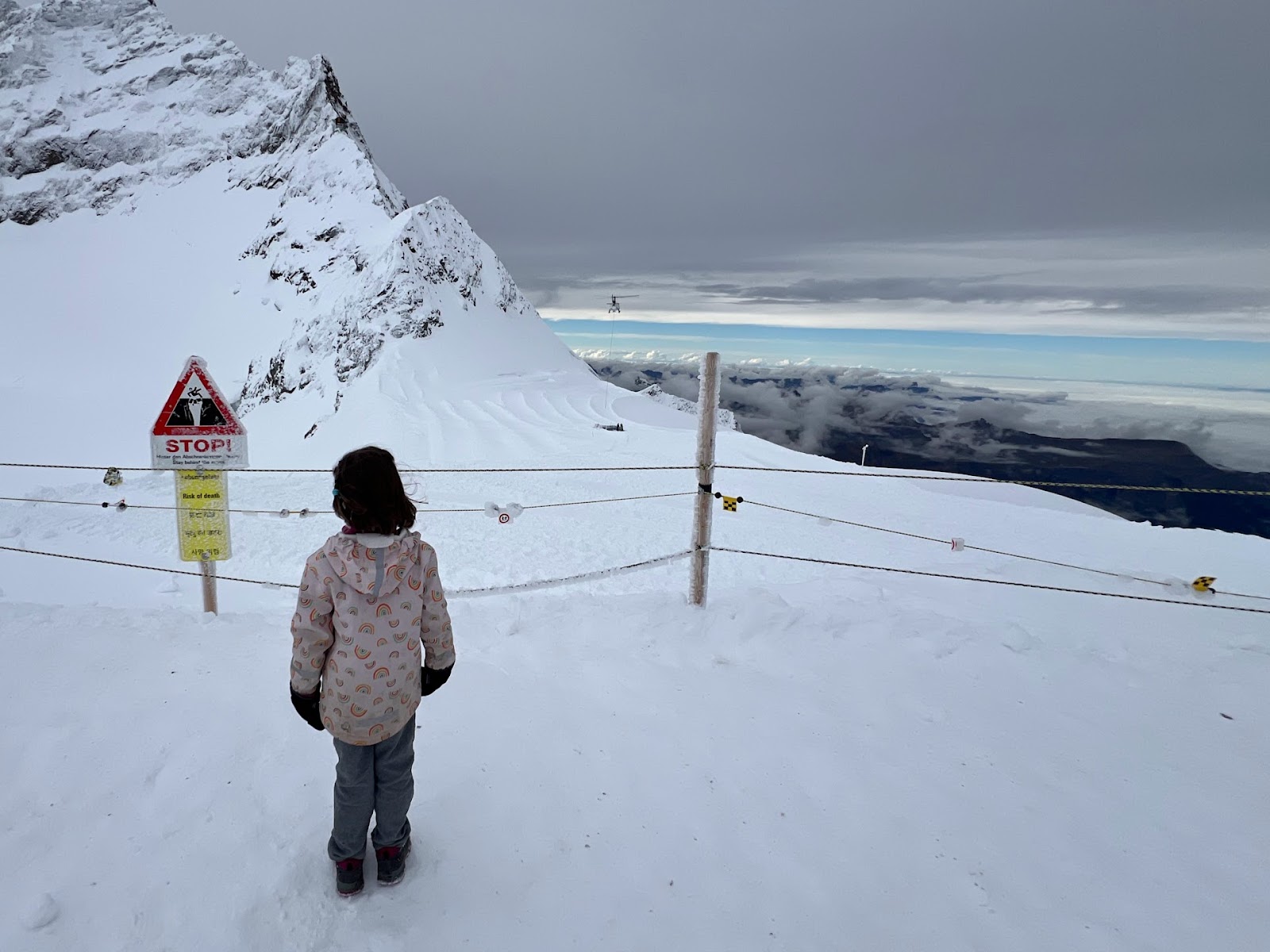


While I am mincing about like the ancient being I am to make sure I don’t fall, Paul and Lexi are enjoying the ice, sliding and skidding for fun. And that is the vibe. Bundled against the cold but giddy, people are posing, flinging loose snow, packing it into projectiles, and laughing aloud.

Our stay outside is not long, however; the cold is cruel, and there are only so many times I can whip off my gloves to snap pictures of the scene, the kids, and those birds before the ache in my fingers begs me leave.   

We head inside the Jungfraujoch complex to  zip down the corridors and past the ice sculptures of the Ice Palace, take a just-in-case trip to the restroom, and board the train for the two-hour ride back to Lauterbrunnen. We have a dinner reservation at 6:00 and cheese fondue awaits. 

Throughout our trip, from the Churchill War Rooms, to the many-times conquered village of Rothenberg ob der Tauber, to the icy reaches of the Jungfrau, I have pondered the forces of man and nature, and the changes they have wrought. Sometimes over eons, as water erodes valleys and cuts through rock, or, over a matter of a few generations as brutal lessons are forgotten and once again, human animosity, conquest, and power-hunger have felled civilizations. With the upheaval that undoubtedly lies ahead for America after this election, it has been a blessing to immerse ourselves in these glorious settings, the lives of our children, and the still-innocent world of our grandkids.   


Friday, April 11, 2025

Turning Six

“It’s so beautiful, it looks fake,” my daughter Casey texts back every time I send her pictures. Harsh as that sounds, it’s true. I’m here, walking in a valley through green meadows bordered by mountains  beribboned with tumbling waterfalls, and it’s hard to believe it’s real.

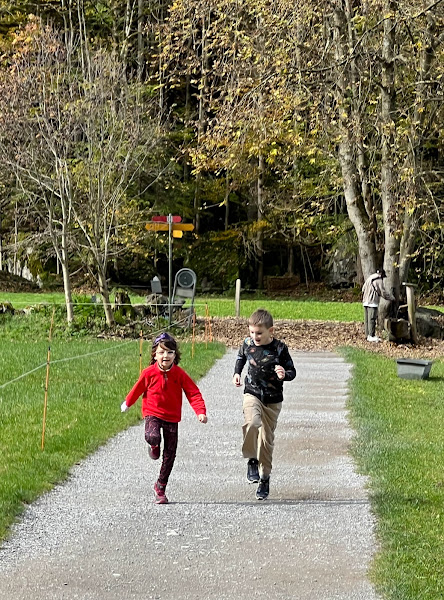
Dave and I are in Switzerland visiting my son Tucker, his wife, Lisa, and our grandkids, Paul and Lexi. Lexi is tireless, and she scampers down the trail ahead of me and Lisa, the bell on her purple backpack jingling in concert with the hollow toll of the bells slung round the necks of the cows and goats grazing in the grass as we stroll by. Propelled by the glaciers melting milky blue ice into its waters, the river rushes alongside.  

Lexi races back to us, her eyes wide behind her pink glasses. She dances with excitement and points skyward. “Look! Look up!

A paraglider has taken off from the cliff above and sails ever lower, a white vision dipping and angling across the trail before us and then dropping neatly into the field to our left. I have snapped, snapped, snapped a series of pictures of his descent, yet another “whoa!” moment in this setting that is magical even without the appearance of a winged human landing nearby. 


But where are the boys? We turn and shield our eyes against the sun hoping to spot them, but Dave, Tucker, and eight-year-old Paul have lingered behind and are still out of sight. What could they possibly be doing?

When we visited the kids in Zurich last January, we were surprised to find the weather so much like Connecticut. It was gray, drizzly, and mild, not calendar Switzerland in the least. “I told you to come in October,” Tucker had groused. He wanted so much for us to see why they loved their new home, but “We are here to be with you,” I would say. “I don’t care about the weather.”

And that was totally true, but Tucker was also right. October in Lauterbrunnen is an artful symphony of spilling water, clanging bells, skipping lambs, and verdant green against the white of snowy mountains. Rustic sheds dot the hillsides, and red geraniums bloom brilliant against the wooden shutters of alpine homes. Months ago, I saw a picture of Tucker and family taken on a path above this village and told him, I want to go there! So, dear souls, they arranged this get-away during our visit. 

Lisa, Lexi, and I skirt the meadow where the paraglider landed and cross a wooden bridge, scanning the trail behind us for signs of the men. “Look!” Lisa says. “A rainbow!” 

Flying humans, contented cows, and now a rainbow? Seriously? Yes. Where the sun graces the mist of one of the waterfalls, a rainbow arches from cliffside to the trail. And there, running toward us, is Paul, with Tucker and Dave in his wake.


“Did you see…. (where to begin?) the paraglider! The rainbow! The cows! The goats!” We greet them with a barrage of all that has amazed us. Yes, they have, and like me, stopped to take innumerable pictures trying to freeze them. 

This has been my challenge since my kids were born. Trying to freeze their precious baby faces, their toddler missteps, their proud accomplishments. Trying to pay attention and take nothing for granted. Trying to do the impossible: slow time. So, I take many pictures, ironically sacrificing the moment in the very act of striving to preserve it. But with Tucker and family now living overseas, imprinting the time together is that much more important. 

When my grandkids were even younger, I’d wonder after a memorable day of picking apples at a local farm, hiking in our woods, or playing in a fort made of a blanket stretched over a quilt rack, Will they remember this? Probably not, but I hoped the feeling would stick. Maybe the feeling of fun and being so deeply loved by their grandparents would last. Shamelessly, I work to cement that. 

“Do you know you’re the best boy in the world?” I’ll say to Paul. 

“Yes!” he hoots.

“How do you know?” I ask.

“Because you’ve told me about a million times!” By then I have him in a smothering hug, so his words are a giggly growl. 

Back on the trail, Lexi dashes off to meet her brother and wraps him in her arms. Today is her 6th birthday, and to Lexi, everything about this day – the rainbow, the paraglider, the music of the bells, our visit – is all for her.  And perhaps, it is. The Universe generous in celebrating this little girl.  

“Where have you been, Paul?” 

“We played ba-loop for a while, throwing rocks into the river. Stopped to see the cows. Did you see the cat at the house with the big garden out front?” 

Yes, we did. “And we got pear chips there!” crows Lexi, with just a hint of “and you didn’t!” in her tone. She is a good sharer, though, and offers Paul a piece. 

That had been yet another fascinating surprise, to come across a vending machine offering raclette cheese, bread, chocolate, and pear chips housed in a charming alpine hut adjacent to a house with an abundant garden. Pear chips can only go so far in staving off hunger and the grouchiness that can go with it, so we head back to the village for lunch and then to the gondola cableway for our afternoon trip to Murren.


                                                                   *

Once we clamber aboard, the gondola lifts us up the steep slope of the mountain. We climb past trees tinged orange and gold, up the white face of the cliff, up until the village is a storybook stage set far below. At Grutschalp, we transfer to a train for the final leg to Murren. Tucker hands Lexi his 360 camera mounted on a long pole. “You are six now, old enough to hold the camera.” Personally, I think he’s brave to hand it over, but Lexi’s proud smile is a gift as Tucker opens the window and extends the pole outside.

To begin with, I’m surprised that passengers are free to open the windows, but more surprising still is when I spot the train’s driver leaning back in his seat, arms stretched luxuriously behind his head. Yes, he is going “no hands” as our train carries us ever higher. He knows his vehicle, though, and we arrive unscathed in Murren. 

The summer tourists have largely departed, and the village is in the throes of build and repair. While there are few private cars, work crews are busy. Trucks shuttle loads of lumber; earth movers shovel dirt; and metal clangs against metal. Still, the town is a collage of color. Window boxes blaze with purple petunias and red geraniums, vibrant against shutters of natural wood or green. Clouds shift across the face of the mountains, and visible far below, we see the waterfalls, village, and snaking path of the river. 


The kids are troopers; scanning scenic vistas is not their favorite thing. But there are tree stumps to climb, a cat to coo over, a grandfather willing to give shoulder rides, and pear chips to nibble.

Across the valley, we see signs of a rockslide, and we’ve heard that the glaciers that feed the river and waterfalls are shrinking. I have allowed myself a respite from the news during our time here, and the affairs of humans seem small and distant in the face of the forces that, over eons, have shaped this expansive scene.

But more immediately, today is Lexi’s birthday, and for me, thoughts of forever hover. 

 “I will miss five-year-old Lexi, but I love six-year-old Lexi sooooooooooo much!” I tell her while enveloping her in a squeeze. 

“Like… for infinity?” she says.

“Yes. Infinity!”

“But what about when you die?” she asks, her expression becoming serious. 

My nose prickles and my voice is strained, although I hope she doesn’t notice. “Even then, Sweetie. I will always be there, watching over you.” 

I remember my sixth birthday; surely Lexi will remember hers?


Thursday, April 3, 2025

Pixel Zoo Jungle

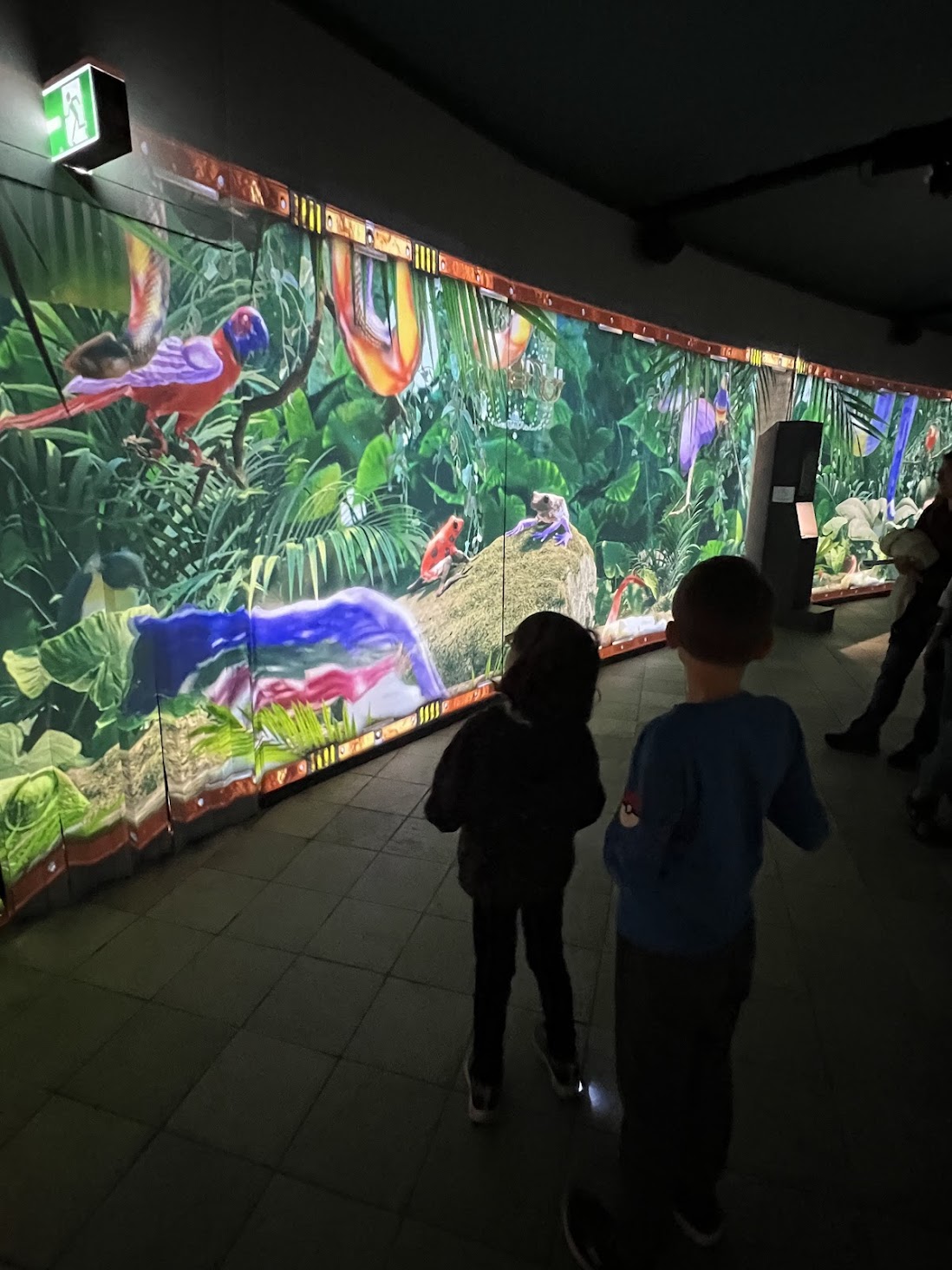
Given the fatigue of yesterday’s journey from Rothenberg ob der Tauber to Zurich, it was lovely to nestle in a bean bag chair with my grandchildren, son, and daughter-in-law snuggled nearby. Dave and Tucker dozed off, lulled by music and masked by the darkness, but Lisa, Lexi, Paul, and I were entranced by the swirling colors, verdant greens, lumbering elephants, loping leopards, and swinging apes projected on the walls encircling us. We had come to experience immersion in the Pixel Zoo Jungle at the Kirche auf der Egg, and, as the kids had promised, to do some coloring afterwards. Nice! Coloring can be soothing.

When the lights came on, we gathered up coats and slipped on our shoes. Tucker and Dave rubbed their eyes and tried to look like they’d not been sleeping. We left the womb of the church theater to enter a hall lined with tables and chairs stocked with crayons and colored pencils. 

Shelves nearby held copious sheets of paper, each with a line drawing of one of the animals portrayed in the show. Paul chose a leopard but colored him with the orange and black stripes of a tiger. Lexi’s butterfly was green and purple. I chose a poison frog and bejeweled him with blue, yellow, and green. Dave’s parrot was a stunning array of scarlet, blue, and yellow feathers. Fun!

Paul disappeared behind a curtain, but absorbed as I was in adorning my frog, I paid no attention. 

Suddenly, he thrust the curtains aside, and ran to us saying, “My tiger is REAL! Come see!”

What?

We followed him through the curtains and down a dark hall where the wall seemed alive with creatures roaming through dense foliage.

“Look! There he is! My tiger!” hooted Paul as a handsome beast, strong and fluid, sauntered before us, his markings exactly as Paul had colored them. 

How could that be?

“Over here!” said Paul as he led the way to a tall, white cubby with a shelf opening to the front. “Put your drawing on this square under the light.” 
 

As instructed, but expecting little, I placed my frog.

“Now, go look for him!” 

As Paul’s tiger continued to prowl, a golden sphere floated across the jungle scene. The sphere expanded, then evaporated… leaving my frog - in his blue, yellow, and green glory - squatting on a rock. 

No way!  

My frog stretched his leg. He did! You won’t believe this, but MY frog stretched his leg! AI or not, modern technology or not, this was magic – our creations come to life!

Next into the cubby and under the enchanted beam, Dave’s parrot and Lexi’s butterfly. And then, the miracle, as they hatched from golden spheres to flutter and fly through twisting vines and tropical palms.

Of course, we were not the only ones populating that jungle and had to take turns at the cubby. So, we hurried back to the tables to produce two anacondas, another butterfly, and a red, purple, and green jaguar, then proudly waited to witness their birth. 

Later that evening, back at the kids’ place, we clustered on the couch to watch a tape of the Space-X Starship launch and the extraordinary precision of the booster rocket’s re-capture when it returned to Earth. 

What a day of marvels! Drawings brought to life and starships guided home. If we humans choose potential over division, what will Paul, Lexi, and Eleanor live to see?  


Wednesday, March 26, 2025

Preserved by Poverty

 October 9, 2024

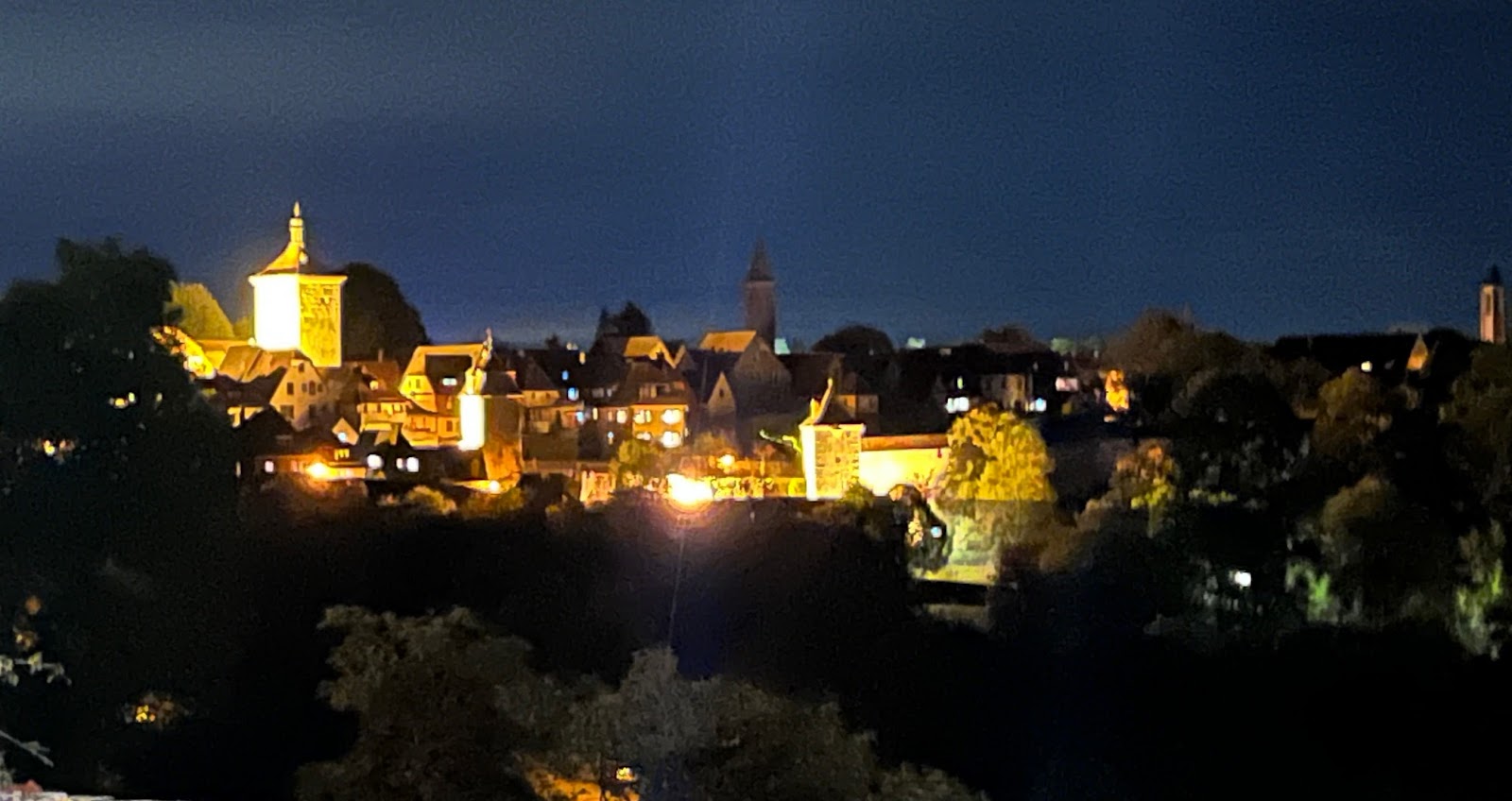
The Night Watchman brushes his long black cape aside as he gestures out over the ramparts. A constellation of encircling house lights crowns the wooded valley below, barely piercing the darkness that enfolds the countryside. 

“In the 1600’s, during the Thirty Years War, security was a priority,” he says. “Enemies were everywhere. So, we are high on a hill, surrounded by thick walls and guard towers. But the enemies breached the walls and brought the plague. They stayed in our homes and took our food and our women.” He looks around our circle of tourists with a rueful smile. “Don’t be fooled. There were no ‘good old days.’ 

It's a message I need to hear because nostalgia for other times is a refuge I often turn to. But for now, Dave and I are exactly where we want to be, in the dark of this historic German village, held in thrall by a master storyteller.   

“For 250 years, the town went silent. 250 years of nothing. There was no money to repair or modernize. Nothing changed. Rothenburg was preserved by poverty. Eventually, artists discovered us… and the tourists followed.  So, I thank you all for coming.”

Twenty years ago, in October, 2005, Casey, Dave and I arrived in this village in flip flops and summer garb after a month’s sabbatical in Italy. Casey was down-spirited and snuffly with a terrible cold, and we were ill-prepared for damp, chilly weather. Still, as we hunched our shoulders against a drizzling rain while trudging from the tiny train station, my daughter’s face lit up as the town came into view. 

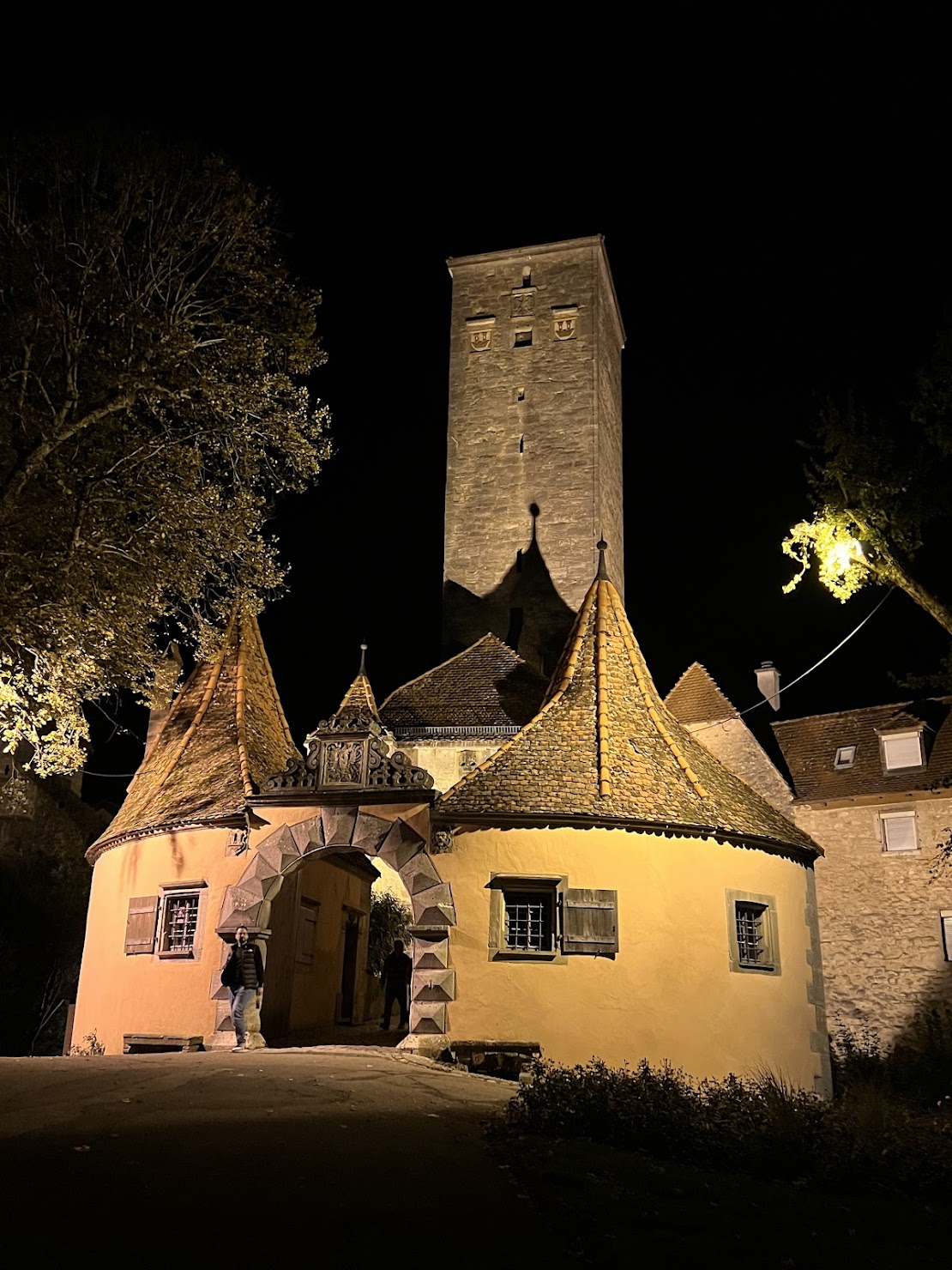
For Rothenburg ob der Tauber is magical, a fortified Medieval village, near frozen in time. To wander its narrow cobblestone streets between pastel-hued homes with steep pitched, red-tiled rooves and exposed beams is to enter a fairytale.  

Once settled into our B & B, the 600-year-old home of our host, musician and inventor, Norry Raidel, shopping for shoes and cozier clothes was a priority. As promising as were several enticing window displays of comfortable shoes at reasonable prices, every shoe store we passed was closed for the day. Casey was drooping, discouraged, and needed a nap, but in the absence of warm shoes, sweaters were a necessity. 

We turned down a side street and stopped in a store tended by a lanky, long-haired proprietor and his wife. Casey tried on a soft zip-up of heather brown and loved it, while the sweater I tried was bulky and a bit itchy. “Looks good,” said the owner, but I shook my head and returned it to the shelf. For the time being, I’d wear layers.   

That evening, after a snooze and dinner, the three of us waited in the central square, the Marktplatz, for an 8:00 tour to help us learn some history and get our bearings. From a side alley, our guide swept toward us, his Medieval cloak swirling about his legs, his long hair flowing over his shoulders. With every stride, he rapped the cobblestones with an axe-headed staff. Once he reached our group, he held up his lantern to better see my face and said, “You should have bought the sweater.” 

Shop proprietor by day, Hans Georg Baumgartner has been conducting the Night Watchman Tour in Rothenburg ob der Tauber for decades. Like us, he is twenty years older, and but for his graying hair, looks much the same in his cape and wide-brimmed hat. The blade on his staff is curved, wicked, and deadly sharp – more so than I remember. He notes my gaze and explains, “Necessary for Night Watchmen. All of the good people were asleep in their beds, and those were superstitious times. Who knew what was out in the dark?”


As he had in 2005, the Night Watchman told us the trials of this small village did not end in the 17th century. During World War II, Nazis held the town, and on March 31, 1945, U.S. bombers destroyed a third of the homes, walls, and municipal buildings. 36 people were killed. In mid-April, the Allies received an order to finish the job. But John J. McCloy, Assistant Secretary of War, was reluctant; throughout his childhood, he’d been captivated by a painting of Rothenburg purchased by his mother during her travels. Rather than proceed with the order to demolish, he persuaded his commanding officer to allow him to try to negotiate a surrender.  

In recent months, human events feel like a dominoes affair, a set-up where a flick on one tottering tile sends the rest in a serpentine tumble, changing all that was. I suppose the citizens living in 1940’s Rothenburg felt that way too, little knowing the conversations at play in the Allied encampment beyond their city's walls.    

During the ‘70’s, Dave and I were entranced by the charm of this place we’d discovered while backpacking through Europe. So, we bought a souvenir, an etching of Rothenburg that has hung in our bedroom ever since. It fills me with wonder to reflect on the ripples set in motion from the moment McCloy’s mother wandered into a gallery, browsed as we had, and selected a painting that, years later, succeeded in saving the town.    


Tuesday, March 11, 2025

What to Do?

October 7

Fatigued after our wonderful day touring Cotswolds villages with Colin, we slumped at the desk at the Lygon Arms dining room. We weren’t hungry, but knew we’d want sustenance a bit later and needed a reservation. Max – garrulous and ever-present – was in attendance with soulful, statuesque Petra, who had been our server at breakfast. Both were perfectly suited to the service industry, for they made us feel like welcome old friends from our first meeting. 


As enchanted as I’d been throughout our tour, my anxiety about the next day’s whirl of train rides and connections had returned, and Max and Petra were kind in their sympathy as I burdened them with our itinerary and my worry. 

"Would it help if I send breakfast to your room? Around 7:00? You wouldn’t have to take the time to come down to the dining hall. Maybe that would relieve a little stress?” said Max.

Touched by his kindness and the thought of such an indulgence, I was incredulous. “Wow. You could do that?”

“Of course! Happy to!”

After we settled on a breakfast hour, Petra said, “so, are you ready for dinner?"

We were not and weren’t sure when we’d be hungry, so Petra said, “You go rest. I’ll reserve a table for you, and you come down when you’re ready.” Oh, to be cared for with such warmth was a gift … as was our dinner of gnocchi with spiced squash and crisped sage and deliciously decadent sticky toffee pudding.


October 8

Dispirited, Dave and I sat on a platform bench encircled by our over-sized luggage and smaller bags. Other travelers marched by, their trim suitcases with surfaces of a smart metallic or business-perfect navy blue rolling easily on four wheels. In comparison, the wheels of my suitcase had been shedding their casings like some long-distance trailer truck dropping its re-treads, making their roll rocky. 

We had left The Lygon Arms at 7:50 am. Petra had rushed out to hug us good-bye and tell me not to stress out. She struck a dramatic pose and blew us a kiss as we climbed into the taxi. 

So began the journey I had dreaded for weeks: taxi to Evesham, Evesham to Paddington, Paddington to St. Pancras International Station, St. Pancras to Brussels, Brussels to Frankfurt, Frankfurt to Wurzburg. Or at least, that was the plan.

We’d made it as far as Brussels and had disembarked with a crowd of passengers rushing to whatever was next. A cheerful young woman bearing a heavy backpack told us she was catching the same connection as us and trotted off. We tried to follow her, but hampered as we were by our massive bags, we lost sight of her in the crush of people. 

Where to go? No signs to other platforms, so we followed the surge. We saw a staircase to the right, but no way could we manage it dragging our bags. A line had formed for two elevators, so the only option was to join the queue. It was a long wait. 

Once attained, the main concourse was awash with people in a hurry. Yes, there were signs, but written in an unintelligible language – maybe Dutch? – and the times indicated were beyond my math skills: 13:05… was that 1:05 or what? I felt frantic, near teary, and my arms were aching from lugging my enemy of a suitcase. Desperately, we scanned the multitudes for anyone who looked official. 

A burly guy in a red vest with badges and a walkie talkie looked promising. He was patient, helpful, and… regretful as he checked his phone for our train’s status. 

“It looks like that train has departed,” he said. He scrolled a bit more, seemingly as hopeful as I was that he was wrong. But no. At my stricken expression, he gestured down the concourse.  “There… there. Go to the international desk. They will help.” He ushered us over to a handsome lad with startling blue eyes who was wearing that same red vest and then disappeared. 

Did I thank the burly guy? I don’t think so. Dave would never fail in that, but he was trailing behind with our heaviest bag. I was so flustered, so upset, and I had mentally moved on, focused on the young guy and finding out what we should do. Still, I hate that I didn’t thank that man.

Blue Eyes was sympathetic but gently accusing. “The train was on time. You…?  What happened? Trouble with your bags? Why…?”

I did not shriek, “Why aren’t there more signs? Where were your red-vested colleagues when we needed them? Two elevators?  Are you serious? You gave us only 17 minutes to figure this out on our own??! ” No. I said none of that. Showing amazing self-control, I said, “Too many people waiting for the lifts.”  

Despite his obvious intent to blame our dilemma on us, he scanned our tickets, transferred them to another train, and directed us to Track 10. There we sat surrounded by our bags to wait another hour and a half. 

Glitches are inevitable while traveling, at least for Sylvestros, but maybe this was meant to be. Once we were seated on the next train to Frankfurt, we shared the coach with Susan, Benjamin, two-year-old Justus, and five-year-old Hemmings. A joy.

Inveterate travelers undaunted by two children, they were returning home to Cologne having spent time in London. “The other day, we were picking up stones along the Thames and throwing them in the water. A boat went by and kicked up a wake. I was not fast enough," said Benjamin, “and Justus fell in.” He gestured the length of his son’s body and said, “He needed new clothes and new shoes.” Justus grinned and looked very pleased about his emerald-green Incredible Hulk tee-shirt.

*

While the Wurzburg train station was neon-bright, disorienting, at 1:30 AM, outside on the street, it was dark, damp, and raw. Disheveled and tired from our frustrating day of travel, we gazed out over ripples of trolley tracks into a city asleep. I had the address of our hotel, and a vague memory of its location as represented on the tiny map on the website I had viewed on my computer at home weeks ago. I prayed it was as close as I thought, but even so, how to find it? It was hard not to cry.

Off to our left was a line of taxis, so we headed over, dragging our bags, hoping someone spoke English. Three drivers leaned against their vehicles chatting and smoking. Would they be honest and not pass up the chance for a fare?

Their English was minimal and even after months of studying on Duolingo, I speak nur ein bisschen Deutsch – only a little German. The five of us huddled close over my now lined and crumpled itinerary as I showed them the address of the Hotel Wurzburgerhof. 

“Is close… I can give a ride?” said one kindly. Perhaps he sensed I was too close to tears to push. I’d made these plans, and they were my responsibility. I didn’t want to drag Dave on a mis-chosen search. I shook my head no, and with a slashing motion of his hand, the man indicated that the hotel was straight ahead, just down the road. 

So, weary, worried, and nervous, we hauled our bags over the trolley tracks and across a thoroughfare that would be a madhouse of cars and motorbikes come daylight. We rattled on, stillness all around us. 

In essence, the men had said, “Soon… a sign.” Two blocks ahead, we could see a vertical neon “HOTEL,” but the facade didn’t look anything like the picture on the website. Whatever. No other choice.  

When we pulled up to the hotel, it was not ours, there were no lights inside, and only a keypad combination lock next to the door. In despair, we scanned our surroundings, seemingly sketchy in the dark. What to do? 

As happened in London, an option was for one of us to stay with the bags while the other went back to the taxi drivers for clarity. “Not gonna happen,“ said Dave. Or, we could return together? Unappealing given our fatigue and weighty bags.   

By now, it was close to 2:00 AM, and there were no signs of life… until a young blond woman carrying a pizza box rounded a corner.

Thank heavens. Literally. I thanked the Heavens, for surely this girl was heaven sent.  

No doubt she was surprised to see two aging travelers surrounded by suitcases standing forlornly in the street. She spoke some English and juggled her pizza box while fumbling for her phone to pull up a map.   

“You are close, “ she said. “See here? Go left, past the bus stop.” Our heads nearly touched as we leaned over her cell… the girl, the map, and the phone, light banishing the darkness. 

Fifteen minutes later, Dave and I were crammed into a tiny lift at the Wurzburgerhof with our cursed bags and a room key in hand.  


Wednesday, March 5, 2025

Glad Colin's at the Wheel

 Car-less we were, and we wanted to visit other villages. Beyond Broadway, we’d read of Stow-on-the-Wold, Burford, Bibury, and Bourton-on-the-Water, and were drawn by the poetry of their names and images conjured by a lifetime of reading English novels. But the thought of Dave navigating twisty Cotswolds lanes on the left side was too unnerving to contemplate. So, at a friend’s recommendation, we turned to Cotswold Tours and Travel and hired Colin Gill. 

Thank heavens we had a proficient local driver at the wheel, for the roads were narrow, basically one lane, cut, to my thinking, for horse and cart travel. Close-packed hedges skirted either side, a gauntlet of green that masked sight lines. I was buckled tight in the back seat and grateful to be so as, more than once, we rounded a blind curve to come nearly grill to grill with an oncoming car. Relaxed, friendly, and flexible, Colin was unfazed by such close encounters. To my squeaks of alarm, he said, “Just the way it is here. I’m used to it.”  

Oh my.  

Our first stop was Bourton-on-the Water, a lovely hamlet of earthy stone buildings along winding streams crossed by picturesque bridges. In my Google search for “best Cotswolds villages,” Bibury was tops, so Colin – willing to tweak his route however we wished – took us there next. Clearly others had read the same lists, and ours was a companionable stroll with a host of others. 


Over the course of the day, we walked to the edge of a steep escarpment where a shin-kicking competition and cheese rolling event are highlights of an annual festival. Elsewhere, we saw the remains of a Medieval cart wash across from a 1600’s almshouse that still houses the “less fortunate.” In Chipping Campden, Colin pointed out the ruins of a once illustrious estate burned in the 1600’s by the Royalists to prevent the Parliamentarians from using it. We also stopped at a brewery to sample the beer and admire the grounds, waterwheel, and lake where swans sailed across still water, their wakes sending shimmering patterns through the reflected fall colors. 


Later we swung by Broadway tower, but it was Stow-on-the-Wold that captivated me with its history, sights, and stories.

When we arrived in the town, Colin nestled the car in a spot on a side street, and we walked to the village square. Warmed by the sun, we were charmed by the encircling shops of ocher brick with shingled rooves and chimneys skinny as heron necks. But surely spirits whisper there, for in the final days of the English Civil War, on March 21, 1646, the lanes into the square were barricaded, and 200 Royalists were massacred. It was said the blood puddled so deep ducks could swim in it. 

Nearby, the Porch House, with sections of the building dating from 947 A.D., claimed to be “England’s oldest inn.” There, too, Time’s layers transform and muffle. Guests have pulled chairs close to the fireplace, and servers have shouldered trays of beer in the pub for hundreds of years, but unlike those long-ago visitors, we were not worried about witches. At our request, a burly, blond waiter was happy to show us the Medieval “witch marks” scratched into the surround of the fireplace to ward off hexes. 

In the corner of the square stands St. Edwards Church where hundreds of prisoners were held at the time of the massacre. Two twisting trees, graceful as dancers, flank the back entrance, reportedly inspiration for J.R.R. Tolkien’s “Durin’s Door” in The Lord of the Rings

Inside the church, a memorial to the 45 soldiers from town who died in The Great European War, World War I, spans a wall. On a table nearby lay a plain, three-ring white binder filled with pages sheathed in plastic. Colin explained that the binder held pages on every lost soldier with pictures, facts about their lives, and reminiscences about the person they had been. As I turned the pages, I stopped periodically to read an entry or gaze at the photographs. Some of the 45 lost were so young, they were pictured in their school uniforms. I thought of the many lists of names on stone or bronze monuments in small towns and cities in every country. Every life cut short. Every name representing a family devastated by grief.  

Rupert Henry Ingles-Chamberlayne died on October 15, 1914, at the age of 17. Ten weeks after his death, his school mentor wrote to the boy’s mother, “His pleasant, open, smiling face… left no doubt in my mind of his character and upbringing. All I ever heard or saw of him only strengthened my first impression.” Rupert served in the Royal Navy and left behind his parents and four siblings.      


Thursday, February 27, 2025

Crazy in the Cotswolds

October 5, 2024

Our Uber crunched across gravel and pulled up in front of an impressive stone façade. Immediately, two men in button-down shirts and tweed vests rushed to relieve us of our hated, monstrous bags. 

Unused as we are to such luxurious treatment, mentally still the scruffy twenty-somethings who backpacked through Europe in the seventies, unworthy to be guests in such a venerable establishment, we protested, “No! NO! They’re too heavy! We can manage them!” 

“We insist!” said one man, and a tug of war ensued as we sought to wrest our suitcases away from him. 

“Please! You’ll hurt your back!” I said.

“We are used to this, really!” 

When I loosened my grip and turned to thank the Uber driver, my attention diverted for but a moment, the men and our bags disappeared. 

Resigned, Dave and I followed, grinning at the vision before us as we left the brightness of day to enter the dimly lighted front hall of The Lygon Arms. The small bags still in our care rattled over the stone floors as we passed the first of several parlors. Inviting it was with its leather wing-backed chairs and massive fireplace darkened by 700 years of smoky fires, and already I pictured myself ensconced there with a book. 

At a broad desk, a young man checked us in, his blue eyes so wide, his accent so English, and his voice so soft-spoken, I had to ask him to repeat himself several times. Such a contrast was his lovely lilt to my flat American, “What? Sorry. What did you say?

After check-in, Sophie - lithe, blond, and dressed in black - led us up a flight of stairs, down a hall, through a glassed annex, up four stairs and down another hall to our room where our suitcases awaited. Lord, we were glad we hadn’t made that circuitous trip with them. Those poor men. 

We unpacked and Dave hopped into the shower while I perused the inn’s history on an electronic tablet. How odd to snuggle in this ancient inn against a comfy headboard upholstered in plaid woolens scrolling for info about dinner reservations on a modern device. 

The matching curtains were of soft, heavy wool in shades of lichen and forest green, and a wingback chair with brass studs graced the corner. Until I scrolled further, I was mystified by the decorative decision to place on the bureau a large white rabbit sitting high on his haunches. All was clear when I learned the original name of the inn was The White Hart. 


October 6

Careful to avoid horse droppings and muddy puddles, Dave and I followed a footpath worn through the green of a well-grazed meadow. Black-faced sheep with blue swatches on their nubbly wool gave us passing notice, while horses and cows further along paid no heed. At various points, we fiddled with ingenious wooden gate systems that kept the animals in their respective fields while allowing us through. Pauses to absorb our surroundings granted sweeping views of the dirt path we had trod, swaths of pasture, a stately stone church tower, and the village of Broadway beyond. Long have I wanted to wander in a scene such as this…   

So, why was I wallowing in worry?  


Yes, despite the gentle wind, chirp of birds, and languid flick of a horse’s tail, I was rumbling about in my head, brooding about catching the Eurostar train from London to Brussels in two days. 

Dave would have thought I was crazy if he knew how many nights this had kept me awake. I thought I was crazy too: making train connections throughout the trip had put a pit in my stomach ever since we made the arrangements. As distant church bells tolled, clamoring for attention, I chided myself, and sought to shake it off.

We had climbed a long but gentle slope, and it was nearing lunch time. As I stepped around a pile of manure and angled to avoid a clump of thorny thistles, I commented that a comfy seat in a pub sounded pretty good. “Let’s go a little further,” said Dave. “I think the trail skirts the edge of the field and loops back on the other side of that hedgerow.” 

Neither of us had any idea what the path might do, or even if the close-packed bushes were a hedgerow, but we continued walking until we encountered some hikers who told us the trail headed back after an abandoned farm. 

We pushed on, lifting latches, winding through gate mazes, and noting the “Cotswold Public Way” signs until we came upon a weathered shed beneath the massive dead-white trunk of a tree. Abandoned, yes, long ago, but definitely not a farm. Still, content to grant it that status as reason to turn around, I said, “You’re welcome to keep on, but I’m heading back.”


By then, Dave was ready for a pub too.   

Return trips are always faster and easier, and we snapped too many pictures of sheep, cows, and horses along the way, our phones switching to low-battery mode from overuse. When we reached that long, gentle slope toward the end, Dave’s toes and my knees were offended. 

“Walk backwards,” I said. Silly as we looked, we turned around and inched our way down the slope backwards… Seriously, we did. And, Cotswold-lesson-learned, it helped.

The village of Broadway is enchanting. Rough walls overgrown with moss and creeping ivy, pink roses blooming in small gardens, whitewashed cottages with exposed beams and thatched rooves. And nestled among all that charm was the perfect welcome after our hike: a pub offering cushioned seats, wine, beer, and fish n’ chips.