Showing posts with label Glacier National Park. Show all posts

Tuesday, July 9, 2019

Late Night at the Depot

It is 12:26 A.M. and the oak benches in the depot at Whitefish are hard. Our 9:15 P.M. overnight train to Portland – with its cozy bunks and tiny bathroom – is delayed. The ETA keeps creeping later, and we hope the current projection – 2:38 A.M. – sticks.

While on the Red Bus tour, our stopover at Glacier’s Lake Macdonald Lodge had been tantalizing, but brief.  Given our naively anticipated departure time today, we had, even then, plenty of time to kill, so we returned to the rustic, 1913 lodge for a tasty lunch and lengthy stroll along the lake before heading for Whitefish.


With its shops featuring an eclectic mix of antlers, stuffed heads, swinging-door saloons, and a nuance of nautical, the town has a “come ski and sail in the wild west!” appeal. We had dinner at a restaurant called “Casey’s”, and of course, took a picture of the logo to send to our daughter. It was still early, so we drove into Lee Mason State Park for a quick look, and when we needed a bathroom, stopped at the luxury lodge on Whitefish Lake.  With the confident air of paying guests, we strutted to the poolside facilities. Then, brazenly, we walked the lodge beach, our bravado rewarded when a staff member smiled and asked if we were enjoying our stay.  Oh yes, thank you!  

Lulled by the memory of our prompt departure and entrancing train ride three days ago from Portland, we returned our rental and headed for the depot with a half hour to spare. Four hours later, we are surrounded by our future fellow passengers, many of them striving to snooze despite the oaken seats. 

The Hertz office is open, so Dave and I bide time chatting with Mr. Duff whose family has run this franchise for over 70 years.  His grandfather’s massive Victorian roll-top desk – with two secret drawers – dominates the small office.     

Hours pass. I should read or write in my journal, but I’m mesmerized by the bizarre programs on the big-screen TV. “Ring of Honor” wrestling? It has to be a parody.  Oh lord, I hope so.  Such posturing, leaping, and flailing!  Wild, swinging punches, tumultous falls, swirling capes, and threatening growls! Totally ridiculous, but a glance around the waiting room reveals that, like me, those not sleeping are riveted. 

A kind young woman offers food from the vending machine to an elderly couple sitting nearby.  A mother strolls round and round, crooning and cradling her adorable chick-fuzzed baby who makes not a sound, but gazes wide-eyed and quiet at each of us in turn. The child’s father snoozes with his head resting on a backpack while his tiny daughter sits next to him playing on a phone. Wizened and bearded, an ancient gentleman sits alone.  If it were possible, I would’ve guessed him to be a Civil War veteran, although Viet Nam is more likely. 

Did I mention the full-grown stuffed mountain goat encased in glass in the middle of the depot?  No?

Around 2:00 A.M., a youthful couple stumbles in; clearly they’ve passed the time at a local bar.  The boy’s round face is good-natured and cherubic, with coppery curls tumbling from beneath his brimmed, leather hat. The girl is pretty, with long blond hair. To our surprise, they greet Dave and me as dear friends, and we realize we met them while waiting for a shuttle in Glacier.  At the time, we were heading up to Logan Pass, and they were off to the wilderness to camp. When you’re traveling, even a brief conversation qualifies as a connection, and when gritty-eyed, tired, and stranded in the wee hours, a familiar face is a welcome sight.   

The minutes crawl by and just as we reach the point of dismissing any announcements related to our train’s status as cruel fabrication, it pulls in at 3:10 A.M.  Our weary crew stands and stretches, gathers up pocketbooks, empty candy wrappers, water bottles, and suitcases, then trudges out to the platform to board.

Once ensconced in our unit, Dave climbs into his bunk and immediately falls asleep. I squeeze into our diminutive bathroom to brush my teeth, and am dismayed by the smears and splatters on every stainless steel and porcelain surface. Oh AMTRAK! I love thee, but you betray me with this dark-of-night, mandatory floor-sink-and-toilet swab.

The rail line is somewhat redeemed when daylight brings tasty boxed breakfasts, although our “vegetarian” offerings, so marked in bold black Sharpie letters, include thick chunks of ham.  After we eat around the misplaced meat, we search out our bleary young friends from Whitefish who have spent their slice-of-night sitting up in coach recliners in a separate car. They’re happy to have a ham-and-bread snack.    

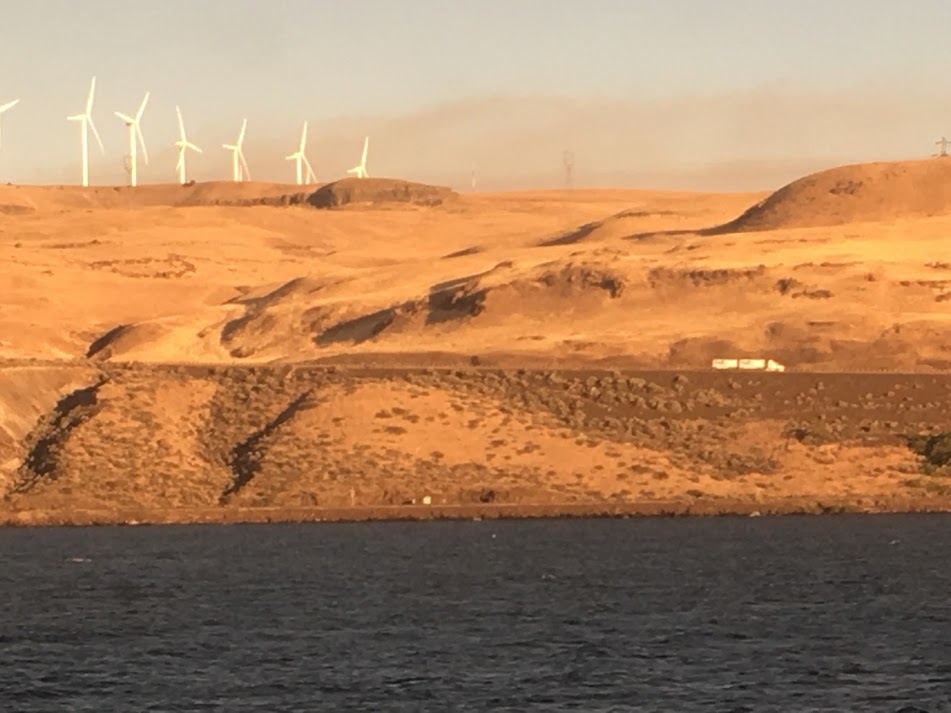
As our train snakes along the Columbia River Gorge, Dave and I snag seats in the observation car and marvel at the stunning variations in landscape.  We lurch from one side of the car to the other, cameras ready, striving to capture it all; the sunset-amber hues of the ragged and rounded cliffs of the gorge; the vast blue sweep of the river; the thunderous thrill of passing trains; battalions of white-winged windmills; bustling logging yards; distant wildfires blowing billows of smoke, ominous as nuclear clouds; and open expanses of water with para-sailers drifting above like dragonflies. 

So, yes, we arrived in Portland five hours late, a nightmare for those meeting friends or making flights. But without that delay, those river views would have passed unseen in darkness.  I stand by my mantra: have faith in the unfolding. 


Thursday, June 13, 2019

Glacier National Park: Going to the Sun

With an elegant carriage that gleamed the deep red of a mountain berry trimmed in black, the Red Bus pulled in at the visitor’s center to take us up the Going-to-the-Sun-Road and beyond during the eight-hour “Crown of the Continent” tour.  Perfectly designed for maximum viewing with roll-back canvas tops, survivors of the park’s original fleet were newly refurbished pro bono by Ford. Our bus hit the road for the first time in 1936, and she was gorgeous. 


Dave and I checked in with Peggy, a park representative, who introduced us to our driver and guide, Peggy. When I slid into my seat, the woman next to me said hello and told me her name was Peggy.  Dave said it was lucky he’d not been born a girl because if he had been, his name would have been Peggy too. Yes, seriously.  

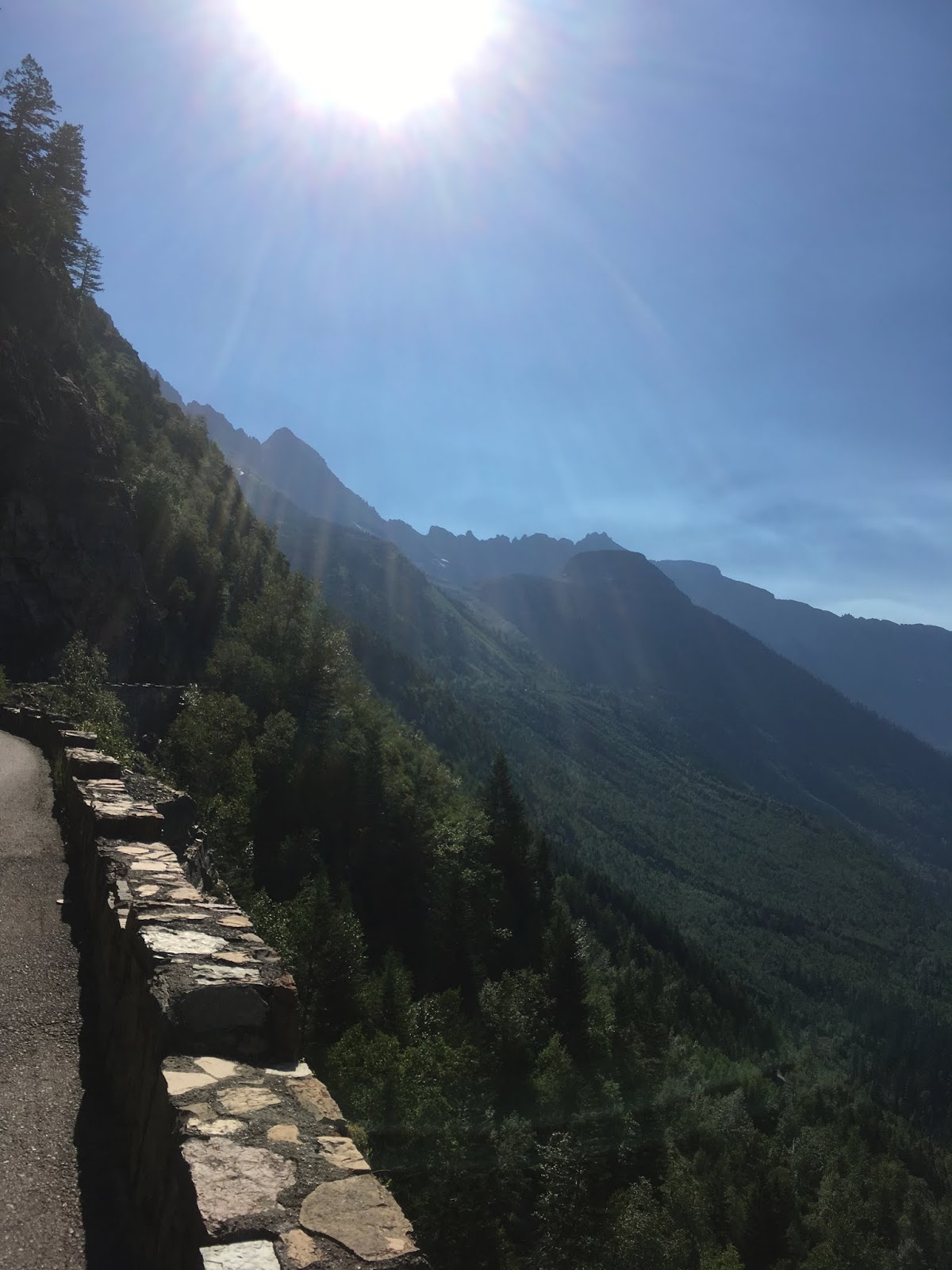
Driver Peggy was freckled and blond, gregarious, energetic, informative, and funny.  Her admiration of the park’s natural features and the builders of the Going-to-the-Sun-Road was boundless. As she skillfully navigated twists and switchbacks, hugging the cliff sides to maintain a safe margin between us and the precipitous drops, she maintained a steady barrage of park facts and history.


The road itself is a marvel. Bound by National Park Service construction standards to “protect the landscape above all else,” a team of “robust men” - World War I vets, Swedes, Austrians, Russians, engineers, and expert stonemasons – labored on the edge of 1,000-foot drop-offs for almost twenty years to carve a winding road that would harmonize with the setting.  “The country was wild, steep, and unforgiving,” the work, tortuous and dangerous, but for the 300 men who took it on, the pay  - $.50 to $1.15 per hour – was solid by 1920’s and 30’s standards. (1.) 

At scenic overlooks, Peggy would pull the bus over and announce, “Yip!  Yip!  Prairie dogs up!” apparently hoping we’d join her exuberant chorus as we stood to poke heads, shoulders, and cameras through the open roof.  Stood we did, but yips, no.  And where other members of our group were initially reticent to Peggy's request for questions, Dave took every opportunity to make up for them, peppering our guide for dates, geology, botany, and wildlife information.  

But as the hours stretched on, we coalesced as a group. At rest stops, invariably Peggy would torment the tardy by steering the bus toward the exit while punctual passengers obediently ensconced in their seats waved and grinned at those trotting to catch up. Ed, an artist, was the first to linger too long over his purchase of a Twix bar.  At the next comfort station, I was too leisurely in the rest room and was the one left briefly alone, sheepish, in the lot.  Ed and I bonded, two rebels, and each stop reaped new recruits to our giddy gang.         

About halfway thorough the tour, we pulled into Many Glacier Hotel in the “Switzerland of North America,” the northeastern section of the park.  Built in 1914, the lodge sits on the shore of a remote lake ringed by mountain slopes that fold and bow like prayerful yogis at the waters’ edge. Peggy gave us an hour to explore and stretch our legs, so Dave wandered toward the stables while I climbed a rock-strewn rise above the lodge. 

Clumps of tiny yellow flowers, potentilla, clung to the dry soil. Three straggly trees, long dead and beaten to driftwood gray, leaned into the buffeting winds.  Gusts whipped my hair and pummeled my skin, stirring the sun-silvered water below into white caps. It was glorious. The misty mountains and solitude. The wind, wild and alive as an ancient spirit.  I couldn’t help but thank God for the beauty of the planet and the blessing of my presence in this place.  


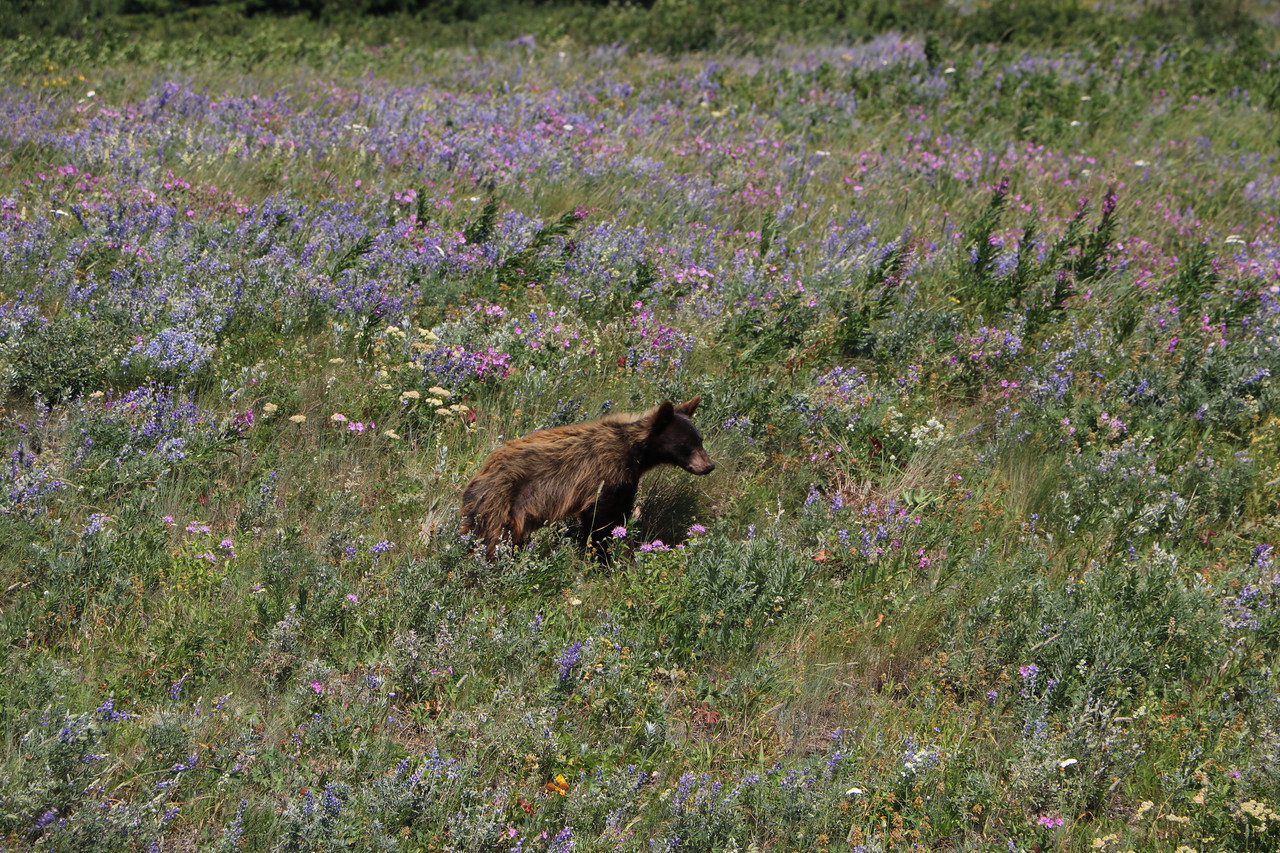
Once back on the road, the bus slowed in East Glacier as we cruised past meadows bright with purple lupines, Indian paintbrush, yellow potentilla, and… a bear! “Yip, yip, prairie dogs up!” Peggy crowed as she pulled to the roadside. A two-year-old grizzly stood among the wildflowers, not far off, quickly gathering a crowd as cars and buses parked to observe him.  Phones and cameras swung to focus as the oblivious young one nosed about in the flowers seeking a snack. 


“Bear jams” such as this occur with every roadside bear spotting causing a potential hazard to the animal. In this case, it was amazing how rapidly two rangers arrived to shoo the bear away. Peggy told us that a female bear had recently been euthanized because she was too seriously injured to save when someone chased her over a cliff. After the sad, furious outburst that followed this news, we discussed the challenge that confronts all the parks: how to do the important work of nurturing a love for nature by encouraging visitors while protecting the park’s features, inhabitants, and the visitors themselves from human stupidity? 

Yes, our species needs a serious whupping to restore some sense and foresight, but the park’s crusty monoliths, lofty peaks, jagged channels, and swooping slopes were a stunning reminder that ultimately tectonic plates and grinding glaciers will have their way.  Dangerous though we are, in the face of seismic upheavals, inland seas forming and disappearing, and mountains rising and falling, we are small.  Is it strange that I take comfort in this? 


1. Going-to-the-Sun-Road, by C.W. Guthrie, Farcountry Press, 2006, pages 7, 29, 34


Monday, June 3, 2019

Glacier National Park: Park Stars

After a glorious scenic overnight train ride through the Columbia River Gorge, Dave and I arrived at the tiny depot in West Glacier, Montana. Early the next morning, we drove our rental to the Apgar Visitors Center, parked, and asked a ranger for suggestions given our lack of rigorous hiking experience.  He directed us to a series of shuttles that would take us up the Going-to-the-Sun-Road to the Hidden Lake Trail.  

My, what a mixed crew marched this accessible route with its enticing name and a trailhead conveniently located above the visitor’s center and restrooms! Seasoned hikers wore safari hats and leather boots and carried walking sticks. Dave and I carried no poles, but wore sensible layers, sturdy sneakers, baseball caps, and fanny packs stocked with sunscreen and water. 

Teens, nimble and spirited, scampered along, shrieking with glee and tossing snowballs scooped from patches of snow.  Some sure-footed souls had opted to wear flip-flops and sandals. Amish nature enthusiasts wore flowing dresses, aprons, and bonnets, and an Indian contingent breezed along in elegant saris. Parents trucked babies in backpacks and held the hands of little ones clutching just-purchased stuffed grizzlies and mountain goats.  


Alpine meadows swept to the foot of striated, craggy mountains. Swaths of snow and stony soil alternated with grasses awash with yellow wildflowers. Towering clouds, puffed and important, mounded overhead. And look!  My God! Look!  A mountain goat! Soon after, we spotted a shaggy mother nuzzling her baby, a snoozy goat under a scrubby pine, and a herd of seven picking their way across a snowfield high on a peak above. Like the bison of Yellowstone, beasts at first remarkable to those accustomed to squirrels and deer, the goats soon became an expected, marvelous, part of the scenery. 


Every wildlife sighting spawned a gathering of pointers and admirers, so no passers-by missed anything. I loved the wish to share wonders, and the elevation of animals to Park Stars.  They aren’t “game,” a nuisance, or something to “harvest”; they are the rightful, extraordinary inhabitants, and all humans trooping the Hidden Lake Trail joyously celebrated them together. 

But often, when it comes to nature, many people seem to have lost sense and instinct. At one point, the trail narrowed and climbed, with steep drops to left and right. It was one-way only, and slippery with smooth, hard-packed snow.  Crossing required caution, so lines formed on the ascending and descending sides as patient hikers awaited their turn to inch forward. 

Suddenly, a young father with a babe in arms and toddler in tow started to run down the path.  A cry went up, and we stretched our arms, as did everyone else down the line, to catch and steady him and his children as they slid, tottered and careened.  Maybe he was trying to be thoughtful by rushing to spare those waiting, but seriously?  Strangers’ arms prevented a terrible fall. 

Joy, awe, and effort combined to steal breath as the trail wound on and up to the overlook with its spectacular vista of Hidden Lake and Bearhat Mountain. A thin rope prohibited access to the next leg of the trail down to the lake.  A sign meant to instill a healthy keep-away response read, “Entering Grizzly Country!  DANGER.” If that weren’t clear enough, it went on,  “This Trail is Closed Because of Bear Danger.”  Of course two teenage boys sat smirking, bold in their bravado, just on the far side of the rope. 


“A bear!” someone called, and every head swiveled.  The two boys lurched to their feet and scrambled under the rope in a hurry. All eyes followed the pointing finger, and scanned the shore of the lake far below. Far, far below. We searched, and then strained, to better see a tiny blotch at the distant end of the lake. It could have been anything. Several brown stumps had already ramped my heart rate with a confusing mix of joy-fight-or-flight, but this blotch was moving, and safely distant.  

“Look!” An even smaller brown speck had appeared by the side of the blotch.  A cub!

Kind onlookers who’d had the foresight to bring binoculars shared this treasure, and we, at the guardrail, were united in our oohs and ahhs in confirming the momma bear and her cub ambling along the shore. 

Yes, mountain goats are marvelous to see, but bears are the beast most feared… and sought. Over our three-day visit, every conversation included bear cautions, sightings, and close-encounters. Many visitors, certainly those embarking on longer hikes or deep-woods camping, carried bear spray, and a number of signs advised this. Dave and I did not, but we learned that if we did have some, we were not to spray at the bear, but in a swath between us and the animal. Good to know. 

We also learned to make a lot of noise while walking, which we did, although we did not jingle like those who carried “bear bells” to add to their clamor. Later, Peggy, our Red Bus tour guide, told us, “Mmm.  Bear bells. More like dinner bells. The bears learn to associate that sound with humans and their food. Some say you can tell the scat of black bears because it’s small and full of berries, while grizzly scat is large, scented with bear spray, and full of bells!”