Showing posts with label climate change. Show all posts

Wednesday, April 5, 2023

What Matters to You Most?

Piles of books beneath my bed beckon as I lie on the floor doing my morning exercises. Experience has proved that engrossing novels read at night are not conducive to sleep, so the under-bed books tend toward educational topics: memoirs, history, and Nature. They linger there, gathering an embarrassing blanket of dust, until my eye rests on a title and stops. A few weeks ago, my wandering gaze found Saving Us by Katharine Hayhoe.  

I don’t remember how the book found its way to the under-bed library – a gift? An NPR interview? A review in The Week?  If anything, the title made me wary. Positive as it sounded, the need for “saving” indicates dire straits, and I already worry about the well-being of the planet and my fellow creatures. Did I really want my bedtime focus to be environmental crises? Sigh. Apparently so.


As it turned out, the book is fascinating and hopeful.  As top climate scientist for The Nature Conservancy, Dr. Hayhoe is an optimist whose enthusiasm in describing solutions both possible and underway make for an informative read. It has been years since I underlined, starred, and dog-eared a book to such a degree.


Dr. Hayhoe is realistic in documenting the causes and consequences of excess carbon in the atmosphere, but in Saving Us, she emphasizes successes and initiatives as well: planting trees and “green roofs” in urban settings to help reduce temperatures and absorb carbon; “cap and trade” programs that allow companies to work toward carbon reduction while buying or selling credits as needed; the addition of hybrid and electric vehicles to automakers’ offerings.  


While a united political front lags, many towns and corporations recognize the economic implications of climate change and are taking action. Remarkably, in 2019, 70% of new electrical installations worldwide were clean energy, and in 2020, that percentage increased to 90%.  In my town of Easton, we are fortunate - and grateful - that forward-thinking by the town’s Energy and Environment Task Force resulted in the installation of a solar field that offsets 100% of the elementary school’s energy use. 


In Saving Us, Dr. Hayhoe stresses the importance of conversations about climate change as integral to meaningful action. She acknowledges that numbers, graphs, and scientific jargon can be overwhelming and, for some, serve only to harden their stance in dismissing the reality of the crisis. Instead, she advocates talking with (not at) people about what matters to them as the way to increase awareness. Whether they recognize it or not, most already do care: be it because of home, hobbies, interests, or loves, everyone has a stake in the planet’s health.


So, what do you like to do? Skiing? Skating? Scuba-diving? Personally, I miss Connecticut’s snowy winters. 40 years ago, Dave and I would skate the Mianus River, breezing along as far as our energy would take us before retreating inside for a well-earned hot chocolate.  While some contend that temperatures have always fluctuated, Dr. Hayhoe makes clear that if that were the case, our experience would be of the planet cooling. Extreme storms, record summer temperatures, and wildfires have become increasingly common. The planet is warming, and skating on the Mianus is but a memory.


Where do you live? In low-lying coastal areas, rising seas and floods will prove hazardous. If you live out west or in arid areas, drought and water shortages are already an issue. Personal safety, food production, physical comfort, and stable economies all depend on a healthy planet, and ours is ailing and angry. As has been said, there is no Planet B… and why would we want one, given the glorious one we have? 


Finally, what matters to you most? We humans seem to disagree on much these days, but we stand united in caring about our loved ones above all, and the future our kids and grandkids inherit depends on what we do now.


With force and hope, Dr. Hayhoe says we still have the time and ability to make choices that will effect positive change.  As climate scientist Peter Kalmus states, “We’re not fighting for a merely ‘livable’ planet. We’re fighting for a riotous, wild, gorgeous, miraculous, life-cradling planet that’s home to a society that works for everyone.” 


I highly recommend Saving UsA Climate Scientist’s Case for Hope and Healing in a Divided World by Katharine Hayhoe.  (One Signal Publishers/Atria, 2021)


Tuesday, October 13, 2020

When Richard Called

Richard, a volunteer for the Biden Victory Fund, called last night.  While sipping a hot cup of tea, I was busy at the time writing letters for Vote Forward, a get-out-the-vote effort. It had been a lovely fall day, but with enough nip in the air to warrant long pants and a sweatshirt plus that cup of tea. When Richard called, it was after dusk, and I’d added a woolen shawl around my shoulders, and snuck up the heat on the thermostat.


Dave and I never answer the phone for telemarketers, pollsters, or “unavailable” numbers, but our Caller ID had identified Richard’s cause, and desperate as I am for a Biden win, I picked up the phone. 


Richard had barely launched his spiel when I interrupted. I thanked him for the work he was doing, told him of my ardent support, but added that I was comfortable with the amount I’d already donated to the campaign.  


To my surprise, he didn’t argue. He coughed.  A hearty, the-man-is-sick, cough. “Can you hold on a minute while I get some water?” he asked. 


“Of course,” I replied. 


When he returned and said, “I’m back,” I noticed how congested he was. 


“Richard, you don’t sound well.  Do you have a cold?” 


“Yes. I’ve had some health issues for a while.  We don’t usually make calls on Sundays, and I’d hoped to rest a bit, but so much is at stake, and the election’s close, so they added this day to the schedule. I’ll keep it light though.  Only two or three hours more.” 


“Maybe you should get a cup of tea,” I suggested. “I’m having lemon echinacea myself.”  


“Sounds like an idea,” he replied, then set about completing his mission. “We’re grateful for what you’ve already given, but just so you know, if you decide to give tonight, it will be triple-matched.”


Triple-matched. Hm. I repeated the line about my comfort at my previous level of giving, but as Richard coughed and sipped his water, I thought about the many sleepless nights I’ve spent staring at the ceiling while holding fervent fictional conversations with Trump supporters. 


Under the cloak of darkness, I have all the right words and evidence. What answer can be given to the damage and cruelty of this administration’s policies? The separation of children and nursing infants from their mothers in detention camps.  Staunch advocacy of the unborn yet tolerance of white supremacists and defense of assault weapons that have enabled mass-shootings. Alienating allies while cultivating authoritarian leaders. Public dismissal of COVID as nothing to fear even as American deaths surpass 210, 000. The dismantling of agencies, programs, and laws set up over decades to protect the planet and its creatures.


I thought of the new word I learned in the Boston Globe this Sunday that described to perfection the habit I picked up in January of 2017: Doomscrolling. While I’d avoided the news since my bout with cancer because I thought it was unhealthy, since Trump’s inauguration, I tap the news feed on my phone every morning, and sometimes several times a day, with the sick need to know what has he done now?  Doomscrolling sets my heart pounding and feeds my fury and incredulity with each fix, yet it’s a compulsion I can’t seem to shake. 


Since I was little, I’ve been a worrier. As a child, I worried about grades and getting in trouble. At work, I worried about word choice, guest lists, seating, and palm fronds. As a mom and grandmother now, I worry about my loved ones’ happiness and safety… and that’s where politics and love intersect. It is relatively new territory to add world events to my worry portfolio, but shootings, COVID, climate change, and this world of endless wars are no longer distant: they threaten my kids and their children… as they do the children of those who support Trump. Hence my disbelief when Republicans say to me, “I hate the guy, but I like what he’s doing.” I’ve heard that too many times and to me, character matters. 


Shields and Brooks, the PBS Friday night commentators, observe that most people are tired of chaos and are looking for “safe hands.” Safe hands. Oh, how that spoke to me of refuge and peace. Unlike Trump who focuses on his needs and the present, Biden’s plans embrace all Americans, as well as future generations whose well-being depends on our actions now.  Biden is not perfect, but he’s honorable, and has given his life to public service. Trump has missed that piece of the job description entirely.  In the search for safe hands, the choice is clear.


“Richard, you salesman you,” I said. “It’s hard to pass on that triple match. You can count me in.”


Monday, November 6, 2017

Honk!

I’m all about visuals, but during this Boston trip, sounds have led to adventure. So when Dave, Paul, and I heard the sonorous blatt of tuba and trombone as we headed home at the end of an evening playground romp, we changed course to investigate.

A jostling, foot-tapping, dancing crowd, drawn as we were, had gathered in yet another playground near Davis Square. Dave lifted Paul onto his shoulders and we inched in and angled for a better view.

The musicians were a motley group of older men with graying hair pulled back in ponytails.  Most wore black shirts, shorts and socks, and we bobbed and swayed along with them.  Heavy on horns and snare drums, they played a loose New Orleans jazz that flowed into a jerky Arabian accompaniment for the belly dancers.

Belly dancers!  My heavens! Three women in garish, burgundy harem garb tapped finger cymbals and gyrated gleefully in unison.  Ample, naked, midriff flesh rippled, as trained, while two apparent acolytes followed the lead of their seasoned mentor, a middle-aged gypsy with flowing raven tresses.  They spun and gestured, their penciled eyebrows arched, scarlet lips upturned in come-hither smiles.


 “Wow, Paul!  What do you think?” 

What was the child to think?  And could he hear me over the tinny din and eager applause of the crowd? From his perch on Dave’s shoulders, he watched intently, his face impassive, his gaze unwavering as the women wiggled and tapped their cymbals.  

    
The music wound down, and the dancers shimmied to the side. In a quick, smooth transition, the Dead Music Capital Band took their place.  Yes, their faces were painted skull white, and yes, fake blood dripped from a hatchet in one musician’s head, but their extensive horn section and bass drums produced a powerful, swelling, fill-your-chest-with-joy volume of sound.


 We’d grasped that Halloween in the offing would explain the blood and skeletal affectations, but still….”What’s this all about?” I asked a woman near me.

“It’s the Honk!” she said. 

Oh, that explains it….

“The parade is tomorrow!  Starts at noon from Davis Square!”

Well! As we wheeled Paul home to dinner and bed, he stretched out and relaxed in his stroller, satisfied by the evening’s entertainment. We still had no idea what was going on, but sure as hell, we would be at Davis at noon!


At 12:00 on the dot the next day, the three of us joined thousands of other enthusiasts on the sidewalk on Mass Ave.  Paul was back at his station on Dave’s shoulders, his expression still inscrutable, which seemed about right given last night’s introduction.

By now, Dave and I had Googled the Honk and learned this was the 12th anniversary of the “Festival of Activist Street Bands.”  Last night, the message had not been the focus, but this morning, the full array of Boston’s diverse population and social consciousness was literally on parade.  Stilt-walkers, cyclists, floats, and bands marched or danced or wheeled on by, exuberantly proclaiming solidarity with groups and causes close to home (a faculty walk-out) and across the globe: climate change, clean energy, Black Lives Matter, LGBT rights, peace on Earth, Dreamers, and Freedom for Tibet.


Lady Liberty was well represented in green foam headdresses and large-scale statues, her promise of equality and welcome deeply meaningful for this city of immigrants, for this country of immigrants.  And my heart was lifted, in these troubling times of competing fears and worries, to see so many people out creatively declaring their commitment and concern.


While Paul remained transfixed more than overjoyed, we delighted in directing his attention to the startling mix of outrageous fantasy and the comfortably familiar portrayed in vibrant costumes, crepe, and papier mache.  “Look Sweetie!  What’s that?”

“Ephalent!” 

“Yes!  An elephant!”


 “And look! Butterflies!”

“Butta-fies!”

“Yay!  Whoa! Check it out, Paul!  A dragon!”

“Dragon!”

And so, in being with our grandson, led by our senses and open to opportunity, we happened upon the Honk with its belly dancers, bands, community … and dragons.


Friday, April 28, 2017

Without Science, I'd Be...

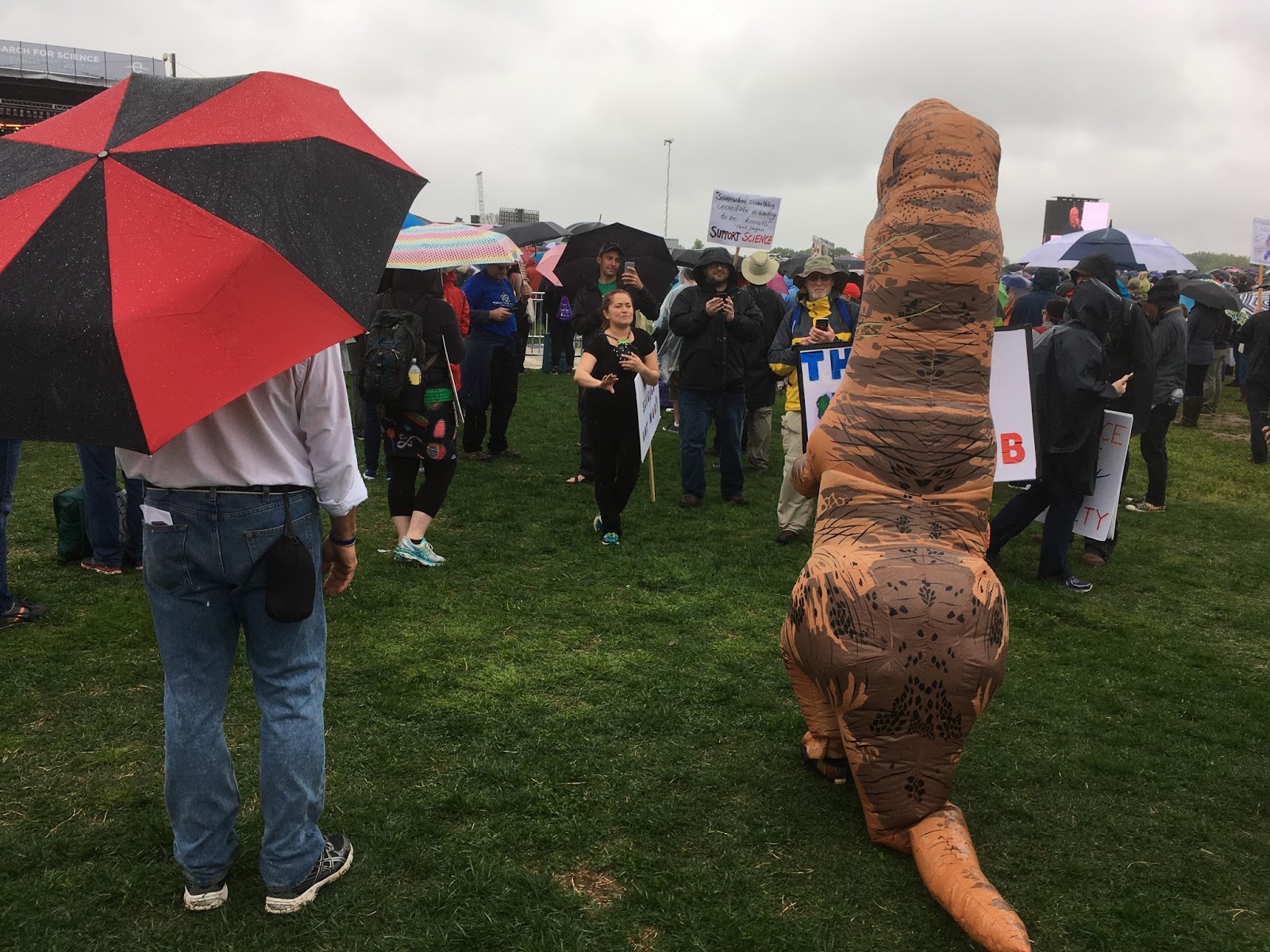
Rain dripped from sodden umbrellas and streamed off cheap plastic ponchos hastily purchased from vendors along the march route.  It was cold, yet the woman wearing the red cape, star spangled shorts, crimson bustier, tight blue leggings, and gold tiara of DC Comics’ Wonder Woman seemed still to brim with energy.  As those marching for Science on this wet Earth Day 2017 wearily reached their destination in the plaza before the Capitol, Wonder Woman leapt onto a retaining wall to take a selfie with her friend. 

Dave and I had spotted a number of full-bodied tyrannosaurus costumes and bushy white Einstein wigs, their connection to science clear, but a comic book super-heroine?  Not so much. Still, part of the Science March experience lay in appreciating people’s creativity and cleverness in conveying whatever message compelled them to come to the nation’s capital this day. So I asked Dave to hold my poster and umbrella, and darted over to the wall to take a picture of Wonder Woman.  Then, Dave and I trudged off in search of the nearest Metro stop. 

Once on the train, blissfully warm and dry among other tired marchers still clutching signs with ink now weeping, Dave and I pulled out our phones, and like those around us, began to swipe, swipe, swipe through our photos, re-living the day.  Only then did I look closely at the photo of Wonder Woman and thought to enlarge the picture so I could read her poster.  “Breast Cancer tried to kill me, but Science…”

Saved her.  Made her strong again.  And made her Wonder Woman in the eyes of those who loved her… just as science gave my doctors - Mary Pronovost, Anke Ott-Young, and Barry Boyd – the tools and knowledge to save and restore me.  


During these times when government support of climate science is of major concern, I hadn’t given much thought to the sweep of science… and to its direct, life-saving impact on me. Science is not separate and abstract. The people in lab coats hunching over microscopes have helped us learn what makes us function, what makes Earth function, and what it requires to ensure that our individual and planetary systems thrive. Why, in 2017, would those in power choose to deny and underfund these?  

The day before the march, Dave and I had arrived in Washington leaving enough time to tour the monuments and memorials on the National Mall.  We scanned the seemingly endless lists of names of those lost etched in the Viet Nam Memorial.  Read the words of Nimitz and Truman inscribed on the wall of the WW II Memorial. Observed the haunting figures of shrouded soldiers drifting past ghostly images of departed service people gazing from a polished granite wall at the Korean War Memorial.  So many sons, fathers, daughters, mothers, and brothers – cherished loved ones – sacrificed in war after war after war.

At the exhibit below the Lincoln Memorial, I spotted a woman, apparently bald, wearing a scarf.  I approached her and asked if she was going through chemo treatments, and she said yes.  Briefly, we shared our experiences and found that Herceptin was part of both our regimens.  When I had breast cancer in 2009, Herceptin had been available for only eighteen months.  From my understanding, this drug made all the difference in my prognosis.  I hope science will help this woman, too, evolve from a scarf-lady to Wonder Woman.     

After a wonderful overnight visit with my cousin and her husband, Dave and I arrived on the mall at the Washington Monument Saturday morning. We had passed through the security checkpoint, jumped over puddles, and gingerly tip-toed through swaths of mud to join the umbrella-sheltered throng before the stage.  “Can you believe this?” said Dave.  “It’s 2017, and we have to march to support Science?  What the hell?”

What the hell.  But the Trump administration has proposed massive cuts in jobs and funding at the Environmental Protection Agency (EPA) and National Institutes of Health (NIH), so march we must.


The first Earth Day in 1970 targeted pollution and led to the regulations that have cleaned our air and water and protected endangered species.  Since then, April 22 has been a day for concerts, school-organized clean-ups, and reminders to recycle.  It has been a celebration of strides made and incitements to improve.  This Earth Day was different, dire, and much like 1970, a warning that failure to act – or worse, to reverse gains made – will threaten the future.

Dave and I stood beside a tyrannosaurus to watch videos of polar bears, penguins, and whales gracefully diving deep below murky blue waters.  


We listened to Bill Nye, the Science Guy, who concluded his talk with a stirring call for “informed science.” Astronaut Mae Jemison spoke of the power and beauty of seeing Earth from space.  Maya Lin, designer of the Viet Nam War memorial, described her next project, “What is Missing?” which she said would be a “wake up call and call to action… we must balance our needs with those of the rest of the species on this wondrous planet.” Denis Hayes, organizer of the first Earth Day in 1970 and founder of the Earth Day Network, warned, “If we lose this fight, we will pass on a desolate, impoverished planet to future generations.”  As numerous posters stated, “There is no Planet B.” 

Jamie Rappaport, president of Defenders of Wildlife, reminded us, “Extinction is forever.”  Because of the Endangered Species Act, itself endangered under this administration, the bald eagle and manatee have been saved.  “Without science,” said Rappaport, “there will be no Monarch butterflies, no polar bears, no red wolves.  Science, for these, is literally a matter of life and death.” Opening with, “I am a patriot.  I fight for spacious skies and purple mountain’s majesties,” James Balog stated, “I am a photographer and scientist, and I have photographed the visual evidence of epic changes…  I have seen it…  Nature isn’t natural anymore.”  

Christina Figueres, Executive Secretary of the UN Framework Convention on Climate Change, said, “Did you know that in Kentucky, they just put the largest solar farm in the world on top of a coal mine?  We are getting there!  We just need a collective intentionality to curb carbon emissions by 2020.  Can we do that?  Of course we can, because we don’t have another option.” She spoke of a vision she has had of hundreds of eyes staring at her and asking, “what did you do?”  She added, “This is a question for all of us.  The answer must be that we work together to do everything we know that is necessary.  In that lies the future of mankind.”

The future.  The future was a drumbeat conjured, portrayed, and agonized over. Many speakers spoke of their children and grandchildren.  Climate change is not in question; it is here.  And while the Great Law of the Iroquois urges consideration of the effect of all decisions even unto the seventh generation out, current plans to curb environmental regulations will affect not only our unknown descendants, it will affect those we know and love… our littlest ones - baby Paul, Ava, Rob, Hazel, Miles, Bennett, Isabel, Sam, Finley, Lily, Lila, Henry, Victoria, Jake, and all children, many of them attending the march.  Some slept on parents’ shoulders, sheltered under umbrellas.  Others peered curiously from beneath stroller canopies.  Still others stood rain-spattered and proud, holding their own hand-lettered signs. 

Many scientists, science teachers, and science students attended the event, and the tone and subject of chants and posters reflected that. There were proud cries about democracy in action, but also calls and responses of: 

“What do we want?”  

“Evidence-based science!”  

“When do we want it?”  

“After peer-review!”  


The pink pussy hats of January’s Women’s March were few, replaced with artfully crocheted caps of twisting coils of gray brain matter.  Posters bore renderings of formulas, graphs, and charts that left Dave and me scratching our heads.  Geologists proclaimed “Geology rocks!” Researchers and doctors demanded, “Fund the NIH!”  Molecular biologists wore elaborate spindly constructions on their heads that we took to be models of molecules, but like I said, we were out of our league in this group.

Like Wonder Woman, many attendees held posters thanking science for cures or listing torments science has consigned to the past.   “Got Polio?  Me neither!  Thank science!” and the more expansive, “Thank a scientist for: antibiotics, polio vaccine, chemotherapy, clean air, clean water.”  Countless posters held images of our beautiful Earth, some with an arrow pointing at the planet, stating, “I’m with her!”   


Humor helps power a message without a finger wag, and Dave and I chuckled often as we wandered about to read signs and keep warm:  

“It’s not rocket science…well, actually, some of it is…”  

“I’m a Mad Scientist”

“What do you call a massive solar energy spill?  A nice day!”  


“Girls just want to have fun…ding for scientific research”


A man and woman standing side-by side held Dave’s favorites.  Her poster read, “Science saved our relationship;”  his said, “Without Science, I’d be bald and flaccid.”  


The presenters onstage were an organized and disciplined lot.  They kept their words succinct and focused, and when the scheduled march time  - 2:00 PM - drew near, they wrapped things up. At the last minute, the moderator announced a final send-off and blessing: a tweet from Pope Francis.  A tweet of all things, praying, “Lord, bring healing to our lives, that we may protect the world and not prey on it, that we may sow beauty, not pollution and destruction.”

With cheers for the Pope, chants of “E.P.A.!  E.P.A.!,” and a rousing chorus of trumpets and saxophones, the crowd surged forward.  We lifted our rain-wilted posters and flowed from the green by the monument down to Constitution Avenue… hoping that those in the domed and columned buildings within sight were watching and listening.