Showing posts with label condors. Show all posts

Saturday, October 14, 2023

Trip West, Part VII: Majesty, Signs, and Stupidity

The guy standing next to me on the rim of the Grand Canyon had an aging hippie look but for his bookish, black-rimmed glasses. His gray hair was pulled back in a straggly ponytail and his eyes were blue and bright as, quietly, we urged the two condors hunkered on a rock far below to take wing. The giant birds were not listening and refused to show off their ten-foot wingspan.
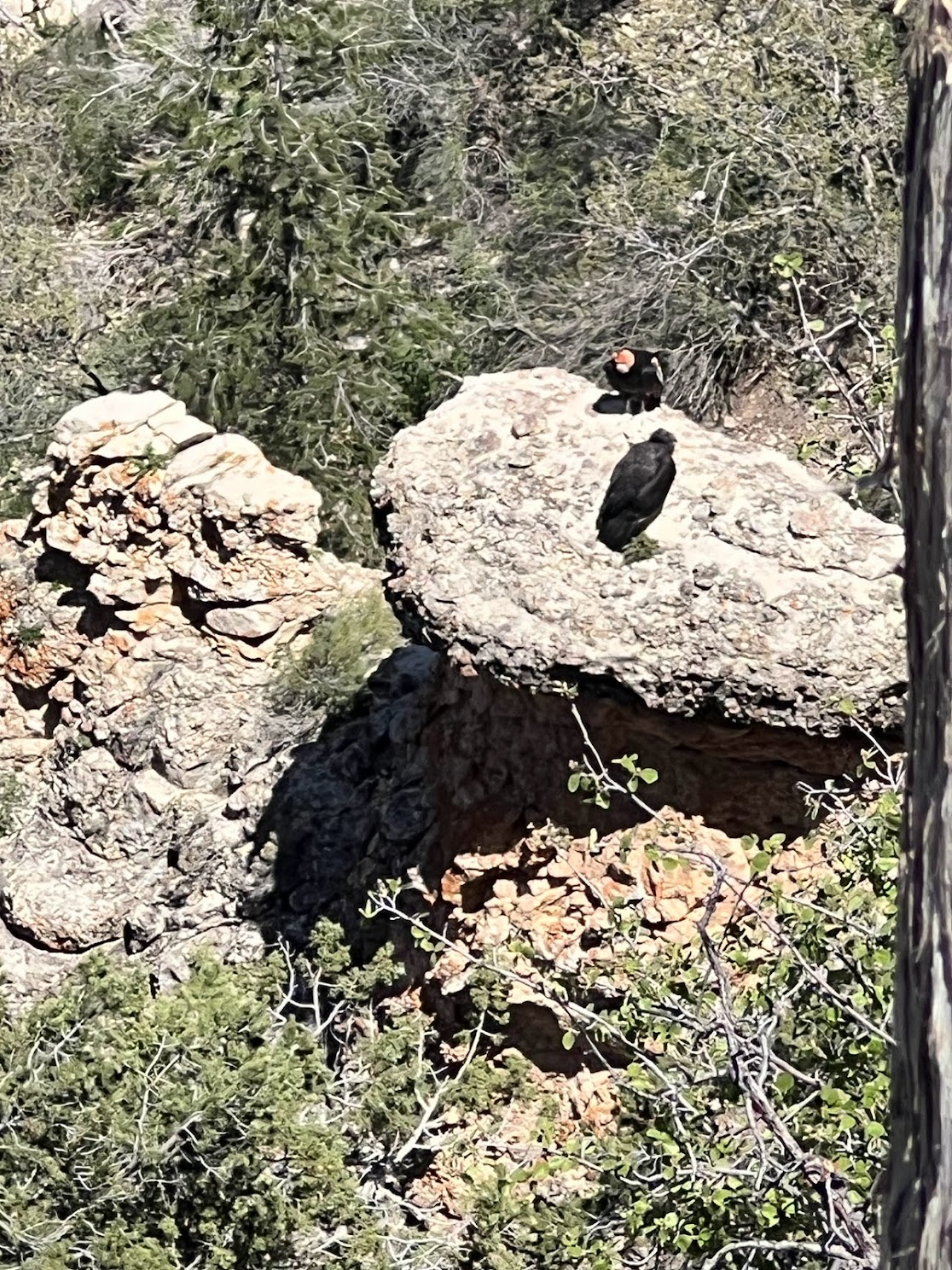

As was a ritual with everyone encountered on our trip, the man and I exchanged stories about our experiences at the parks we’d visited.  I told him about the condor expert in Zion and his plea to pass along word to any hunters that they switch to steel bullets since the commonly used lead shot was lethal to scavengers. Having chatted awhile, and feeling I was on reasonably safe ground, I murmured, sotto voce, "I'm not a fan of hunting."


“Me either,” he said. In fact, he was well aware of the perils facing wildlife from human activity given his work as a veterinary pathologist. 


“Ah. It must be hard to be immersed in the harm inflicted on creatures, whether intentional or not,” I said.


“Yes. Certainly. But my hope is that my findings will make a difference by increasing awareness. The restoration of condor populations is one of conservation’s great success stories.” 


“We learned from that condor guy that their numbers had sunk to twelve breeding pairs. A near-miss in terms of extinction.”


“Truly.” 


 “Speaking of, have you seen the sign over at The Lookout about not throwing coins into the canyon?” I asked.


“Yeah,” he said. “Obviously not safe to hikers passing below to throw anything, and again, condors are scavengers. They’ll go for the coins, and the zinc can poison them.” 


“Exactly! Yet while I was reading that sign, a few feet away a kid was tossing stones over the side.” Incredulous, I looked at the pathologist. “They were stones, not coins, but still. What the hell?  He was 11 or so, old enough to know better.  I had to say something. In my nice –but-concerned-grown-up voice I said, ‘did you read this sign?’ Judging by his expression as he scurried away, he had.” 


We shook our heads. Humans. Sigh. 


While some signs at the canyon offered alerts such as the one about coins and condors, others conjured… novel images. In one hotel restroom, a sign urged visitors not to drink the toilet water, and another insisted that guests not stand on the toilets. Hm. Surprising. 


Along the popular Bright Angel Trail, the signs were cartoonish, but ominously clear:  people have gone over the side. Dehydration creeps up on you. Pay attention. You could die here.


Personally, I needed no warning signs. The Bright Angel is narrow and sinuous, the soil, dry and sandy. It is well-traveled by seasoned hikers laden with enough equipment for a week and folks like me and Dave who just want a lovely experience of the canyon beyond the rim. I was mindful that an errant sneeze, a misplaced foot, or an inadvertent hip check from an overlarge passing backpack could mean a fatal plummet. 


The canyon is staggering in its immensity and vibrant hues. Rock faces layered in pink, white, and red plunge a mile to the shining ribbon of river below.  Our human status as relative newcomers to the planet - perhaps with self-imposed, short-lived tenancy - felt evident while in the presence of this massive fissure in the enduring, still-evolving Earth.


When first Dave and I hiked the trail, I hugged the cliff wall and crept with an old-lady caution that prompted a passerby to ask sympathetically, “Afraid of heights?”


No. Afraid of falling. The evening before, when I returned to the bus after a stunning sunset tour, I’d asked our guide how many people die in the canyon each year. He responded, “Maybe three or four? Not bad given the millions of people who visit annually.”  As my eyes met those of my fellow passengers when I walked down the aisle to my seat, it was apparent that none of us liked those odds.  


Dave and I had already witnessed some risky behavior: I’d had to resist the urge to hover around a toddler who was cheerfully collecting stones near the precipice while his  parents enjoyed the view.  And there was the couple we encountered while resting along the trail who were visiting with their teenage boys. “The twins have already run down to the bottom. If you see them on the way back, tell them you saw us and their dad’s still alive.”


Ha, ha, ha… but this pleasant fellow had had open heart surgery six weeks before. He was huffing and puffing and needed that rest stop. Was it really wise to hike the canyon so soon? I tell you, I was relieved to see him later in the gift store. 


Then, there was the young man – dark hair, 25-ish, loose white shirt, jeans -  we met on our way back up Bright Angel on another afternoon. He came prancing down at a solid clip … in bare feet. He had no water with him. After we chatted a bit – he had just arrived that day for a job working in one of the restaurants for the summer – I told him, again with the nice-but-concerned-grown-up voice, that sneakers and water were a must. He dismissed my worry with a laugh. We offered him one of our water bottles, but he turned it down. Then, he noticed a hat caught in some shrubs about 20 feet over the side. “Look! A cap! I’m gonna climb down and grab it.”


“Ah, no. You’re not,” I said. My tone was light, but I meant it. Not on my watch was this foolish kid going scrabbling over the side. “You can come back and get it once I’m gone.”  


I know you’re thinking who the hell is she to boss this guy around?  I totally get that, but if you’ve stood on that trail and gazed out over the vast majesty of the canyon and peered inches past your feet to the dead drop to the bottom, you know. The Grand Canyon is no place to mess around. 


But it IS a place to glory in the elements that have shaped the Earth. A spectacular place of beauty where upheavals and erosion have banished seas, carved craters, and uplifted pinnacles. 


A place where condors now swoop and soar.  


Saturday, July 1, 2023

Trip West, Part I: Ducklings Launched

Our banana-yellow Spirit Airways plane is at the gate and ready to go. This sunshine shade seems today’s travel theme as we were delivered to the airport in a Prius of the same color. One would have thought the driver of such an eye-catching car would be equally bright and flashy, but no. Sour, smile-less and mum, even “hello” was a stretch for this guy.

What a contrast to our three days at McMenamin’s Edgefield Inn! Unlike our Uber driver, McMenamin’s lifts the soul with art, humor, serenity, and food. Once a county poor farm, the long-abandoned buildings and campus were transformed when the two visionary McMenamin brothers purchased the property and sought artists, carpenters, chefs, brewers, gardeners, and vintners to reclaim it. 


The former power station now houses a restaurant and pub; the brick building that encased an incinerator is now a cozy, vine-shrouded bar. Paintings throughout the halls and rooms tell stories, some mystical, some poignant, in depicting the lives of those once compelled by age or poverty to live at the farm. Each room pays tribute to a former resident, their names and stories inscribed in murals that adorn the walls.  


Edie, my friend-from-birth, and her husband, Dave, have been the spark to several of our greatest trips. In 2018, they recommended McMenamins, and this May, invited us back to celebrate their 70th birthday along with their sons and close friends. 


While chatting at dinner and hiking along the Columbia River, Dave and I realized our lives were mundane and danger-free compared to those of this active and activist crew. We learned about Rick and Sue’s romantic meeting while in Africa with the Peace Corps, Bart’s photography trek on the Chisolm Trail, Shaun’s bone-breaking fall while rock climbing, Bob and Genevieve’s work with Greenpeace and Earthjustice, and Patty and Joe’s plummet over a waterfall while rafting. Lordy! In June, Edie herself flew to Denver to advocate for an assault weapons ban. She has knocked on doors, marched, and made calls, literally sacrificing her voice for justice and the planet following a surgery that was supposed to silence her for weeks.  


As they did in 2018, ably and safely guiding us up Misery Ridge Trail on Smith Rock, Edie and Dave led us, their ducklings, on a hike through mossy forest, past blooming white trillium and pink bleeding hearts, up, up, up to stunning views above the Columbia River. While but a stroll for many in this group, five miles was a feat worthy of pride for Lea and Dave. A soothing soak in the warm water pool back at the inn while sipping Cock n’ Bull ginger beer garnished with lime was our glorious reward.


Now, here at the gate, I am feeling a little vulnerable, uncertain, a duckling launched. In our yellow plane, we fly from Edie and Dave’s care to Las Vegas, hoping there are no glitches in picking up our rental car to drive across the desert to the Driftwood Lodge near Zion National Park. 


*          *


The delightful shady trail along the surging chocolate tumble of the Virgin River began to climb. Dave and I had just remarked on how nice it was to be able to look up at our stunning surroundings without constant focus on footing when loose sandstone on the steep incline returned focus on footing to top priority. Um, and focus on handholds too. The well-packed sandstone trail surface had surrendered to sand, shifting sand, like beach sand, and uplifted though I was by the magnificence around me, caution demanded eyes downcast to scan for roots to grasp or avoid. 


During stops to take pictures – and, let’s be honest, to rest and catch breath - the rewards were bountiful. Towering peaks layered in pink, red, and white thrust from the Earth like whale teeth, marking eons of change in colors and crags. Over millennia, the river had carved its way ever deeper, sculpting paths and crumbling seemingly solid rock faces. 


While evidence of change and endurance were all around me, I was wilting.  Panting, heart pounding, I considered the hateful mental worm whispering, am I too old for this?  We had planned this trip thinking, do it while we still can. Had we, in fact, missed the window?


No! Virtually upon conception of these heinous reflections, my second wind kicked in. What is the biology behind that saving grace? Revived, relieved and elated as that miraculous breeze blew away thoughts of age, I strutted on.  


We were hiking the Emerald Pools trails at Zion National Park at the recommendation of a helpful ranger at the Visitor Center. With three levels of varying difficulty, it was up to us to assess what we could handle, and with the blessing of that second wind, we made it to the topmost, with its waterfall cascade and pool. While Dave and I gratefully claimed a comfortable rock to relax and drink in the beauty, nimble teenagers – Dave dubbed them “the mountain goats” - leapt from rock to rock, scaling the rock face to stand beneath the tumbling water.   


With their wiry bodies, youthful energy, and no signs or guards to shoo them away, adventurous souls were free to thus scramble. The message was clear in each park we visited: individuals are responsible for their own safety. Still, we found that most everyone was mindful of others. In French, Italian, German, Ukrainian, Japanese, and English, camaraderie, conversation, and courtesy conveyed whatever was needed. People encouraged each other on challenging stretches, stepped aside and waited when the trail was perilously narrow, offered to take pictures where selfies were a stretch, and shared in the wonder with smiles and exclamations. 


At one point, a ranger with condor expertise directed our gaze to the skies in search of those massive birds with wingspans up to ten feet. How I yearned to catch a glimpse! The ranger explained that in the 1980’s, the condor population was down to twelve breeding pairs due to poaching and lead poisoning from tainted carrion. While that is still an issue, population restoration has been successful, bringing the number up to 330 birds through zealous protection and monitoring. Condors are trapped twice a year to test their blood for lead: if the level is not too high, they can be treated and ultimately released. The ranger urged us to pass the word along, so, hear ye all hunters, make the change from lead bullets to steel.