Tuesday, March 31, 2015

Sweet Ride

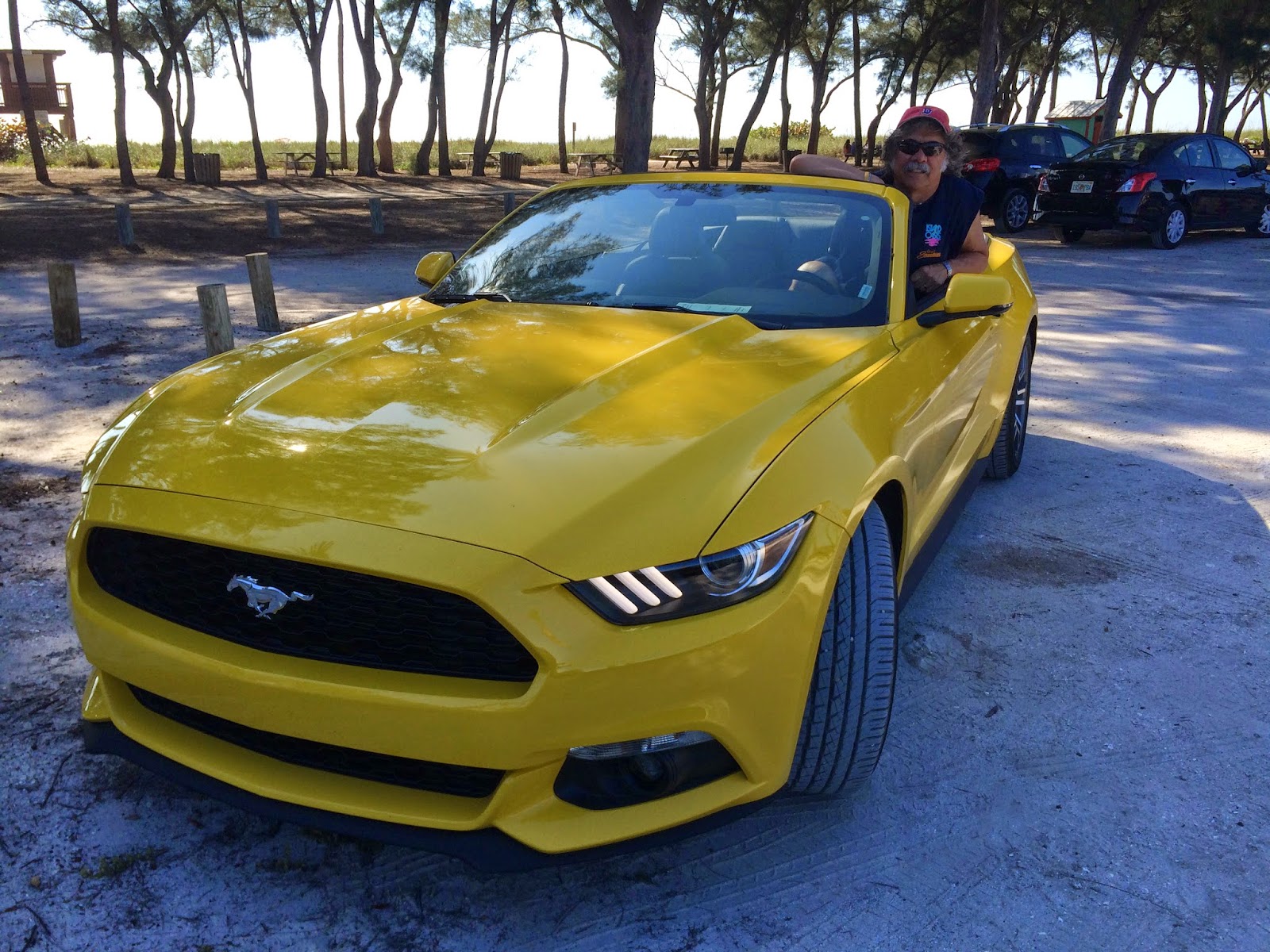
Dave clicked the button on the keys and the car’s lights flashed.  Suddenly, something bright materialized on the asphalt paving just beneath the two doors.    

“Whoa.  What’s that?  Was it there before?”

No. It was not.  This was a feature of our rental I have to think was greeted with hoots of appreciation as raucous as ours when some guy in a brainstorm session came up with the idea.   “Hey… What if? … Wait.  Let me think for a minute.  What if …a sprinting mustang is projected to light the way every time the driver unlocks the door?”

Totally cool.

Neither Dave nor I is particularly a car person; basically, we just want to get where we’re going. For twenty-five years of commuting, Dave has depended upon a rotating fleet of dependable, used Volvo “beach wagons,” as he calls them.  Those cars have been tanks, solid and safe.  Two years ago, I tearfully gave up my aging used Caravan after eleven years of faithful service.  Her replacement, my little Ford C-Max, has proved a worthy friend, chugging her way up snowy hills and easing me over icy roads during this long Connecticut winter.

For this spring’s Florida trip, however, the car-of-the-week sale model, cheaper than the Neons and Elantras which have transported us in the past, happened to be a bright yellow Mustang convertible.  “Like Bumblebee, the Transformer,” I noted.  An association that meant little to Dave, but for me, gave the car personality and the potential for unexpected powers. 

But a yellow car?  As a rule, I’m not a fan.  Convertibles?  Make me nervous.  “I’ll want a helmet,” I’d said to Dave when first he mentioned this possibility, my disappointing caution immediately dousing his boyish expression of glee.  But when the car glided to a stop in front of us at the Alamo tent in the parking lot outside Sarasota Airport, we turned to each other and grinned.  Oh yeah.

I did not mention to Dave that I have a history with Mustangs. 

In 1971, at 18, I was a late bloomer, and my first real boyfriend, Chip, invited me to go camping with him in Maine.  My mother was leery about the idea and I received several lectures on separate sleeping bags prior to my departure.  I was a little leery about the whole thing myself, to be honest, although I was not going to admit that to Mom.

I’d never gone camping.  Never spent an extended period of time with a boy.  Never climbed a mountain.  Never eaten freeze-dried food.  Chip had sent me a list of provisions to acquire, and as I stuffed my new backpack with thin foil containers of beef stroganoff and chicken a la king, my mind churned with misgivings.  

I remember only bits and snatches of that excursion: a lobster dinner by Lake Sebago, my exhaustion in climbing and hauling that pack, Chip’s humor and kind patience in encouraging the wilting flower his girlfriend turned out to be, the separate sleeping bags…and for a good part of the trip home, I drove his white Mustang.

Now, forty-four years later, I sit writing on a balcony above a palm tree–lined boulevard.  Across the street, an expansive white sand beach stretches along the shore of the Gulf’s blue waters.  My feet are propped on the wrought iron railing, my toenails freshly painted a tarty Goth eggplant/black shade.  It is so me.  Well, not really, but after a winter of snow, heavy clothes, and colorless toes, this brazen hue, the spring’s first polish, is as symbolic as shedding my wool coat.  Vacation-Lea has returned, and she’s so much more fun.

To my mind, a key element of a good get-away is car-avoidance.  A yellow Mustang convertible has not changed that.  An hour or so ago, when stomach rumbles prompted thoughts of lunch, I suggested a stroll to Tommy Bahamas, just around the corner.  But Dave had a hankering for tuna mixed with capers, celery, and mayo.

Seriously?  “But Honey, that would mean a trip to the grocery store,” I noted with a hint of a whine. 

He admonished me lightly for “yucking his yums,” a Casey-phrase which holds solid wisdom, I think, but why drive when one can walk?  Oh…

“You want to drive the Mustang,” I said. 

And there he is!  Just now!  Passing beneath the balcony!  The car’s top is down, and it’s brilliant yellow color is a gleaming statement of bold cheer.  With repeated, lasting, lusty honks; a smile I can see and feel from several floors up; and an arm upraised in a gesture that’s a salute as much as a wave, Vacation-Dave cruises by. 

Life is good.


Tuesday, February 10, 2015

A Tale of Two Sisters, One a Tad Tremulous

Dave muffled a dry hack of a cough in the crook of his arm when he and I met up with my sister, Rita, and her friend, Susie, at the Hilton Garden Hotel.  I doubt the girls noticed that he turned his face away as he gave them each a hug and, as for his pallor, well; he always looks gray in the winter.  Plus, Rita’s wound was far more dramatic than a cough.

Since we were kids, Rita’s been prone to accidents, and more importantly, famous for her bravery in their wake.  When she was two, she cut her little finger.  Sadly, I have to admit it was largely my fault.  Well, maybe all my fault.  We’d been making a pyramid out of empty Coke bottles on the kitchen floor, and she’d inched her finger into the neck of one of the green glass bottles where it stuck. 

“Break it,” I suggested.  At age three and a half, this made sense. 

She whacked the bottle on the floor, freed her finger, but bloodily, and spent the next few hours with Dr. Lamp.  Mom returned with tales of Rita’s courage, and how she peacefully hummed a tune while the doctor stitched her up.

That summer in Cape Cod, Rita and I joined a gang of kids in clambering up the remnants of an old wooden jetty and racing to its end to jump into the sand. Somehow, my sister slipped, and thirty-two splinters lodged in the bottoms of her feet.  A Coppertone-scented crowd gathered to watch as the lifeguard performed the extractions, announcing each, like a countdown, as Rita hummed a song. 

On another occasion, we were watching television.  Rita was in my way, so I gave her a push.  Just a little one.  But enough to send her tumbling into the TV, splitting her lip, and requiring another trip to the infamous Dr. Lamp.  Again, Mom came home, agog at my sister’s courage.

Two weeks ago, although weather forecasters cautioned us about black ice, my sister ran errands. As she stopped at a friend’s house to pick up a donation for the local hospital, she slipped on an ice patch…and broke her elbow.  I swear I had nothing to do with it.  I was in Connecticut, nowhere nearby.  She had surgery the next day, and had she not been under anesthesia, no doubt, she would have hummed. 

By the time Dave and I saw her in New York, only a thin sheath of fabric covered and protected her scar, so of course – we are sisters after all - we played show and tell, and eww: 30 staples, a metal track of cruel teeth, zipped the bruised and swollen skin together.  I witnessed no wincing, nor heard a single complaint; she was cheerful and jolly, excited to watch her boy play basketball.

For, on that Friday night, my nephew, Jared, was playing for the University of Rochester against NYU.   Jared is blond, handsome, athletic, and 6’7”, and despite dependable losses for his team whenever Dave and I attend his games, we were there to cheer him on.  Given our record – and our effect on his - he might not have been so excited about that.

The NYU gym was steamy, steamy enough to warrant a full peel of coats, gloves, scarves, and turtlenecks; I was down to jeans and the University of Rochester tee shirt Jared gave me for Christmas.  I wished I’d worn some snappy boots like every other woman in that gym, but no, in my aversion to cold, I’d chosen sensible footwear: my cozy, but ugly – one might say butt-ugly - brown hiking boots.  Plus, I noticed I was the only woman in that gym, except perhaps for a few aged grandmothers, who had not tucked her pants fashionably into knee-high boots.  Sigh.

I rarely feel envious of youth.  In a college setting, however, the contrast between the parade of sprightly hair-tossers with flawless skin and this wan 61–year old was brutally apparent.  There was so much energetic bouncing going on!  Balls on the court, and boobs under tight shirts as cheerleaders leapt to the top of a pyramid of friends, and pert young ones bounded lightly up the bleachers.  With my creaky knees and clunky shoes, every descent from my seat was an awkward, halting affair.

The game was terrifyingly close.  Rochester established a ten-point lead, but fell behind after half-time.  Our throats grew hoarse as we cheered for our boy and roared at the refs, who were intent on calling fouls on Jared while ignoring hideous abuses by NYU, or so it seemed to my nephew’s fan club.  Two points ahead, two behind.  Up again – Yay!  Down again, groan!  Jockeying, sprinting, all kinds of great passing, but why don’t they try for the basket more?  Argh!  And finally, whoo-HOO!  Rochester won!  62-60, with eight points by Jared.  Briefly, we met him in the field house foyer, and gave him triumphant hugs before he headed out to the bus with his teammates.

The next morning, after a hasty good-bye to Rita and Susie and a fitful night with a hacking cough, Dave was sick, his cold in full attack.  As he lay in bed, his face pale and sagging, his body heavy and limp, my mind flashed images of two empty seats at that night’s performance of “Jersey Boys” and the daunting prospect of our move – within hours – to a different hotel. 

Yes, this was a weekend of plentiful entertainments, or that had been the plan.  Last spring at a silent auction, we won tickets to Jersey Boys and a night at the Hotel Lucerne; for months, this date had been marked with capital letters and stars on my calendar.  I am a capable person, but of the Lea-and-Dave team, Dave is the navigator when we hit tricky waters, and New York City, even at its best, represents white water rapids to me.   As I listened to Dave’s snorflings and barks, I wondered, as I am wont to do in times of challenge, “What would a grown-up do?”

Obviously, the man needed medicine, and he said he might be able to nibble an orange and a plain bagel as well.  “Don’t worry, honey!” I said gamely, as I shrugged on my heavy coat, scarf, ear-warmers, and gloves, giving every appearance of a person comfortable with the idea of venturing out, alone, into the streets of the city. “I’ll be back shortly!”  I said as I blew him a kiss and closed the door of our room behind me.  

Okay.  Here I go.  Out on my own in New York. 

I took the elevator down to the lobby and the bright-eyed receptionist at the front desk.  We exchanged good-mornings, and I told her of Dave’s cold and asked if there was a CVS nearby.

“Let me check,” she said, tapping on her keyboard.  “Yes.  One mile away.  Will you walk or take the subway?” 

The subway!  As if.  “I’ll walk,” I said. 

“It’s frigid outside,” the girl said kindly.  “What do you need?  If it’s over-the-counter, there’s a pharmacy on the next block.”  And she told me about a convenient good bagel place too.  Easy!  What a revelation.  Ask for help…and people will help.

I can do this!

Buoyed by kindness happily given and the proximity of answers to Dave’s discomfort, I breezed through the automatic doors into …sunshine!  And brisk, fresh, air!  Into bustle, and life, and a sense of purpose! I turned to my right and spotted the huge green pharmacy sign, just as the receptionist had described.  Heart uplifted, I marched, humming - almost as brave as my little sister - toward that beacon.

                *                                  *                                  *

To reach the pharmacy, I had to cross a small park ringed with wrought iron railings and snow-dusted evergreen shrubs.  Oddly, some New Yorkers had thought this the ideal spot to dump their garbage, leaving a prominent pile of stuffed black plastic bags smack in the midst of a circle of benches. 

Just as I was forming nasty judgments, I realized the bags were bronze.  This was not garbage, but sculpture!  An intriguing contestant in the “What is art?” debate.

My friend Carey tells of attending an avant-garde art show, and her bemused wanderings from installation to installation, marveling at the…hm... shall we say obscure nature of some of the presentations.  Was she too shallow, she wondered, to properly appreciate the masterpiece that was a string stretched from floor to wall, affixed with a thumbtack?  Were others similarly dumbfounded or was it her failing alone?  Finally, a piece caught her eye.  Ah.  Perhaps in this – slatted metal emitting a rush of air – she could understand the message.  Intake and out-take.  Coming and going.  The very breath of life!  She was close to turning to another visitor to expound on her interpretation when she realized the piece was not art, but a heating vent.  A standard issue heating vent.  Not "an Installation," but installed, yes, to keep the building warm.  

I grinned in recalling Carey’s story, and as I neared the bronze, realized the piece before me was not what I’d thought either.  Often art is an unfolding tale, imparting different meanings to different people.  In this, I imagine, I’d reacted as the artist had intended, my perception shifting from garbage, to judgment, to sculpture, to… the unexpected.  I laughed aloud, for the “bags” were mounded, tied, and welded to form a giant teddy bear.  While the word “whimsical” annoys me, this bear was just that, in the best of ways.  And I beamed, for yet again, New York had surprised me, forcing that shift in perception, from daunting and distasteful to friendly and delightful. 


Susie, Lea, Jared, and Rita at NYU


Tuesday, December 16, 2014

A Beautiful Story


With one hand upraised, palm up, the woman burst into song.  Maybe she’d intended to give us a small sample of this traditional hymn from her native Puerto Rico, but the lyrics and its memories carried her from slow start to crescendo, and we all smiled as she continued to sing, wavering at the high notes, but finishing strong and proud.

Another woman, from Nicaragua, closed her eyes in bliss while reminiscing about the foods served at Christmas in her family home.  Then, a Nigerian woman, Taiwo, shimmied in her seat as she laughed with pleasure, emulating the dances she loved during the holidays in Africa.  Someone else, a lovely Mexican with cocoa skin and long black hair pulled back in a braid, spoke of the joys of family and friends celebrating together, then paused and said wistfully, “I miss my country.”

With my two students, Taiwo from Nigeria and Mary from Congo, I had joined the gathering for Mercy Learning Center’s (MLC) annual Holiday Tea.   Located in Bridgeport, MLC serves over 800 women with programs in life and computer skills, ESL, reading, math, writing, and GED training.  The center’s motto is: “Educate a woman…Educate a family.” 

As we sipped tea and nibbled Christmas cookies and sandwiches, Jane Ferreira, MLC’s director, encouraged the women to speak of the distinctive foods and traditions of their native lands…and then it was time to sing. 

With handouts to guide us, we launched into “Jingle Bells” with jaunty enthusiasm, winding up with a gratifying flourish.  Jane took a moment to review vocabulary -  “sleigh” and “bob-tail” - before indicating that the next song, “Rudolph the Red-Nosed Reindeer” was a very important song.  “Important?” I thought.  Hmm.  Not the word I’d use.  Annoying would be the word I’d use.  Across from me, Taiwo was nodding as she read the lyrics before her.  “This is a beautiful story,” she said. Beautiful?  Are we all talking about the same song?       

With Jane in the lead we sang in chorus, belting out the verses, and for once, I paid attention to the message.  Rudolph was different, and he was mocked for his shiny red nose.  The other reindeer resorted to the weapons of all bullies; they laughed at him and called him names.  But then came the moment when everything rested on that difference, and Rudolph’s shiny nose was the only way out of the fog.

Differences. They make us wonderfully unique, but separate us if we let them…and out there in the world, we have let them.   We need a way out of the fog.  Often, it is surface differences that cause discord, when at heart, there is far more that unites us: love of family and friends, music, dance, and a hope for peace and security.  At the MLC Holiday Tea, indeed, during the holidays themselves, the fog clears and those bonds shine through.   And that is a beautiful story.       

Tuesday, November 4, 2014

Remembering Rome

Rome is not a foliage destination like New England, but the sycamores along the Tiber River turn yellow in the fall, and a walk along the banks has the same rustling crispness.  The chestnut vendors return to street corners to roast their wares, and the scent of smoke and sweet mingles with the city-hint of diesel.  The vendors split the nuts’ burnished brown shells with a swift knife stroke and slide them into a horn of rolled paper.  Heaven. 

In the fall of 1973, I was appreciably rounder than I’d been when I boarded the plane for Rome at the end of August.  With some effort, I could still button my Dentyne pink corduroy blazer, but the strain on the fabric was evident.  Who knew when I would return to Italy?  Who knew when I’d again eat pasta so incredibly good?  Of course, I had to take advantage at meal-time!  I knew my mother would be horrified, but when the nuns came round with refills, I was ready for them.

Nuns?  Yes.  Having never before left the shores of the U.S., I was in Italy for Trinity College Rome Campus with close to forty other students, all housed in a convent, just up the Aventine Hill from the Circus Maximus. There was a crucifix on the wall of every cell-like room, and in the bathrooms, the shower nozzle thrust from the wall without benefit of curtain or stall. Unfortunately, it took more than one sodden towel to remember to remove linens and toilet paper to avoid the water sprayed on every surface within reach.  A new world. 

I was twenty years old, in Rome for four months with some of my best friends and my boyfriend.  My career goal at the time was to be an Egyptologist:  yes, I know, wrong country, but I loved ancient history in general, and the ruins I’d studied since seventh grade were within walking distance of the convent. From my current vantage point at age sixty-one, I could weep with envy at the good fortune of that young girl.  Thank you, Mom and Dad.

When first we arrived, the city was in the midst of a cholera epidemic; our parents must have loved sending us off into that.  We’d been vaccinated, and were cautioned to avoid seafood when eating out, but what did we know of the words on the menus?  Not enough, and our sign language must have been poor, for Frank’s first restaurant dinner was a heaping platter of fried fish.  Perfect.  We worked hard at improving our restaurant-Italian after that.     

This was a school semester, let’s not forget, and I was in Italy to study, so in addition to eating as many bowls of pasta as I could comfortably consume (really, I’m not exaggerating), I joined my friends on motorbike excursions along the Appian Way: in explorations of Hadrian’s Villa, Pompeii, and Ostia Antica; and in scrabbling the slopes of Monte Testaccio in search of sizable pottery shards.  While watching black and white films in Italian Cinema class, we pondered the craft and dark themes of “neorealismo.”  In art class, we took to the streets of Trastevere with paints, canvases, and easels, and wandered the Forum and Colosseum for “Topography and Monuments of Ancient Rome.”

On one memorable weekend, we went to work on a vineyard in Tuscany.  As we clambered from the bus, all so young, strong, and eager, the vineyard owner probably thought he’d gotten a great deal in free labor.  Mm, maybe not so much, as it turned out.

Warm, yellow sunlight bathed an expanse of gently rolling land neatly striped with rows of vines. Clippers were distributed, and we were released to the harvest.  Throughout the morning, we bent beneath curling vines heavy and fragrant with purple grapes, plucking some to snack on as we cut bunch after bunch to load into rustic wooden carts.  

After hours of snipping and wiping sweaty brows, we were invited to feast on sausages, cheese, bread, and wine.   With that, the industry of the morning fled.  A grape fight erupted while Bons, Ozzie, and FaPoco did yeoman duty, volunteering to shed their shoes, leap into the cart, and stomp grapes.

Recently, some of my fellow Romans decided it was time to get together.  Last year Bart arranged a lunch in Boston’s North End.  This September, Donovan scoured the Internet and enlisted Trinity’s alumni department in an effort to locate as many of us as possible, and invited us to gather at his place.

It is the way of long-awaited reunions that one enters a room filled with strangers, strangers with expectant faces, hesitant smiles, and eyebrows politely raised.  And then, there’s a shift, a dissolve, just like we learned in cinema class.  Something about that person’s smile, or the sparkle in the eye… and there they are!  Despite hair longer, grayer, shorter, or absent.  Despite weight added or taken away.  Despite those glasses, nearly ubiquitous, there were our fellow grape-tossers and ruin-scrabblers.  And as our day in Donovan’s backyard unfolded, our collective memory helped restore the magic of that semester together, a semester immersed in antiquity, art, opera, cinema, wine, and plenty of pasta.

We recalled the scratchy, screechy hall intercom.  Menzies in his blanket.  Fried artichokes at “Vecchia Roma.” Breakfast rolls with Nutella.  Primavera.  Lucchesi’s portrait of Bonnie.  Prostitutes luring customers (none of our group, mind you, at least not to my knowledge…) to the brass bed hidden in the shrubbery along the Circus Maximus while the boys played football… And beyond specific incidents and experiences, a new sense of a world to be explored and our own desire and ability to do so.

Thank you, Donovano, so very much, for bringing us all together.  Thanks to Pam for flying in from California, Jonny from Cincinnati, and Vicki from Cleveland. It was a joy, beyond words, to laugh, reminisce, and re-connect.

For me, fall will always smell a little like Rome.