Saturday, October 19, 2019

A Vision from Pain, Rocks, and Refuse

Toni is blond, animated, and about my age. Her hair is caught up in a ponytail under a baseball cap. Despite the gift of this mild day among a string of those gray and chilly, she’s wearing a fuzzy black vest over an orange turtleneck and jeans.  Dave and I are standing with her in the gravel driveway that circles before her home. As our tour begins, she gestures behind her and says, “Pete brought me up to this rock and said, ‘I’m going to build a castle here, and I want you in it. Will you marry me?”

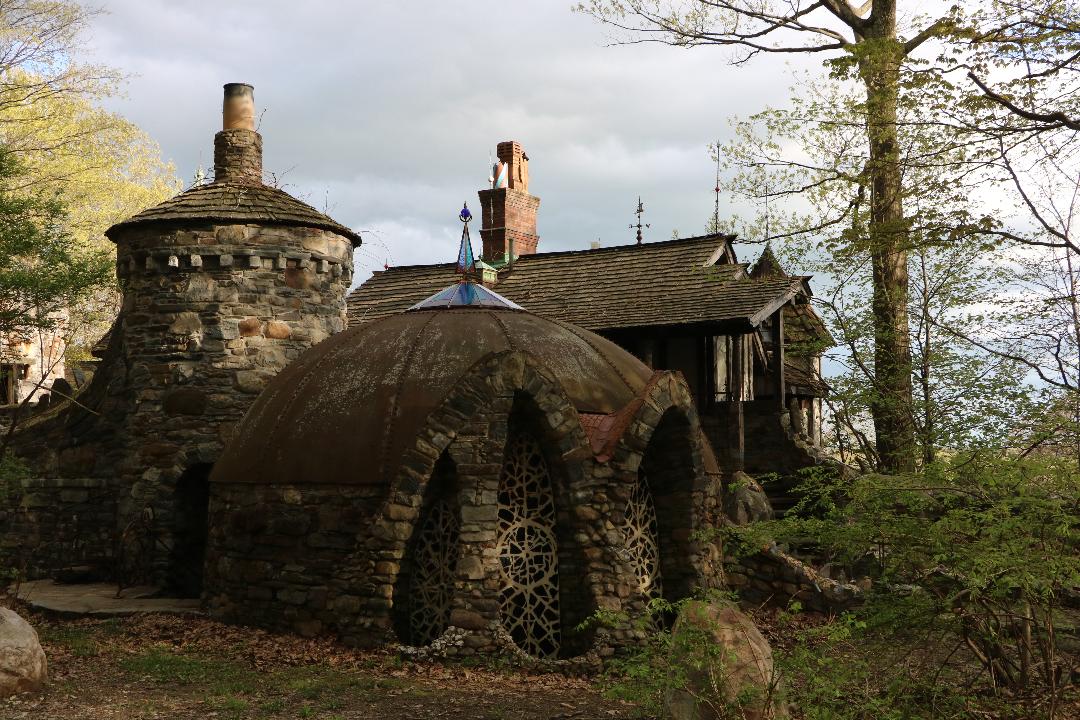
Our eyes travel the rough stone face of the castle before us with its turrets, balcony, and arches; its walkways, crenellations, and green copper pinnacles.  Toni grins at our awed expressions and says, “Of course, I said ‘yes.’”


Ten days ago, Dave and I were sofa-snug, watching “American Pickers” on TV.  Frank and Mike, the Pickers, rove the country seeking their idea of treasures in attics, dilapidated barns, corroded trailers, and obsolete warehouses.  Their primary interest is vehicles of every kind, and Mike goes into paroxysms over rusty handlebars and seemingly worthless headlights if he knows they’re rare and he has the right collector or a bike they would fit.  Even watching from our sofa, Dave and I share the Pickers’ thrill when the beam of their flashlight passes unexpectedly over the chrome grill of a vintage Rolls Royce or catches the snarl of a carousel lion stored in a tumble-down shed.  

On this particular TV night, Mike and Frank steered their white van into a curving, wooded driveway. As they rounded the bend and broke through the tree cover, they gasped.  “Omigod!  It’s a castle!”

From the couch, Dave and I echoed, “Omigod!  It’s a castle!  Where is it? Back up the tape!  There was a sign at the foot of the driveway!”

Lord knows, TV remotes are not my friends and I would have no clue how to “back up the tape,” but Dave does. Still frame, still frame, still frame….”There! Stop!”

“Wing’s Castle,” said the sign, and as Mike and Frank explored the property and 
out-buildings with Toni Wing, I tapped in a search on Google to find out where it was. “It’s a Bed & Breakfast in Millbrook, New York.  An hour and a half away!  We can GO there!”

Just over a week later, Dave and I stand in Mike and Frank’s footsteps chatting with Toni.  How I love the openness of retirement!  The ability to say “yes!  Let’s go!” And do it! 

“80% of the materials are recycled,” explains our host as we pass the moat that winds from our cottage, the Annex, and under an overhead walkway to the main castle. “Pete grew up on the dairy farm down the hill and knew all the farmers in the area. He’d make the rounds buying decrepit barns in order to use the beams and planking.” Periodically she points out farm implements and tools incorporated into railings and rooflines. We peer more closely and spot iron cogs, wrenches, and augurs used to purposeful and decorative effect. “Often the farmers would say, ‘If you’re taking the barn, take all the crap inside too. What am I gonna to do with it?’”

  
“Back in the seventies, you were allowed to poke around at the dump, and we acquired all kinds of broken materials – tiles, glass, wrought iron. Pete figured out uses for all of it. He wasn’t an architect.  He’d never done tile work or built an arch. He was a farm boy… and he just learned how to do what he needed.”   

Pete is everywhere and nowhere.  We’d learned from American Pickers that he died in an accident four years ago, but as we tour his castle and marvel at his vision, humor, and craft, he is walking with us, and I surprise myself in tearing up, grieving at the loss of this man I’ve never met.  I miss him. 

From the top of the turret, we gaze out at waves of low rolling hills and distant mountains beyond the winery that was once the Wing family’s dairy farm. Toni leads us down a twisting, narrow stairway, and once outside, draws our attention to a sinuous dragon with glossy tile scales snaking along a half wall. Nearby, a former water tower dome serves as the roof to the meditative Buddha room.  Out front, massive stones rise from the Earth, Stonehenge, overlooking the vineyard.  Familiar items, cast-offs reclaimed and re-imagined, are transformed into gargoyles, weathervanes, heraldic shields, and yes, dragons and Buddhas. 


In the living room of the main house, too, what appears to be the prow of a ship is actually a railing from a Victorian porch.  Colorful carousel horses gallop from wires suspended from the ceiling. “We’d get them at flea markets and tag sales for $25.  No one wanted them.”  In fact, it was a carousel creature that captivated Mike and Frank during their visit. 


Toni leads us down another stone stairway to an underground passage that connects the Annex, where we are staying, to the Dungeon.  I stop and angle my head to better see the floor tiling.  “RIP PETE WING” is set in jagged white letters against a dark background. The letters seem to emanate light in the dim passage. “Pete had completed the exterior of this section,” Toni says.  “He was going to walk through that door to start on the interior the next day.” 

But he died in a car accident.  His son, Charles, is continuing the work, tuned into Pete’s medieval vision as surely as if his father were handing him pieces of tile and directing his next move.  My heart aches for Charles, as I picture him kneeling here, imbedding this tribute to his father.


                                    *                      *                      *

After browsing the so-called collectibles and mid-century relics in the Millbrook antiques mall, Dave selects a primitive wooden mallet, and I find a weighty black mortar and pestle. It would look great on the mantle at home and I hope it dates from the nineteenth century as the label states.  The vendor is chatty and friendly when we approach the desk to settle up. “So, where are you staying?” he asks.

To our response, he says, “Mmm. The owner died in a car accident a few years ago.” We tell him we’d heard, but he has a story to tell and continues. “He was driving a rare three-wheeled car to the vintage car show in Rhinebeck. Lost control of the car. Maybe hit a pothole or something? The last words he spoke to the EMS guys were, “Don’t tell my wife…’” 

My eyes fill at those words, and as we head to the next shop, I reflect on Pete’s message. Beyond the obvious, what did it mean? Had Toni asked him not to go? 

When we return to the castle, we Google Pete’s obituary.  He’d been driving a 1936 Morgan Supersport.  The article said speed was not a factor in the accident… perhaps a malfunction of the rear tire.  The Morgan does not have a seat belt, and Pete was ejected. 

We continue to discover that Pete is a legend in Millbrook. At Nooch’s for dinner, we sit at the bar and order bourbon-glazed salmon, broccoli and mashed potatoes. Jim, the bartender, is about fifty, attractive, tall, and graying.  “Where you folks staying?” he asks after establishing we’re not locals. We tell him, and his eyes widen. He says, “I saw the castle in its earliest stages. I was about four. I took my kids over to visit when they were little and they loved it. That man, Pete, was crazy talented.  He could do anything.”  

Our dinners are served, and Jim waits on other patrons. A balding man sets up an electronic trivia game in the corner.  Jim comes by to check on us and, without prompting, remarks, “I’ll tell you, Viet Nam was not kind to him. Pete came back from the war and disappeared into his basement for about six months. He dealt with it eventually. He carved life-sized statues for a number of stores in town. Not sure where they are now. Maybe you can find some old pictures?”

                        *                      *                      *

Morning sunlight slants through a slice of window as Dave sits reading in an antique straight-backed chair.  Beside him, the front door is gothic in design, one of many doors salvaged by the Wings. “We had a whole shed full of doors!”  Toni has told us, and each one is unique.  Even our bathroom door is beautiful, made of deep red cherry wood carved in gentle folds to emulate curtains. 


I’m writing at the long dining room table before a brick fireplace. A full suit of armor stands guard at his station by the door to our tiny Tuscan-style kitchen. Pete imagined everything that surrounds me.  With Toni’s constant help, that of their kids as they grew, and occasionally from friends, he conveyed the castle in his mind to paper, and then, to reality. Toni labored and lived the castle’s creation too, hauling barn beams, hefting rocks, and clambering over refuse in search of finds at the dump, yet Pete is always the one acclaimed. I wonder… has it been hard for Toni, to be cast so often as supporting player in Pete’s production?    

And there were many acts to Pete’s story, eagerly offered at the mere mention of his castle. Enthralled as we were, we never sought information, but with each trip to town, we learned something new.  Pete built a haunted house that still opens every Halloween. During the summer, he ran a theater camp that specialized in Shakespeare. During our initial tour, Toni had directed our gaze to a window above a walkway that had featured in many performances.  She recalled a rehearsal, and a young thespian’s complaint that, as Juliet, she had to appear on a balcony.  “Pete said, ‘Don’t worry.  You’ll have your balcony in time for the show.’” 

“As you see,” she said, “he was as good as his word.” 


Monday, October 7, 2019

Strangers No More


The soft glow of candlelight.  Well-worn plank floors.  Low, beamed ceilings tinged by centuries of smoky fires. A blaze leaping, orange and hot, beneath an ancient mantle.  The clatter of glassware and pewter, a murmur of conversation. With ease, I mentally garbed our server in Colonial mop cap and apron while I settled into a seat across from Dave in the 1700’s tavern with a sense of cozy familiarity. 

Dave has hazy memories of robes sweeping sandy soil, and his feet, sandal-clad, during a former life in Medieval times. My comfort in Revolutionary settings is so total I feel I must have worn that skin before.  A guide to castles and dungeons of the Middle Ages might have been a fitting Christmas gift for Dave, but I’d chosen “Taverns of the American Revolution” by Adrian Covert instead. 

Over the following months, Dave and I have snuggled up with Mr. Covert, charting future jaunts to battle sites, historic homes, and taverns. The Griswold Inn in Essex, featured in Covert’s book, is only an hour from our home, and has become one of our favorite destinations. 


Open for business since 1776, The Griswold Inn (fondly known as “The Gris” to locals) survived a sneak British attack during the war of 1812 that left 27 ships aflame, decimating the town’s shipbuilding industry.  The inn is gracious, beautiful, and comfortable, and beyond its history, boasts several unique features.  

One of the inn’s dining rooms is made of wood salvaged from an old covered bridge, and the Taproom is a repurposed 1738 schoolhouse.  Among the antique firearms displayed in one dining area is a musket, and with it, an aged handwritten note dated July 7, 1776, that was discovered in its barrel:

“My dear son Jared,
I send you this my gun,
Do not handle it in fun,
But with it make ye British run,
Join ye ranks of Washington,
And when our independence is won,
We will take a drink of good old rum.  

In a way, my own past seems almost fiction, as hazy and unreal as Dave’s stroll through dusty medieval streets in the thirteenth century, so grasping history as the lives of real people is a stretch for me.  But as I read Jared’s father’s note, I could picture him putting quill pen to paper, squinting in the dim light of a candle at a scarred wooden tavern table. Most likely, he quaffed some ale or rum as he urged his son to join the cause of independence two days after the Declaration was approved. I hope Jared survived the war and lived to share that celebratory toast with his dad.

On this evening at The Gris in 2019, without threat of British interruption, Dave and I sipped red wine and beamed at each other as our server set down platters of salmon with creamy leek, mustard, and wine sauce, and trout over beans with roasted tomatoes.  Heaven. 

Meanwhile, we could see from our fireside table that the adjacent Taproom was filling in.  The crowd was a mix of ages and predominantly male.  Regulars, I guessed, by the grins, greetings, and glasses raised high.  The Gris boasts live music every day of the week, year round, and while we couldn’t make out the words, it was clear from all the “fare thee well, me lads” and talk of tossing seas that we’d happened upon chantey night with The Jovial Crew. 

Dave and I finished dinner as robust bass voices rolled and rumbled in unison, swelling in waves to carry us toward the Taproom as sure as fair winds bear sailors back to their families.

“Remember Lad, he’s still your dad, though he’s working far from home…”

As we inched between the companionable patrons, a muscled, portly, skinny, clean-shaven, tattooed, and flannel-shirted lot, I noticed all of them were singing. All of them!  No one checked cell phones, and no TV distracted with the shriek of a referee’s whistle or the squeak of sneakers on polished wood. Every face was turned toward the five musicians up front, and every person knew the lyrics.  Each song was hallooed as an old favorite as guitar, fife, vocals, and concertina* spun tales of homesickness, travel, good rum, and women. The Old OhioRunning down to CubaFishin’ for a Whale, and The Girls of Old Maui begged that we bemoan and bellow, and the singers supplied the chorus in a call-and-response so newcomers like us could not plead ignorance and stay silent. 


Eventually, I managed to snag a seat near the door, and saw that new arrivals edging into the bar picked up whatever song was underway, joining in as they shrugged off coats and raised a finger to order a beer. 

During a break, the man in the seat across from me said he learned the chanteys when he was a Boy Scout. “The scoutmaster used to come here on Mondays and then teach us scouts the songs around the campfire.”  He gestured toward the lead vocalist, a sturdy guy with a close-shaven beard and white hair.  “Cliff has been singing chanteys at The Gris on Monday nights for 47 years.” Soon thereafter, Cliff, having spotted us, the only strangers in the crowd, sidled over to introduce himself.  “So, first time here!  Where you folks from?”

Much as it’s always been in convivial taverns – even when revolutions were being planned, tea parties hatched, and drafts of broadsides and pamphlets scribbled – conversation flowed freely between sets.  Members of The Jovial Crew and those around us made sure we didn’t feel like outsiders. Tim, the tall, white-bearded vocalist for the band, told us,  “These are work songs. I can hear chanteys sung in foreign languages and know the job being done by the nature of the rhythm. Think about it.  Most of those sailors were 14 to 17.  Boys. They missed their moms and girlfriends.  They were homesick and horny!  The chanteys tapped into that to perform the work of keeping them synchronized while hauling up sails or anchor.” 

Indeed, the songs chosen for the third set were clearly created to keep those lusty boys focused. The lyrics were joyously raunchy and the crowd belted them out with grins and gusto.  A slew of verses I’d never heard in that innocent old ditty She’ll be Coming Around the Mountain would certainly fuel a young lad’s fantasies while he swabbed decks and hauled ropes. “You had to hold those boys’ attention!” said Tim.  “That’s what interested them!”

It seemed we could all sing together forever, but ways must surely part.  Lynn Anne, the server, bustled about, smiling and singing along, but probably ready to call it a night. Chairs scratched across the floor. Empty glasses were set on the bar and tables. But instead of leaving, people circled the room and linked arms. Obviously, it was the thing to do, so Dave and I rose, a bit befuddled, and searched for a spot.  There was a gap near the door so we angled that way.  A hubbub of protest from around the room rang out, “Wait!  No! You can’t leave now!”

Oh!  How lovely to be so welcomed! “We’re just trying to find a place in the circle,” we stammered.  Room was made for us, and we squeezed in.  Swaying together, we all bid farewell, strangers no more, singing, “Rolling home to old New England. Rolling home across the sea.”    


*concertina: small bellow-like instrument with buttons for keys and handles on each of the two hexagonal ends.  

Sunday, September 15, 2019

Skin Deep

The young woman bent at the waist, camera held to a squinted eye as she turned the lens for better focus on a pink hollyhock.  On this sweltering sunny day, Dave and I had taken refuge under a shady trellis in the Edgefield Inn's garden, and had noticed her, a colorful blossom herself, amid the profusion of flora.  

Her head was partially shaved, the remaining hair dyed magenta and pulled in a ponytail. Her arms, chest, and shoulders were a swirl of tattoos.  While her look was exotic, her partner appeared scholarly. Dark-haired, bearded, and be-spectacled, he, like us, sat beneath a trellis, and was absorbed in the large book open on his lap. 

We’d seen the couple in passing before, and now, as we had then, as everyone did at Edgefield, we nodded and said hello as we left the garden. 

That afternoon, it was studious John and tattooed Clarissa who settled in at the steamy river pool, close enough to us that conversation was a given. We were not surprised to learn John was a physicist, a scientist like his father, and Clarissa, a tattoo artist. We reminded them of our brief encounter earlier in the garden and Clarissa said, “Lots of people like flower tattoos, so I keep a portfolio of possibilities.  I like to offer a wide range.”

While floating idly or sitting neck deep in water on seats carved into the sides of the pool, we covered John’s degrees and aspirations, but found we had more questions about Clarissa’s field. What was your favorite project? How deep does the needle go?  How do you control the depth? How do you promote speedy healing? And how do you handle a drunken request for a girlfriend’s name inscribed on a butt?

“I never tattoo someone who’s been drinking.  Alcohol thins the blood and there’d be too much bleeding,” Clarissa stated firmly.

Huh. I’d never thought about blood as a complicating factor in tattoo art, but of course it is. Not easy to “paint” with a needle and ink while swabbing up gore.  

“Plus, the image can change some during the healing process, so I include a follow-up to make any adjustments necessary, “ she explained. 

Dave asked, “What do you practice on?” 

“Humans,” said Clarissa.

“Husbands,” corrected John. We laughed as he lifted the leg of his swim trunks to reveal a graceful, flowing image of a bear and two ravens on his upper thigh. Wow. Truth is, although I’d heard the term “tattoo artist” before, I confess I’d not given much credence to the “artist” part; meeting Clarissa and seeing her work convinced me.  If she lived in Connecticut, I’d get a tattoo.

When Dave asked her, “How’s business?” Clarissa mentioned the spike in requests for tattoos around mastectomy scars. I have not sought that route, but told her I’d had the surgery.

She was thoughtful a moment and said, “Do you mind if I ask about the length and process of your treatments?” 

I did not and gave her a run down.  

“My father had a brain tumor,” she said, and described his surgery and chemo, and the gallows humor he employed to keep the family’s spirits up. 

“How’s he doing?” I asked.

“He passed in December,” she said.  Her sunglasses masked her eyes, but she was quiet and still in the water.  She was about 28 years old and had just lost her father. I was tempted to tell her about Mom’s recent death, but I’m never sure when “I know how you feel because I…” builds a bridge of common experience, and when it’s an intrusion into someone else’s story. I decided to hold back, but I knew her pain, and oh, how I felt for her. 

Tattooed, retired, or trying to be trans; liberal… or even more liberal; aware of the fear of a dread diagnosis; bereft of a father or mother: all of us are doing our best in the hot tub of life. If everyone were required to strip to near-naked and spend time together in a warm, salty pool, maybe we’d be gentler with each other.

Sunday, September 1, 2019

Joyful, Joyful...

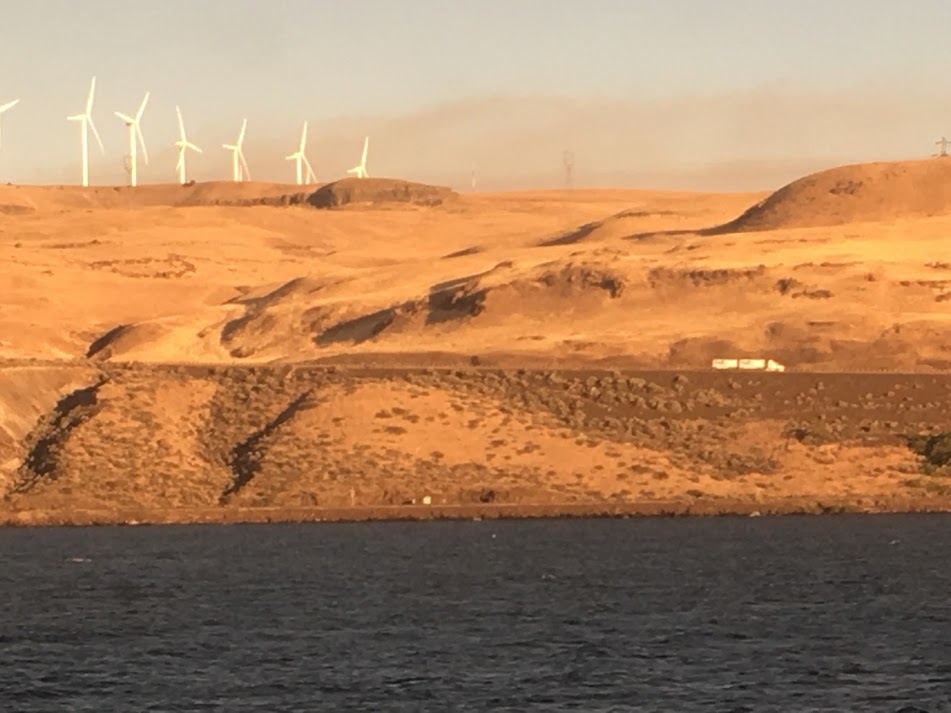
To either side, amber slopes swept down to the road from ridges topped by miles of swirling windmills, then pulled away like curtains from center stage as we drove on. We left reddish earth and the dramatic beauty of the Columbia River Gorge behind as the land flattened, giving way to vast yellow fields of grain.  Vultures soared overhead, and once I spotted two lugubrious fellows hunching on the branch of a withered tree, their great black wings folded about them like some Victorian mortician’s overcoat. 

What a difference from our usual travel route along the Merritt and I-95! To an annoying degree, I tell my children to drive as if every other driver is an idiot, because many of them are. The texters, speeders, lane-weavers and drifters: every one of them a danger to my loved ones. 

“How carefully are you going to drive?” I caution them at every departure. 

“Very carefully,” they respond wearily, too familiar with my question. 

But here, Dave and I were content to spot the occasional truck or car on the endlessly unfurling ribbon of road.  We drove on and on and on and on, and always, our fellow drivers kept a comfortable distance. 


As we neared Seattle, traffic thickened. My cunning husband aimed for the HOV lane and we sailed past the multitudes of single-driver cars. I blessed him for his wisdom, little knowing how critical that choice would turn out to be. 

Once we entered the city, I tapped on WAZE and typed the address for our Budget Rent-a-Car drop-off location.  Dave was relaxed now that the long drive was nearing an end, but I grew tight-lipped and anxious as we scanned the crowded, unfamiliar streets, searching for a Budget sign. 

“There!” Dave cried as we glided past the door.  Stopping was impossible, so we circled the block. At least we had a sense of our destination.

As he slowed to pull over on our subsequent pass, Dave said, “You go in with the paperwork and find out what we should do. I’ll wait with the car.” 

Good plan.  I climbed out, crossed the sidewalk, and pushed the storefront door. It didn’t move. In panic, I checked the hours posted.  It was 5:45, and Budget closed at 6:00. Omigod. Thank heavens we hadn’t known our time was that tight; I would’ve been a wreck in that traffic. 

Only fifteen minutes to closing. I pulled at the door, as clearly indicated on the bar-handle, and it opened easily. I darted inside and down a flight of steps. 

From behind the desk, a bespectacled Asian man greeted me pleasantly in heavily accented English and fired off an elaborate series of instructions. “Go out. First right. Into lot. Second level. Find empty slot. Check number. Bring back card and key.”

“Okay.  Okay,” I said, and repeated his instructions.

“”Yes! Yes! Go! We close at 6:00!”

Hurry! Hurry! I trotted up the stairs, out the door, hopped into the car, and barked out commands. Dave swung around the corner… and overshot the parking lot entrance.  Too easy to do! Where was the sign? Barely visible. And the entrance, so narrow; thank god Dave was driving. 

Back the car up, take the right, follow the ramp down. Down?  Yes, down! What? The guy said second level! I know, but look! The second level is below ground. Agh.

Dave parked the car and we unloaded our bags. Okay!  Let’s go! But my husband was rummaging around the seats. He stood up and frantically patted his pockets. His face was set as he bent back into the car.

“What? What is it?” I snapped.

“Where are the damn keys?”

“The keys?! We’re here, so they have to be someplace!” How often have I unhelpfully said that as Dave and I have enacted this same scene in so many places? But, these were those tricky keys that only have to be in the car to start it. So both of us were back in the car, on our knees on the seats, fingers straining down the sides of the cup holder, hands wildly brushing across leather, then opening the glove compartment two, three, and four times. What was the hour?  Surely 6:00 had come and cruelly fled!

“Here! Found them!” I waved my trophy triumphantly.  We locked the car and dashed for the elevator.  It released us into a lobby abounding with unmarked doors … and Budget was not listed on the directory. 

Which way to go? Are we too late?  What to do if we are?

“Look!  I saw that truck when I was waiting for you!”  Dave pointed through a window, and we sprinted outside. On the sidewalk, we looked left-right-left and there was Budget! 

We made it inside at 5:57.

                        *                                  *                                  *

Princie has been like a big sister to me, minus the teasing that might naturally accompany that bond. Where I am prone to worry, agitation, and a tendency to run dark, she is calm, practical, soothing, and optimistic.  We both love antique homes and antiques, and in matters of conservation and activism, she has been my mentor since I met her in the early nineties. When her husband, Bob, spotted my folk art wall calendar, he shook his head.  “Really?  Princie has the same one. You too are so alike it’s spooky.”  (But for that worry vs. calm, dark vs. optimistic thing…)  

When she mentioned four years ago that she and Bob planned to move west to be closer to their children, I fully understood. How could I not?  But selfishly, I was distressed.  Seeing my pained expression, she assured me, “Don’t worry.  You know how slow the real estate market is. It will take at least two years to sell our house.”

Not so.  A young couple toured their gardens and 1700’s house surrounded by acres of woods and, before a price had even been set, declared it a “forever home,” and claimed it as their own.  So Princie and Bob moved far more quickly than expected, and our trip west was a chance for us to glimpse their new life in Washington. 

More than once, they’ve told us they don’t miss the east, and as we explored their house above a bay, the sun shining, gardens abloom with dahlias, phlox, roses, and hollyhocks, we understood why.  Dave whispered, “We’ve come west on an adventure, and they’re living their adventure.” 

And they were eager to give us a taste of what that meant.  One morning, we scrabbled about a beach mounded marvelously and mysteriously with driftwood tree trunks, fodder for rafts, forts, floating, and photographs.  In the evening, we enjoyed a picnic and performance on the lawn at the Bloedel House and Reserve while Tybalt dueled Romeo, and Juliet swooned from her balcony before us. 


The next day, speaking in the hushed tones a mossy forest seemed to require, we walked the primeval Fairy Dell Trail, taking care not to disturb a garter snake sunning in the midst of the path. Before catching our ferry to Seattle, we browsed the farmers' market stalls of vibrant red cherries, ripe tomatoes, leafy multi-colored Swiss chard, crusty fresh breads, and … sculptural tractors assembled from vintage sewing machines. Hm. Yes. 


We ran into two of Princie and Bob’s new friends who directed us to check out the Chihuly Museum while in Seattle. They were confident we’d heard of the artist, and while avoiding eye contact and studying the handmade soap display nearby, we murmured that the name sounded familiar. But the meeting was fortuitous and after we lingered over farewells and hugs good-bye, Dave and I boarded the ferry, disembarked in Seattle, and sought to rectify our ignorance with a visit to the Chihuly Museum.


Dale Chihuly is a man enchanted by the tendrils, tentacles, pods, buds, and blossoms of this Earth and beyond. His brilliant spires of vibrant glass undulated from the foliage surrounding the museum and swirled from chandeliers suspended from the ceilings within. Crabs, turtles, octopi, and fish swam, iridescent, within ocean fantasies of swaying glass kelp while other creations seemed sinuous curiosities from a distant planet. 


As exuberant artistically was Chihuly’s work, in the sliver of Seattle Dave and I visited, nothing prepared us for the magic of the International Fountain. It was a hot afternoon when our meanderings led us to a wide lawn.  In its center, an expansive piazza curved to encircle a silver half-sphere.  Water streamed down its sides as the opening strains of the “Ode to Joy” emanated from its core. Children of every age in bathing suits, summer garb, or underwear hovered expectantly.  As the music built, sprays of water shot rhythmically skyward in a powerful rush of mist and crystal drops, rising and falling in time to the resounding tympani and brass.

Oh, the euphoria for observers and splashers as little kids wiggled their butts with glee and danced with arms flailing!  As grown-ups, granted childhood again, swirled with faces upturned to the heavens and spun in the cooling waters.  The shrieks and laughter competed with the music’s swells… and sent my spirits soaring. 


Monday, July 22, 2019

Glorious Currents

When I was born, my parents were living in Edie’s family’s garage apartment, so Edie and I go back as far as friends can go.  We attended each other’s first birthday party. We suffered the wrongs of an evil science teacher who accused us of cheating (which we had not).  We both adored Ms. Josten, our beautiful 8thgrade Latin teacher. We danced, over and over, to Steppenwolf’s “Magic Carpet Ride” in our living room at 638.  We drove stealthily past Cliff Pemberton’s house when, at sixteen, I longed for him. We made mashed potatoes for midnight snacks and begged Edie’s mother to make her famous chocolate sauce. And fifty years later, when my Mom received her diagnosis, it was natural to call Edie and weep while curled on the green-carpeted stairs of 638 where, as teens, we’d spent countless hours gossiping about boys. 

Before Mom got sick, Edie and her husband, Dave #2, invited us to their time-share in Bend, Oregon, and that is what prompted our entire trip west.  

Edie and Dave #2 are seasoned travelers and hikers, and after my Dave and I experienced Glacier’s High-Line trail – during which we inched along a foot-wide pebbly path while clinging to a cable bolted in the rock face so as not to be swept to our deaths by buffeting winds – we thought we were reasonably ready to keep up with them. 

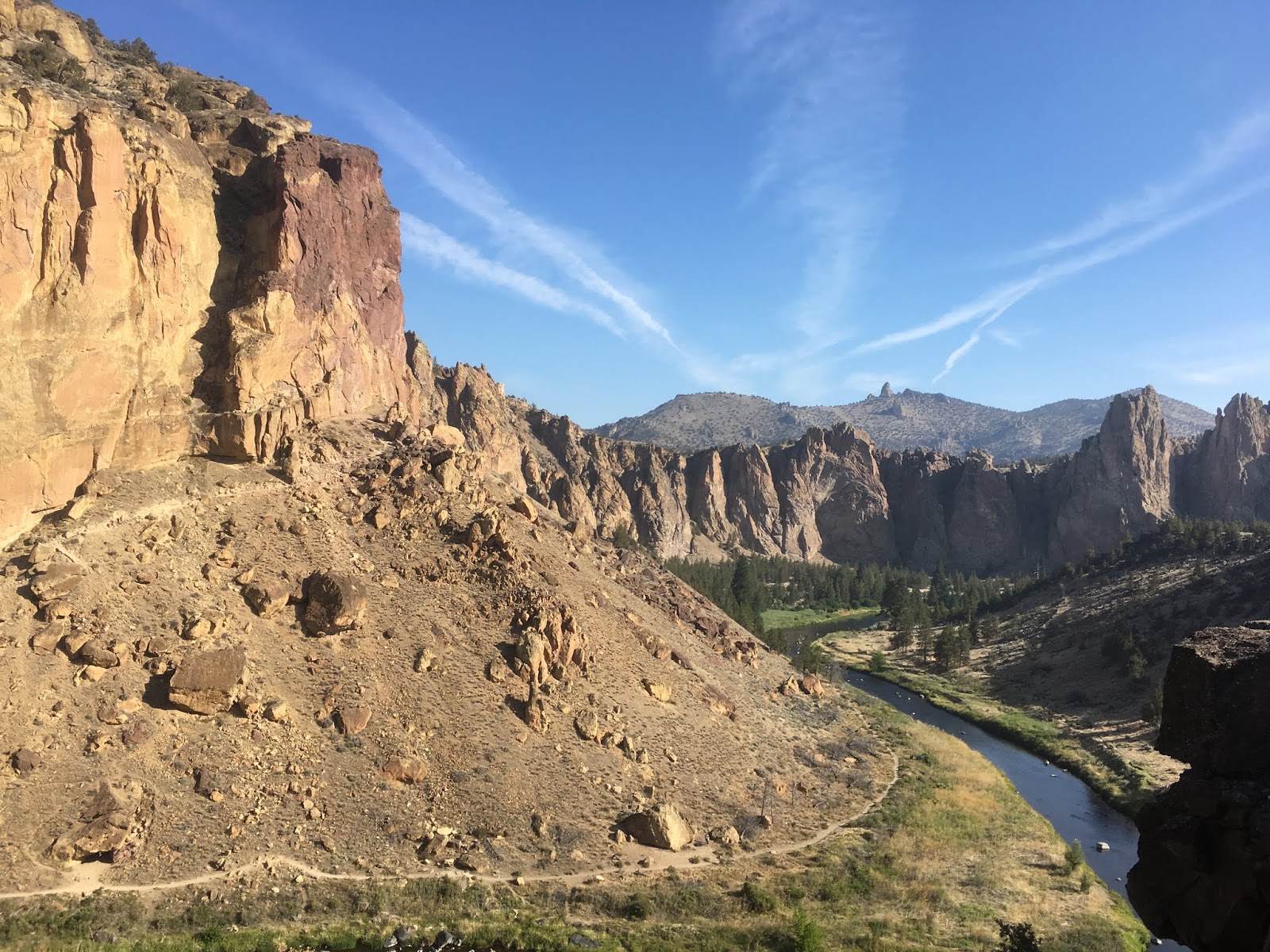
On our first evening in Bend, they eased us in with a lovely canyon walk.  The next morning, we were up at 7:00 AM, slathered with sunscreen, fortified with granola and yogurt, and out the door by 8:00 in order to stay ahead of the scorching sun during our hike up Smith Rock. 

Edie and Dave #2 were compassionate to us Smith Rock neophytes.  Yes, they’d chosen the Misery Ridge Trail, clearly designated “Most Difficult,” for our second day, but as I said, my husband and I were secretly preening with unearned cockiness after conquering at least a mile of Glacier’s High Line, and, adrenaline-charged, we were game. Besides, Earth herself beckoned to us, her bones exposed, ragged, red and raw, towering above and before us. Onward campers!


Our Bend Camp counselors were mindful of hydration and stamina, and insisted upon regular shade and water breaks, and, omigod, Chocolate Mint Cliff bars.  Can I tell you how good those things are? Anyway, we didn’t realize how significantly Edie and Dave #2 had slowed their pace for us, and Dave and I thought we were hoofing along just fine; we were solid.  The breath-stealing sight of rock climbers suspended from cables slung from one precipice to another gave us yet another excuse to take a good long pause for pictures and exclamations. 


Ultimately, the sun caught up with us, and our final descent down a series of switchbacks was sweltering as well as challenging, but Dave and I were proud and exhilarated that we’d hiked this “most difficult” trail.  Were we undone by the rattlesnake curled in the rocks to the right on the teeny trail? No! We inched by and took pictures. 


When we reached the end of the trail, mentally, I danced a victory lap that, at 65, I had successfully, fairly comfortably, achieved such a feat. But, I had not remembered, had not considered, the climb back up to the parking lot.  When I gazed up toward the lot - so faraway it seemed! - my body began to protest. 

You know that let-down response when you really have to go to the bathroom and you pull into a rest stop and your body thinks, “Yay!  Now I can go”? And then, the bathrooms are closed for renovations and you are really screwed because your body thinks it has permission to release?  Yeah.  It was like that.  

Agh, I was so close, but my knees said, “no way,” so I sat in the meager shade of a stunted pine while my heart cursed me with a frenzied, erratic, reproving beat.  Wait. Wait. Slow it down. Slow it down. I reflected on an incident at Logan’s Pass, when Dave and I witnessed a rescue helicopter landing to pick up a hiker who’d had a heart attack. Oh Lord. I’d not been charitable in thinking the man had been unrealistic in gauging his abilities.  Breathe.  Breathe. Judge not, lest ye be next. 

When my heart calmed, I stood up, and remarkably, that respite was enough. I crested the final leg to the parking lot where Dave #2, bless him, waited in the car with the air conditioner blasting.  Once seated and cool, my triumph and bravado returned. 

So, what next?  Bring it on!   

                        *                                  *                                  *

In the morning, rested and well fed, again we were up and out by 8:30 to hike the volcanic cone of the Newbury Shield.  It was forbidding and charred, a vast expanse of spikes and crevices. Surprisingly, berry-studded bushes and yellow potentilla bloomed from cracks in the rock, and chipmunks and lizards scurried about the black surfaces.  How could that be?  Oh, this Earth! So beautiful, bountiful, resilient, and mischievous!  I’m thinking about having her tattooed somewhere on my body.  


In our normal life, a moonscape stroll such as this would provide stories and adventure for months, but this was but one morning at Edie and Dave’s Bend Camp.  For, that afternoon, we were off to the Sun River Resort for a bike ride followed by tubing down the Deschute River.  

After a tasty lunch on the balcony of a club overlooking a golf course, we changed into bathing suits, took a shuttle upriver, and slipped into the water, each cupped in our own royal blue inner tube, at the mercy of the river’s whims.

For three hours we drifted. Three hours to gaze at blue sky. Three hours to admire passing greenery and the occasional bird. Three hours to chat, when our tubes floated close enough, about the wonder of creation, man versus nature, evolution, and the danger of Trump’s roll backs in environmental and species protections.  

Three hours where my control was limited to what paddling hands could accomplish in steering clear of debris or maneuvering toward a promising current. Despite what we like to believe about life, isn’t that really all we are ever able to do? 


Tuesday, July 9, 2019

Late Night at the Depot

It is 12:26 A.M. and the oak benches in the depot at Whitefish are hard. Our 9:15 P.M. overnight train to Portland – with its cozy bunks and tiny bathroom – is delayed. The ETA keeps creeping later, and we hope the current projection – 2:38 A.M. – sticks.

While on the Red Bus tour, our stopover at Glacier’s Lake Macdonald Lodge had been tantalizing, but brief.  Given our naively anticipated departure time today, we had, even then, plenty of time to kill, so we returned to the rustic, 1913 lodge for a tasty lunch and lengthy stroll along the lake before heading for Whitefish.


With its shops featuring an eclectic mix of antlers, stuffed heads, swinging-door saloons, and a nuance of nautical, the town has a “come ski and sail in the wild west!” appeal. We had dinner at a restaurant called “Casey’s”, and of course, took a picture of the logo to send to our daughter. It was still early, so we drove into Lee Mason State Park for a quick look, and when we needed a bathroom, stopped at the luxury lodge on Whitefish Lake.  With the confident air of paying guests, we strutted to the poolside facilities. Then, brazenly, we walked the lodge beach, our bravado rewarded when a staff member smiled and asked if we were enjoying our stay.  Oh yes, thank you!  

Lulled by the memory of our prompt departure and entrancing train ride three days ago from Portland, we returned our rental and headed for the depot with a half hour to spare. Four hours later, we are surrounded by our future fellow passengers, many of them striving to snooze despite the oaken seats. 

The Hertz office is open, so Dave and I bide time chatting with Mr. Duff whose family has run this franchise for over 70 years.  His grandfather’s massive Victorian roll-top desk – with two secret drawers – dominates the small office.     

Hours pass. I should read or write in my journal, but I’m mesmerized by the bizarre programs on the big-screen TV. “Ring of Honor” wrestling? It has to be a parody.  Oh lord, I hope so.  Such posturing, leaping, and flailing!  Wild, swinging punches, tumultous falls, swirling capes, and threatening growls! Totally ridiculous, but a glance around the waiting room reveals that, like me, those not sleeping are riveted. 

A kind young woman offers food from the vending machine to an elderly couple sitting nearby.  A mother strolls round and round, crooning and cradling her adorable chick-fuzzed baby who makes not a sound, but gazes wide-eyed and quiet at each of us in turn. The child’s father snoozes with his head resting on a backpack while his tiny daughter sits next to him playing on a phone. Wizened and bearded, an ancient gentleman sits alone.  If it were possible, I would’ve guessed him to be a Civil War veteran, although Viet Nam is more likely. 

Did I mention the full-grown stuffed mountain goat encased in glass in the middle of the depot?  No?

Around 2:00 A.M., a youthful couple stumbles in; clearly they’ve passed the time at a local bar.  The boy’s round face is good-natured and cherubic, with coppery curls tumbling from beneath his brimmed, leather hat. The girl is pretty, with long blond hair. To our surprise, they greet Dave and me as dear friends, and we realize we met them while waiting for a shuttle in Glacier.  At the time, we were heading up to Logan Pass, and they were off to the wilderness to camp. When you’re traveling, even a brief conversation qualifies as a connection, and when gritty-eyed, tired, and stranded in the wee hours, a familiar face is a welcome sight.   

The minutes crawl by and just as we reach the point of dismissing any announcements related to our train’s status as cruel fabrication, it pulls in at 3:10 A.M.  Our weary crew stands and stretches, gathers up pocketbooks, empty candy wrappers, water bottles, and suitcases, then trudges out to the platform to board.

Once ensconced in our unit, Dave climbs into his bunk and immediately falls asleep. I squeeze into our diminutive bathroom to brush my teeth, and am dismayed by the smears and splatters on every stainless steel and porcelain surface. Oh AMTRAK! I love thee, but you betray me with this dark-of-night, mandatory floor-sink-and-toilet swab.

The rail line is somewhat redeemed when daylight brings tasty boxed breakfasts, although our “vegetarian” offerings, so marked in bold black Sharpie letters, include thick chunks of ham.  After we eat around the misplaced meat, we search out our bleary young friends from Whitefish who have spent their slice-of-night sitting up in coach recliners in a separate car. They’re happy to have a ham-and-bread snack.    

As our train snakes along the Columbia River Gorge, Dave and I snag seats in the observation car and marvel at the stunning variations in landscape.  We lurch from one side of the car to the other, cameras ready, striving to capture it all; the sunset-amber hues of the ragged and rounded cliffs of the gorge; the vast blue sweep of the river; the thunderous thrill of passing trains; battalions of white-winged windmills; bustling logging yards; distant wildfires blowing billows of smoke, ominous as nuclear clouds; and open expanses of water with para-sailers drifting above like dragonflies. 

So, yes, we arrived in Portland five hours late, a nightmare for those meeting friends or making flights. But without that delay, those river views would have passed unseen in darkness.  I stand by my mantra: have faith in the unfolding.