Showing posts with label Democracy. Show all posts

Tuesday, September 24, 2024

Centuries of Service

In top hat and great coat, the tour guide swung his lantern to illuminate the stone façade of the building before him. A cluster of tourists crowded closer, eager to hear a ghostly tale. From my perch in the upper window of our room across the road, I could sense their disappointment in slumped shoulders and shuffling feet as the guide spoke of history, not spirits. 

Newport’s Clarke Street is lined with clapboard eighteenth and nineteenth century homes painted the dark colors of that era. The glow of streetlamps is just bright enough to light the way, and the past seems to coexist with the present. I must have made a movement that caught the attention of one of the tourists, and my face, suddenly glimpsed through the misted glass pane, seemed the eerie vision they’d hoped to see. There was a ripple of startled exclamations as heads turned and tipped, then a hesitant flutter of hands returning my wave. 

Because of that gathering in the street below, I keyed into the 1838 Artillery Company Museum, and the next morning, Dave and I went to visit. 

The stone building houses an extraordinary collection of military memorabilia and is home to the Artillery Company of Newport, chartered in 1741 by King George II of Britain. The company is now a ceremonial unit of the Rhode Island militia and the Council of Historic Military Commands.

We were greeted by men in navy blue polo shirts bearing the Artillery Company’s insignia. I could imagine each of the three volunteers, whether bearded, craggy, or clean shaven, in the  uniform of the Union or Confederate armies. In fact, this company fought in the French and Indian Wars, the Revolution, the War of 1812, and the Spanish-American War. Members of the Company have served in the country’s  20th and 21st century engagements as well. Memorabilia from each are preserved in the museum.

A faded American flag with a unique circular configuration of  37 stars spans most of a side wall, its tattered condition attesting to years of service to the company. Uniforms, still gold-buttoned and dignified in bearing, surround the room. Once worn by such illustrious individuals as Prince Philip of England, U.S. Secretary of State Colin Powell, Egyptian president Anwar Sedat, and Colonel Katherine Towle, first Director of  Women – U.S. Marine Corps, they stand guard now over four bronze cannons cast by Paul Revere in 1798. In glass cases, spent shells and bullets from the World Wars and the Battle of Gettysburg rest beside letters, medals, weapons, caps, and vintage photographs.


Near hidden in the shadows in the back of the museum is an ambulance jeep, the poles and canvas stretchers that once carried the wounded mounted on each side. I thought of Dave’s Uncle Jack, who was assigned to a medical unit in Africa as an ambulance driver during World War II. His brothers, Dave’s dad and Uncle Phil, served in the Air Force and Navy in Italy and the Pacific, respectively. All three boys were first generation Americans born of Italian immigrants.

Jack was a gentle guy, not cut out to carry a weapon that might harm someone else, but he saw, up close, the brutal aftermath of battle. 

Whatever wounds he tended, whatever fears he tried to soothe, whatever carnage he witnessed, came home with him after the war, pain as real to him as the suffering of the men he’d transported on stretchers. While he was always funny and dear to Dave and Steve, his little nephews, Jack was never the same.

Now, the tactics employed by the Fascists in the 30’s are back in play: dehumanization of vulnerable populations, exaltation of a cult leader, violent rhetoric, and disinformation. Those who support them or remain silent dishonor the uncles, aunts, parents, and grandparents who endured grievous harm in striving to defeat such forces. 

We Americans have a critical choice before us. Now, all together, Vote as if Democracy depends on it… because it does.


Wednesday, July 17, 2024

Project 2025: What Would Change? What Would We Lose?

Project 2025, or The Presidential Transition Project, is no secret. A quick Google search opens Project 2025.com, and those interested can read on. Given the document’s daunting 900+ pages and extravagant language however, few people will. So, beyond the introduction that follows, I recommend the 17-page Foreword by Kevin Roberts, president of The Heritage Foundation, and a selective wade into the areas of greatest concern to you.

Because you should be concerned. We all should. If the Supreme Court ruling on presidential immunity didn’t shake you, familiarity with the changes Project 2025 proposes in our government policies, programs, and personnel will. 

Authored by contributors from over 100 conservative organizations and facilitated by The Heritage Foundation, Project 2025 is a game plan for the next conservative president and his administration. As Paul Dans, Project 2025 director states in his opening note, “Our goal is to assemble an army of aligned, vetted, trained, and prepared conservatives to go to work on Day One to deconstruct the Administrative State.” (pg. xiv)

When Donald Trump won the 2016 election, he was surprised, unprepared, and ill-equipped. The chaos caused by his style and lack of experience in governing was, to some degree, offset by civil servants with expertise in their fields as well as the checks and balances established in the Constitution… inconveniences that Project 2025 seeks to address. 

One might hope Congress would be a check on the expanded presidential power outlined in Project 2025, but beyond the divisiveness and inertia apparent in that body, impoundment is a means to circumvent policies by withholding money already appropriated by Congress. We saw impoundment in action when the former president sought to withhold money from Ukraine unless President Zelenskyy launched an investigation into Hunter Biden. Also, the document states that some significant offices and acts, such as those within the FBI, can be eliminated “without any action from Congress.” (pg. 550)

In the work of deconstruction, the crosshairs of Project 2025 are focused on ending the independence of the Department of Justice and the FBI. The document aims to “place the FBI under a politically accountable leader” (pg. 550) and “prepare a plan to end immediately any policies, investigations, or cases that run contrary to law or Administration policies.” (pg. 557, italics, mine.) In this, one can foresee a rash of pardons and dropped court cases related to January 6th.

In his Foreword, Kevin Roberts states, “There are many executive tools a courageous conservative President can use to handcuff the bureaucracy.” (pg. 9) The word “handcuff” is certainly troubling, but that aside, another tool, Schedule F, would reclassify nonpartisan, merit-based, career civil servants – experts in fields such as science, health, etc. -  to facilitate firing those viewed as inadequately dedicated to the president’s agenda. Reportedly tens of thousands of jobs could be affected, making way for that army of loyalists who lack independence and expertise in arenas important to the American people.  

It's fair to say that those arenas are, to some degree, common to most of us. “Life, liberty, and the pursuit of happiness” covers them well, assuming our health and well-being and that of our loved ones fall under those headings. But as much as Project 2025 pays lip service to reducing the size and scope of government, its recommendations send that conservative army nosing into bedrooms, bathrooms, and mailboxes to gnaw away at established freedoms in ways not seen in half a century, the privacy protections of the Fourth Amendment be damned. 

Project 2025 proposes new goals for the Department of Health and Human Services (HHS): “Protecting life, conscience, and bodily integrity.” Existing social services such as Head Start, school meal programs, and Temporary Assistance for Needy Families (TANF) would be abolished or reduced. In reinforcing the “traditional family” – married mother, father, and their  children – programs supporting single mothers and funding for out-of-home daycare would be curtailed, all the better to restrict women’s job opportunities beyond motherhood. 

Across all departments, policies related to the LGBTQ+ community, gender-affirming care, and Diversity, Equity, and Inclusion (DEI) would be assessed and for the most part, repealed. In the belief that “abortion pills pose the single greatest threat to unborn children in the post-Roe world,” Project 2025 states that the FDA should reverse approval of Mifepristone. Invoking the Comstock Act of 1873, the mailing and interstate sale of such medications would be prohibited. As Roberts affirms in the Foreword, “the Dobbs decision is just the beginning.” (pg. 6)  

The danger to women’s health in the wake of overturning Roe vs. Wade has been apparent in publicized cases of doctors immobilized by uncertainty as to abortion laws in their state. Whereas the Emergency Medical Treatment and Active Labor Act (EMTALA) was enacted to protect medical professionals deeming an abortion necessary for the health of the mother, Project 2025 states, “the EMTALA requires no abortion, preempts no pro-life laws, and explicitly requires stabilization of the unborn child.” (pg. 473) 

Funding for Planned Parenthood would be eliminated, and coverage under the Affordable Care Act (ACA) for “women’s preventative services” – i.e. contraception – would be rescinded. Despite a litany of new rules directed to women, their bodies, and reproductive rights, and in denial of the mutual responsibility for pregnancy, men are mentioned only to say that men’s “preventive services” should not be considered under a mandate for women.  

If the Christian Nationalism theme has not yet been apparent, Project 2025 proposes to change the name of the Office for Civil Rights to “Conscience Enforcement.” Feel free to think about that while your conscience is your own.

Beyond that, the Project seeks to rescind countless Biden initiatives and dismantle, reform, and reduce many departments and regulations established and enacted to protect and preserve the people, the planet, and the creatures. The authors ignore or disdain the reality of the importance of the health and connectivity of this shared Earth and global community in sustaining us all in terms of climate, trade, agreements, and alliances. 

Science that conflicts with the presidential agenda of “Energy Dominance” is seen as a threat. Offices, acts, and regulations that contain references to climate change, clean energy, renewable resources, and sustainability are viewed as impediments to the project’s reorientation of America’s energy programs toward nuclear research and development and increased drilling and mining for fossil fuels, natural gas, and coal. 

Viewed as “one of the main drivers of the climate change alarm industry” as it monitors and alerts the public to weather, storms, and rising temperatures, the National Oceanic and Atmospheric Administration (NOAA) would be dismantled and many of its functions eliminated. “Scientific agencies like NOAA are vulnerable to obstructionism of an Administration’s aims if political appointees are not wholly in sync with Administration policy. Particular attention must be paid to appointments in this area.” (pg. 677)  

Through revocation of funding and termination of personnel, the Environmental Protection Agency (EPA) would be reduced in size and scope. Provisions of the Clean Water Act and Safe Drinking Water Act would be reviewed as possible infringements on private property rights. Clean air standards related to interstate pollution, downwind impacts, greenhouse gases, etc. would be “reconsidered or repealed.” 

Redirection of Department of Commerce services would reduce protections for critical habitat and threatened species under the Endangered Species Act (ESA) and Marine Mammal Protection Act (MMPA). In this time of rising seas and temperatures, extinctions, extreme storms, subsequent human migrations, and international turmoil, it is at our peril that experienced scientists and experts would be relegated to the visions of a president and his or her loyalists. 

Project 2025 recommends abolishing the federal Department of Education and turning that responsibility and funding over to the states, thereby eliminating national standards for academics, civil rights, and psycho-social support. Programs and references to DEI, gender identity, and Critical Race Theory would be purged. Rather than an emphasis on meeting the needs of students, the Project’s contention, voiced by Kevin Roberts, is that “schools serve parents.” (pg. 5) 

National security under Project 2025 will undergo a “most significant shift” in discerning “who are friends and who are not.” (pg. 179) The State Department must “right the ship,” and presumably in a quaint reference to President Lincoln’s hat, “Bureaucratic stovepipes of the past should be less important than commitment to, and achievement of, the President’s foreign policy agenda.” (pg. 176) The text is clear that those stovepipes are existing international treaties, agreements, and organizations. Since it is not George Washington running for president, one must question what that foreign policy might look like under a president who admires authoritarian leaders and stores classified documents in his bathroom.

In the “execution of U.S. policy that is focused on [the president’s] vision for the nation and the world” (pg. 196), the authors propose dismantling the Department of Homeland Security while investing in a Department of Defense (DOD) devoted to “warfighting.” Additionally, military personnel would be deployed to prevent illegal crossing at U.S. points of entry as well as assist  in completion of the wall at the southern border. The Department of Energy would veer from alternative energy initiatives toward nuclear research programs and expansion of the nuclear arsenal. International nonproliferation agreements with the United Nations and Iran would be terminated.  

DACA, or Deferred Action for Childhood Arrivals, is viewed as “unlawful,” thereby opening the “Dreamers” previously protected to inclusion in the expanded and expedited arrests, detention, and deportation of illegal immigrants outlined in Project 2025. State and local enforcement officials, as well as the military and secret service personnel not involved in a protective capacity, would also be enlisted in these actions. 

While Candidate Trump has claimed lack of knowledge or support for the Project, 25 of the 36 principal authors are involved in the former president’s current campaign or served in his administration. His speeches and posts have reflected many of the stances and policies outlined in the document. Presidential adherence to the Constitution and the rule of law is a drumbeat throughout the pages of Project 2025, but that rings hollow in the face of January 6, election denial, and 34 counts of falsifying business records.  

Federal safety nets for American citizens, from children to seniors, would be compromised as food programs, Medicare, Medicaid, Head Start, and the like are reduced or eliminated. In fact, the long-standing role, in a broad sense, of the United States federal government as a safety net for humans, planetary ecosystems, and world peace would be abdicated in consolidating power to serve the president’s agenda. Economics – bolstered by resource exploitation, military sales, and elimination and reduction of “entitlements” – would take precedence. States’ rights, touted as a cornerstone of Project 2025, would remain in force only in areas that suit that agenda. State policies governing environmental regulations, immigrant protections, and women’s health and reproductive rights would be overridden.  

Throughout their writings, the Founders considered the needs of future generations in an America beyond 1787. They enshrined the guard rails of checks and balances to protect against the rise of a dictator and included amendments to allow for a changing world. Partisanship has weakened those safeguards. Christian Nationalism and near-unbounded presidential power dominate Project 2025, and Americans are left with a new take on our unalienable rights as: Life (certainly for fetuses), “ordered Liberty” (whatever that means), and the Pursuit of “Blessedness” (or doing “what we ought.” Pg. 13). 

If that’s not your vision, VOTE… for Democracy.


Tuesday, February 16, 2021

Pummeled


Waves of fury and incredulity pummel my mental shores. Naïve as I am, despite the pundits’ prediction that Senate Republicans would vote to acquit Trump, I believed that dedication to democracy, oaths of office, oaths of impartiality, and love of country would win out over party politics in the face of evidence and the terror of personal experience.
  

But no.  


Buffeted by cross currents, America has been twisted and tortured like its flag in an insurrectionist’s grip.  Abused were the stars and stripes on January 6 as they were wielded as a weapon to bludgeon police.  Those who derided Black Lives Matter protesters this summer with calls to “Back the Blue” swarmed the Capitol howling “Stop the Steal” as they brandished the American flag along with their arsenal of bats, fence posts, and pitchforks to bloody those defending the Capitol.


When I was a child, I was told to kiss the flag 100 times if it touched the ground by mistake. Was this my parents’ invention or a national rule? I don’t know, but the message was clear. Dave’s father too, a WW II veteran, taught his grandchildren the solemn lesson “Honor the soldiers and the flag.” 


Although they sought to appropriate the motives of America’s revolutionaries, the Trump supporters who breached the Capitol can lay no claim to heroism. They desecrated American symbols while impeding certification of an adjudicated election, endangered lawmakers, spread feces, and destroyed and stole national treasures. Thugs were these, not patriots. The fever of doing Trump’s bidding superseded respect for the flag, democratic process, and human life.      


What to make of Mitch McConnell? He refused to call the Senate to session when the House Managers were ready to present the case in mid-January.  There was time for a trial, and the former president was still in office. Mitch had not the balls to vote “guilty,” but had the gall after the count to affirm the House Managers’ evidence of Trump as inciter-in-chief.  Although the Senate had already addressed the constitutionality by a majority vote, McConnell defended himself with the timing technicality he created.  


In his closing remarks, lead House manager Jamie Raskin looked around the Senate chamber at those before him and quoted Benjamin Franklin, saying, “If you make yourself a sheep, the wolves will eat you. Don’t make yourself a sheep.” How else but as sheep are we to see Senators who believed Trump guilty, yet in their fawning loyalty, absolved him of accountability at the expense of our democracy? 


What now?  In betraying their oaths and ignoring the result of the vote on the impeachment’s constitutionality, those senators eviscerated the Senate of its credibility and power.  They did not “defend the Constitution of the United States against all enemies, foreign and domestic” when Trump and his mob sought to hold power despite the vote of the people. They waived their sworn charge, and clung to a technicality already dismissed by majority vote.  


By that acquittal, the Senate has granted future presidents a “January Exception” for whatever purposes he or she might have in that final month in office; Congress and the Republic be damned. After his final summation of the evidence of Trump’s efforts to prevent the transfer of power, delight at the attack, and refusal to send help, Representative Raskin said, “If that’s not a high crime and misdemeanor, then nothing is.”  


It is work to contain my fury and contempt, but friends remind me of reasons for optimism.  President Biden has remained focused on the people and the planet. Vaccinations have doubled. A COVID relief bill will soon pass. The U.S. has re-entered the global community in positive ways, re-joining the Paris Climate Accord and the WHO.  In discrediting their vote and abdicating their responsibility, the Senate has re-affirmed what has always been true: it is up to us, the people, to govern wisely with our votes. 


Sunday, February 5, 2017

Something I Can Do

Sometimes I realize I’m humming.  It starts as an unconscious lips, tongue, and breath thing that I, thinking-Lea, a spectator curious about the content, happen upon with surprise.  I don’t always recognize the tune immediately and have to keep humming until I identify the song.

Often during election seasons, “America the Beautiful” has been my soul’s selection, looping continuously while I’m driving, typing, walking in the woods, or washing dishes.  But, its wistful lyrics - “and crown thy good with brotherhood, from sea to shining sea" - seemed so poignant and unattainable in 2016. Instead, something stirring, something rousing, something rebellious kept burbling up from my subconscious. 

What was it?

Got it!  “Sister Suffragette!”  A revolutionary cry from actress Glynis Johns in the 1964 movie, “Mary Poppins.”  Mary Poppins?  A song of revolution?  Yes!

“We’re clearly soldiers in petticoats,
Dauntless crusaders for women’s votes…

Cast off the shackles of yesterday!
Shoulder to shoulder into the fray!
Our daughters’ daughters will adore us,
And they’ll sing in grateful chorus,
“Well done!  Well done!  Well done, sister suffragette!”

Long before the election results were tallied, somewhere deep within me this rallying cry ramped up.  But why?  That battle had been fought and won in 1920. Not so long ago.  And we are the daughter’s daughters those courageous, forward thinking suffragettes fought for.  Catch me at the right moment, and I’m weepy with gratitude to those women.  

Almost 100 years later, Donald Trump has been elected president. Our right to vote is not up for grabs, but he has bragged that, for him, our private parts are.  

For years, I’ve warned my daughter not to be complacent about her rights, but why wouldn’t she be?  She has grown up in a world where women are CEOs, surgeons, and senators, where she has known she can be almost anything she wants to be.  Sure, tampons and sanitary pads are taxed while Rogaine and Viagra are not, and yes, women are paid $.78 cents on every dollar a man earns, but we’ve made solid headway.

Wait. Rewind. Having not needed a tampon in over a decade, I wasn’t aware of that tax, and while I knew about pay inequality and thought it unfair, I wasn’t really bothered by it.  Why not?  WHY NOT?  Why have I accepted that so quietly? 

Flash to January 2017 and I’m not accepting it anymore.  I’m also reeling at America’s choice for president.  Fortunately, so was Teresa Shook, a retiree living in Hawaii who was so disturbed by Donald Trump’s win that she posted her idea for a March on Washington on Facebook.  By the next morning, 10,000 followers had signed on to join her.   My sister Francie and I missed that initial call to action, but we had our bus tickets to the march secured within a month of that posting. 

In the weeks before the march, I worried.  About cold feet and frostbite. About the possibility of violence.  About the availability of bathrooms.  That was the main thing, actually. I worried about that a lot.  So I added maximally absorbent sanitary pads to my Women’s March pile of gloves, woolen socks, granola bars, and dried apricots.  Even if I were desperate, I doubted I’d be able to convince my lifetime-trained body to release and go in a pad, still, I felt better having a “what-if-I-can’t-find-a-bathroom” plan.

But the Women’s March committee assuaged my fears.  By email, they kept me posted with updates about permits, police coverage, suggested supplies, things to avoid, march route maps, and guidelines to follow in case of disruptions.  Plus, it sounded like they were renting plenty of port-o-potties.  By the time I was on my knees on the floor, Sharpie in hand, preparing my poster, I was unequivocally excited.  This was the antidote to Trump despair.  This was something I could do.   

On Friday the 20th, I drove to Pennsylvania to stay with my sister as we’d be waking at 4:15 AM in order to board the bus in Villanova at 5:30.  Francie’s friend, Jen, pulled in at 5:00, and the three of us arrived at the bus with enough time to order coffee at Starbucks.  Our coordinator, Kat, a welcoming, energetic blonde, checked us in as we climbed onto the bus.  We settled into our seats and unpacked hardboiled eggs, granola bars, and water from our specially-purchased-for-the-march clear plastic backpacks.  I had decided on drinking minimally during the day to reduce bathroom trips, and would allow myself only occasional, tiny sips. 

It was 5:45 AM, so while some of our fellow marchers introduced themselves, many dozed off. 

About an hour out of DC, Kat took the microphone at the front of the bus, reviewed logistics and meeting times, and invited those who wished, to share their reasons for marching.

There were teachers, physicians, healthcare workers and coaches among us, women who worked with small children and with students.  One teacher spoke of a student of hers, a girl of color, who’d been accosted by two boys who called her a pussy during a sports event at their school.  "You can’t call me that,” the girl had said.  “Sure we can,” the boys answered.  “The president does.”

“I’m marching for her,” the woman said.  “For her and all my students, boys and girls.  I want them to grow up in a world that values respect.”

Some spoke of marching for their daughters and granddaughters, or in homage to mothers and grandmothers who had marched for reproductive rights or even, votes for women. One woman said ruefully,  “I can’t believe we still have to march... “

A mother reported her three year-old daughter’s remark upon seeing the president on TV.  “Mommy, President Trump doesn’t have any parents.”

“No parents?  Sweetie, why do you say that?”

“Because he has no love, so he must not have parents.” 

A sad silence settled in at this.  “I’m marching for my daughter,” the speaker continued.  “I want her to know a world that loves.”

My sister Francie spoke of our good fortune in having a family united in our political views and in being fairly secure economically.  “I’m marching for those more likely to lose jobs, insurance, and rights,” she said. 

I spoke of my years at Eagle Hill, a school for children with learning disabilities.  I mentioned volunteering in a women’s literacy program and on my town’s conservation commission.  “I fear that these, my priorities, are threatened under this administration.  I am marching for their protection.”

A woman from the Ukraine stood to speak, but was choked by tears and sat down.  Later, she tried again.  Still weeping, she spoke of the relief her family had felt and the welcome they’d received when first they moved to this country, and how that contrasted to the belligerence unleashed by Trump’s bullying.  “I am marching because you are the America my family moved to.  I fear the America this man represents.”

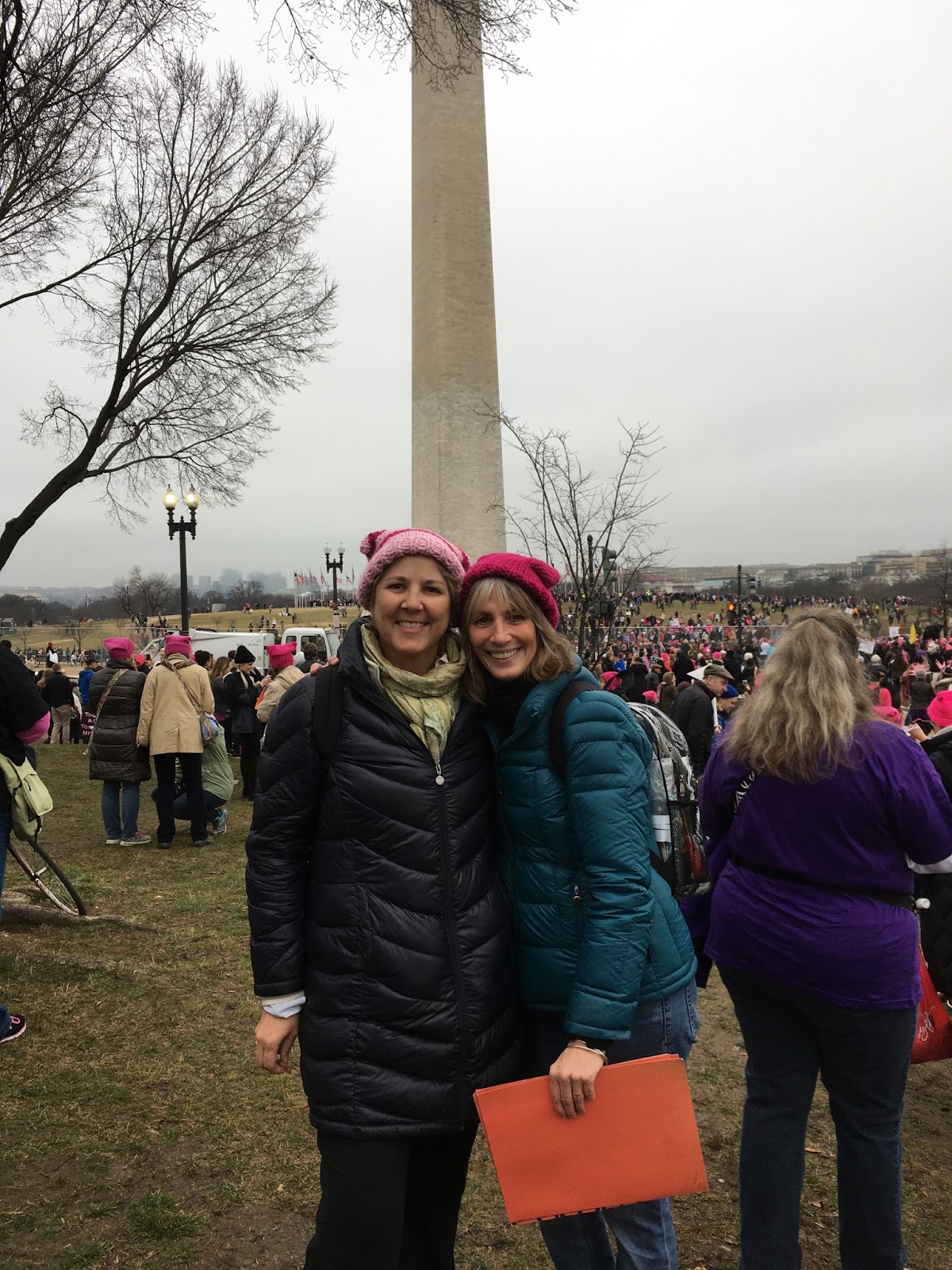
When we reached Washington, our bus lined up behind an armada of others angling for access to the lot at RFK stadium.  Francie, Jen, and I shrugged on our coats and plastic backpacks and donned our pink pussy hats.

A week ago, my friend Ben texted to say his wife Kristen had “been knitting pussy hats 24/7.” She was unable to attend the march and wanted to support the effort.  Would I like a hat?  And how many others were marching with me?  She would make hats for them too.  Jen grinned as she pulled hers on and said,  “I love that someone I don’t even know made this for me.” As we descended the steps to the lot, we marveled at the swarm of people in pink hats weaving among buses that tiled the vast lot.


Francie had printed out the march route from the Women’s March website, so with that as our guide, and thousands of other pink-hatted marchers before us, we headed for the starting point at Independence Avenue and 3rd.  As we walked, people leaned from windows and front stoops to wave and thank us for coming.  In one neighborhood, residents had posted black lawn signs bordered in white with quotes from Martin Luther King Jr: “We must live together as brothers or perish together as fools.”  I was surrounded by sisters, and quite a few brothers, bent on that unity. 


A sand-colored tank attended by two MPs was parked at an intersection.  One of the soldiers, a slight African-American woman, smiled at us, but her blocky, red-faced male cohort stared straight ahead, his expression gruff. We thanked them, as we did all police and MPs on duty that day, but his attention did not waiver.

Still, the mood was ebullient, and as our throng surged within sight of the impressive domed Capitol building, I felt my first real sense of where we were and the importance of our message.   “Are you listening?”   Francie called out.


In front of us strolled three young women garbed in cloche hats and ankle-length black coats with purple, green, and white sashes – suffragettes!  I trotted to catch up with them and timidly started to sing.  “We’re clearly soldiers in petticoats, dauntless crusaders for women’s votes…” They turned to smile at me, and, despite her youth, one woman knew the words. Together we warbled, our voices growing stronger together,

“Cast off the shackles of yesterday!
Shoulder to shoulder into the fray!
Our daughters’ daughters will adore us,
And they’ll sing in grateful chorus,
“Well done!  Well done!  Well done, sister suffragette!”


As we neared the gathering place, we could hear amplified speeches and cheers. Further down the block, filmmaker Michael Moore loomed large on a Jumbotron screen, and press vans lined the avenue. Shoulder to shoulder, ass to stomach, elbow to hip, breath to breath, people were packed tight.  Movement was difficult, but everyone was polite and cheerful, saying “’scuse me” or “Oops, sorry,” when a toe was scrunched or a cheek poked. It was past 11:00 AM, and the program had started at 10:00, with the march planned for 1:15. We had missed hearing Gloria Steinem and the march organizers, but we threaded our way closer to the screen to hear actress and activist, Ashley Judd.

Periodically, a whisper of a whoop would start among those assembled blocks away. It would roll toward us, gaining power and volume as thousands of people took deep breaths and joined in the wave.  It swelled around us, triumphant, joyful, defiant, unified, and we inhaled deeply then expelled a roaring whoop, sustaining it as long as we could, heaving it forward to those beyond us, who took it up and carried it further.  On and on it went, mounting, echoing, and fading, conveying the vast breadth of the exuberant multitudes.  

Since movement was limited, reading posters was a pastime both entertaining and empowering.  A sampling:

“Dissent is Patriotic”

“If you cut off my reproductive rights, can I cut off yours?”  (with a drawing of a pair of  scissors)

“Keep Your Rosaries off my Ovaries”

“I’m With Her” with arrows pointing in every direction.

“Free Melania”…and it’s varaiation:

“Melania, Blink Twice if You Need Help”

“Mr. Trump, if my vagina were a gun, you wouldn’t try to regulate it”

“A Woman’s Place is in the Resistance”

“Love, Not Hate, Makes America Great”

“A woman’s place is in the House…and the Senate” 

 “Make America Kind Again”


 Booming over the amplifiers, one of the speakers said, “No one is going to rise up and save us.  We are the ones we’ve been waiting for.”  And maybe that’s the silver lining to this election: complacency recognized for the danger it is.  Democracy requires an engaged populace, yet only 45% of registered voters bothered to turn up at the polls.  Trump’s poor character and bad judgment were apparent throughout the campaign season.  He hid nothing… well, except for his tax returns… and he was elected anyway.  This was our responsibility, and we’ve learned a hard lesson.  Now we know, we are the ones we’ve been waiting for, and we have to show up.  

“Tell me what democracy looks like!”  A call rang out, a single voice, and hundreds boomed in response, “This is what democracy looks like!”  All colors, all ages, all religions, and sexual persuasions.  This is what democracy looks like. In his farewell speech, President Obama urged the nation, “Our Constitution is a remarkable, beautiful gift…but it has no power on its own.  We, the people, give it power with our participation and the choices we make.”

The 1:15 march time came and went, and speakers droned on with poems and calls to the choir for equality, unity, rights, and healthcare. These were why we’d all traveled to DC, but wedged body to body with our fellow Americans, inhaling their exhalations while crushing dry stalks of sage and drooping tomato plants in the remnants of a crowd-pulverized community garden, the choir was eager for action.  “Oh no, another poem,” moaned someone nestled into my armpit. The poems were powerful and uplifting, I’ve no doubt, but we’d heard a lot of them, and it was time to go.  A baying cry went up and was multiplied by thousands. “March!  March!  March! March!”


 “Okay,” said Francie.  “Maybe we should get out of this crunch and try to get closer to the mall.”  Hm. True, but challenging.  Madonna started to sing “Express Yourself,” initiating a general bobbing – as close to dancing as the lack of space would allow - but even this slight shift eased the pressure and caused a ripple effect, as if many had the same thought at the same time. People started to edge toward side streets. 

One block over, the crowd was still immense and slow moving, as was true of the next.  Finally, we turned onto a street still surging with people, but we could stride and dance as impromptu drummers and bands thrummed on corners.  We advanced to the mall, a demanding but effervescent sea of people in wheel chairs, babies in backpacks, little ones in strollers, elders on canes, women - and quite a few men manly enough to wear them – in pussy hats. Those hats made a statement and evoked a sense of unity, and again, we were grateful to Kristen for her gift.


Eventually, we turned toward the mall, thrilled to spot the obelisk of the Washington Monument rising before us.  We merged onto the greenway with the flood of pink-hatted people as they swept in from side streets, and lent our voices to that soaring, soul-lifting whoop as it rolled in with them.


 A massive, tiered, brown edifice reminiscent of a barge hulked on the lawn to our right as we climbed toward the monument: the new African American museum.  Such a contrast to the classic architecture of the buildings around us. 

“Why did they go with that style?  It doesn’t fit at all,” said Jen.

“Maybe that’s the point,” Francie offered.

“Yeah. Slavery didn’t fit in with American ideals either,” I said.     

Down the lawn, beyond the pulsing sea of people, posters, and pink hats, gazed the windows and portico of the White House.  The Obamas had emphasized that this was the people’s house.  Now the people clamored for attention, but it seemed Trump had closed the door to many.  Like Francie, I hoped Congress was listening and watching.

“Tell me what democracy looks like!”

“This is what democracy looks like!”


In their wisdom, the event organizers figured clenching had taxed muscles as much as marching. Upon cresting the slope between the iconic sites of our nation’s capitol, a phalanx of port-o-potties – probably fifty of them! – welcomed weary protesters.  The lines were long, did we really want to wait?  Despite my worry about the discomfort of holding, I’d opted to sip water sparingly, and that strategy had saved me. Still, “Don’t pass up the opportunity to use a bathroom” was a pointer in the protest guidelines, and we embraced it.  As was true of the march as a whole, even people desperate to go were patient and polite, awaiting their turn and making sure they weren’t cutting in front of anyone else.    

It was 4:30 and we were due back at our bus by 5:30.  I was loath to leave as people continued to flow onto the mall chanting and proudly brandishing posters.  “Women’s Rights are Human Rights!”  “Black Lives Matter!”  “Protect the Planet!”  “Love Trumps Hate!” Determined. Buoyant. Powerful. In my heart and head, this is what America looks like.  What I want it to look like.


Moving against a tide that rushed as strongly as ever toward the mall, we headed down Independence Avenue toward RFK stadium.  Our hiking boots had been comfy, our plastic backpacks light throughout the euphoria of the day.  Now, we limped, exhausted.  I took off my backpack and carried it in front of me to relieve my knotted, aching shoulders.  Jen checked her Fitbit and it registered 9.1 miles walked.  Felt like it. Still, homeowners waved from their windows and yards and said, “Thank you for coming!” and that helped.

Again we passed the two MPs on duty before the sand-colored tank and thanked them.  The woman now held a bouquet of yellow flowers.  Her gruff companion seemed softened by the day’s events.  He smiled broadly and said, “You did good, ladies.  Safe trip home.”