Dave’s grandfather, Michael, was a boy when his uncle from Rome came for dinner at the family home in Caserta, Italy. Business was good, the uncle announced, and he needed another street vendor to help sell shirts. From the head of the table, Michael’s father surveyed his children until his gaze fell upon his eight -year-old son. “Take Michael,” he said. “He eats too much.”
Perhaps, in part, it was that forced early independence that led Michael, like thousands of Italians in the early 20thcentury, to seek new opportunities in America a decade later. By the time the Statue of Liberty came into view, Michael had met his future wife, Lucia, on board.
Michael and Lucia settled in Worcester where he became a tanner preparing raw cow hides, while Lucia cooked, cleaned, and raised the family. As often happens, their children were staunchly American, and had little interest in the language and culture their parents left behind. However, beyond the barrier of their grandparents’ mystifying inability to speak like normal people, their grandchildren, Dave and Steve, found life at Nanny and Grampa’s house fascinating.

There was Grampa’s homemade wine served in jelly jars, shelf upon shelf in the basement of canned vegetables from Uncle Jack’s garden, and Auntie Carmela’s heavenly pasta sprinkled with crumbled nuts. When Rinny, the family dog, brought home an unlucky rabbit, Nanny praised the pup, and served the rabbit for dinner. Nothing was ever wasted, much less perfectly good meat.

Auntie Carmela always told Dave he had the map of Italy all over his face, and when Trinity College offered a semester in Rome, it was a chance to find out. But when we departed in 1973, we flew, never glimpsing the statue that had welcomed Dave’s grandparents.
At age 69, I sheepishly confess, I’d never seen Lady Liberty up close. So, when our son Tucker invited us to join him, his wife Lisa, and our grandchildren Paul (6) and Lexi (3 ¾) on a visit this summer, Dave and I were all over it.
Given their ages, it was unlikely the littles would be moved by the statue’s symbolism nor her impact on those escaping persecution and economic hardship as she seemingly rose from the sea in welcome. As yet, Paul and Lexi knew nothing of the Lady’s role in greeting their great-great grandparents, but we hoped the fun of the ferry ride, the whir of helicopters overhead, and a glimpse of massive toes would captivate the kids in ways that heritage, freedom, and opportunity would not.
It was sweltering the day of our visit, and we were grateful Lisa had insisted on early morning tickets. For most of our time on the dock, we were shielded by an overhang, but before the ferry was even in sight, crew members waved, shouted, and hustled the prospective passengers, herding us like driven cattle onto the sun-baked dock to await transport. I wondered how similar this discourteous boarding might have been to the start of Michael and Lucia’s journey. They spoke no English, and all that awaited was unknown. What courage to endure the jostle and push, and the lengthy voyage over uncertain seas.
As we waited in the heat for the ferry to pull in, the kids were amazing. They really were. But despite our efforts to distract them with glimpses of ships, seagulls, and a treasure trove of coins tossed into gullies along the docks, Lexi and Paul were wilting. Dave hoisted Lexi onto his shoulders and when he tired, transferred her to Tucker’s. When she was finally set on her feet, she gave up and lay down, not whiney or grumpy, mind you, just ready to rest in the shadow of encircling grownups. True to form, Paul used his time constructively, playing chess on Tucker’s phone.
When the ferry arrived, the staff urged us forward. It was unnerving: the rocking of the boat, the shifting of the gangplank, the press of masked passengers, the unrelenting heat, and the insistent staff. “Keep moving, keep moving. Step up! Step Up!” Again, I imagined Michael and Lucia and all the anxious immigrants like them hoping this gamble was a move forward, a step up.
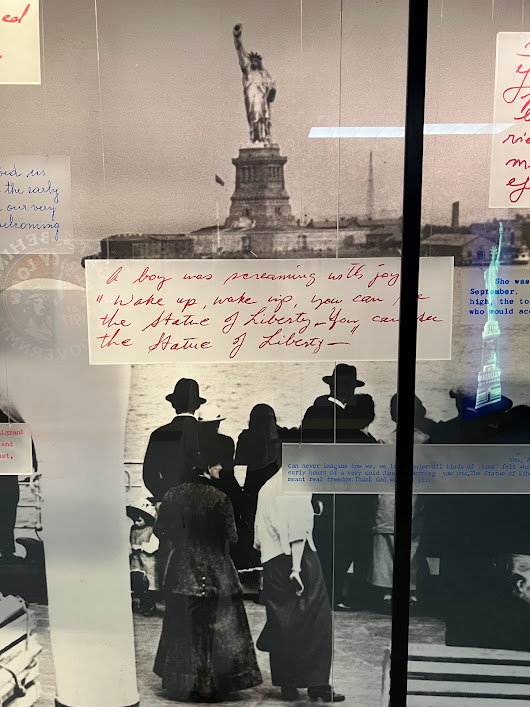
Blessedly, we found seats inside, out of the sun. The trip to the island was quick, and as we drew closer, despite my lifelong citizenship and lack of desperation, my first glimpse of Lady Liberty filled my heart with yearning. Unlike the waves of immigrants arriving at the Statue’s feet from 1886-1914, the pang in my heart grew from the beauty and poignancy of the Statue’s message, and America’s failures to meet her promise of refuge. Thoughts of Japanese internment camps; ships turned back to Nazi Europe; and most recently, caged, weeping children separated from their parents weighed on my mind.
Much as it is my way to sully pleasures with painful reflections, it is the kids’ way to find fun where they can. Soon after docking, we came upon a water system spraying droplets and mist over the brick walkway. A delightful respite on this steamy day! Visitors of every age, size, and color, speaking countless languages, frolicked, giggled, soaked, and took selfies in the sparkling shower of water. True to form, Paul was primarily intrigued by the hose hook-up.

Whether it was mindfulness of the kids or the aging grandparents, Lisa, wisely, had not purchased tickets for the crown, and opted only for the pedestal. High enough! Dave and Lisa braved the 195 steps while Tucker, Paul, Lexi, and I waited in line for the elevator.
For Edouard de Laboulaye, the end of slavery and America’s Civil war signaled an inspirational turning point with potentially global implications. With sculptor Auguste Bartholdi and Gustave Eiffel, he set out to shine the light of freedom around the world with a gift to the newly re-United States in the form of this monumental statue. In October, 1886, “Liberty Enlightening the World” was re-assembled on Bedloe Island. As time passed, the statue came to mean something other than enlightenment. Her torch, her face, and the sunburst of her crown were beacons of freedom, signs of arrival in a safe place. Lady Liberty came to symbolize America itself.
As it should be, the walkway around the pedestal is surrounded by a wall too high for Paul and Lexi to see beyond. So Tucker and Dave held them aloft while I fluttered about, anxious at mental images of a child going over the side. Better to keep our stay at the pedestal brief, and hustle along to the shelter of the air-conditioned museum.

Vintage souvenirs and posters, and a variety of artistic interpretations of the statue were on display. While Paul and Lexi were drawn to climb and probe massive models of the Lady’s face and foot, I searched for and found the original bronze plaque bearing Emma Lazarus’s poem. “The New Colossus” echoes the vision that motivated de Laboulaye and Bartholdi: “Give me your tired, your poor, your huddled masses yearning to breathe free.”


For our littles, and perhaps their adults as well, sitting was our current goal. Three darkened theaters, thoughtfully carpeted, offered the refuge we needed. Lexi sat in my lap and Paul snuggled with Tucker as we sat on the floor. Churning waves rolled across the screen as an audience of immigrants’ descendants listened to the story of the Statue of Liberty and her role in the lives of their ancestors.


