Showing posts with label George Washington. Show all posts

Saturday, July 6, 2024

Revolution... and the Man: Mount Vernon Part III

Surprisingly, when Washington returned to Mount Vernon for good after long years away as Commander of the Continental army and then as President, his finances were unstable. His policy had long been to keep enslaved families together, and as his “unavoidable regret” over slavery grew, he had vowed to no longer buy or sell humans, so there was no gain to be made there. Steve Bashore, master distiller, told our group that, knowing the perils of liquor, Washington was disinclined to encourage that industry when his Scottish farm manager, James Anderson, urged him to open a distillery. The estate was not producing enough to offset expenses, however, and when Washington discovered he could turn a much-needed profit from whiskey sales, he cautiously delved into that enterprise. 

                                                                      
After a delicious lunch of salads from the Mount Vernon Inn, it was time to visit the re-enactor encampment and browse the vendor’s wares. While my friends and I wished to support the distillery, we had not indulged in any noon whiskey tippling, planning instead to purchase some later at the museum gift shop. In the meantime, distant drumbeats bid us hasten to the field of battle. 

The Crown Forces were lined up at attention, impressive in striking red uniforms, targets as bold as a cardinal against snow. On command, they broke from the line in groups of six to wheel about, maintaining formation, to march to the far end of the field. Hup! Hup! Hup!

While Colonial Massachusetts had militias, for the most part, the soldiers of the Continental army were untrained, undisciplined, and unused to following orders, a source of tremendous frustration for General Washington. The re-enactors in the buff, blue, and cream uniforms of the Continental soldiers seemed similarly at ease compared to the strutting scarlet enemy. 

The sky was heavy with the threat of rain, and an announcer made clear that wet gun powder was no friend to war. As onlookers in capes tugged them closer and those in jeans raised umbrellas, the Continental soldiers loaded canons as the Red Coats closed in. Amid flashes of musket fire and billowing smoke that all but engulfed them, those engaged on the field appeared as ghostly as the long dead men they represented. 


After the re-enactment, it was fitting that we visit the Washingtons’ tomb. Every day at Mount Vernon, a prayer is read, and a wreath laid on the President’s sarcophagus. During our visit, we were given that honor. Washington himself chose the site and the design for the tomb where he and Martha rest. Unlike others who extol themselves with grand monuments and epitaphs, his bears no dates, no weighty words, and no mention of achievements… simply his last name.


When the MVLA began their fundraising campaign, the country was still young, and the divisions that led to the Civil War were simmering. In America, no one was thinking to preserve historic sites… until Louisa Cunningham spotted the deteriorating mansion on the rise above the Potomac. In saving and restoring Mount Vernon, the preservation movement itself was launched. 

It was late afternoon when Dr. Susan Schoelwer, Executive Director of Historic Preservation and Collections, met us at the mansion. As we walked around to the piazza facing the river, I spotted a tourist from a bygone century, a member of the Royal Highland Regiment perhaps, craning to peek in the dining room window. How many different frocks, bonnets, boots, and overcoats have clothed those who explored these grounds and peeked in the windows in the years since The Ladies preserved the property? 

On the far side of the house, a flock of geese wandered and browsed the lawn as, with a sweep of her arm, Dr. Schoelwer gestured to the opposite bank. It was lush and green with no sign of human intrusion, “Just as the Washingtons would have seen it,” she said. “The Ladies felt this was an important feature, and through outright purchase and conservation easements they have ensured this view would remain.” 

We began our tour of the mansion in the front hall. I gazed up the staircase and into the adjacent rooms and mused about the many homes, taverns, and inns that boast, true or not, “George Washington slept here.” My nose prickled, as it did so many times during our visit, in thinking this was the man’s home.

While most of the original furnishings were dispersed to family members or sold after Martha Washington’s passing, one item, weighty in fact and symbolism, has remained in the house since the President placed it in a display case in the foyer. Presented to Washington by the Marquis de Lafayette after the demolition of the notorious prison during the French Revolution, it is the key to the Bastille: “a tribute I owe as A Son to My Adoptive father, as an aid de Camp to My General, as a Missionary of liberty to its patriarch.”  


As Dr. Schoelwer led us from room to room, commenting on the research commissioned by The Ladies that led to the upholstery patterns and surprisingly vibrant paint colors, I tried to conjure Washington as the human who lived here. In paintings and statues, he is frozen, regal as the king he refused to be. Since he is always portrayed tight-lipped, I wondered, was he much of a talker? The curse of terrible teeth caused him constant pain, and his spring-loaded dentures must have made speech a challenge. No doubt people expected profundity whenever he opened his mouth, a pressure he probably wished to avoid.  

Correspondence from early in his presidency indicates that he would have preferred to avoid being president as well. As he approached the day of his inauguration, he wrote to Henry Knox that he felt like “a culprit going to his place of execution.” To Edward Rutledge, he worried that he would not meet the expectations of his fellow Americans. The man was nervous, like any of us would be.

Toward the end of the tour, we entered the bedroom in which Washington died. Against the wall under four portraits of the Washington grandchildren, was a small desk. “Although Martha burned all their correspondence, two letters from the President to his wife were discovered behind the drawer in this desk,” said Dr. Schoelwer. “One told her of his call to head the Continental Army; the other of his election to the Presidency. Given their significance to the two of them as a couple, I think she held on to them on purpose.” 

Dr. Schoelwer then told us about a postscript to one of the letters in which Washington mentioned that he had purchased some fabric Martha had requested, and he hoped it was what she wanted. 

“He was shopping for her!” exclaimed Dr. Schoelwer.  

And, like any husband, hoped he had done the right thing.   


While Washington was widely esteemed and felt to be the one man who could, perhaps, unite the new states, this remained a challenge. Within his own cabinet, Thomas Jefferson was wary of centralized government and the President’s popularity and sought to undermine him, and the heated debate over slavery already threatened to divide the fledgling nation. Washington’s Presence was his power, and he knew the people needed to be convinced. To familiarize himself with the customs of the formerly separate colonies and to bring that personal power into play, Washington undertook several lengthy tours after his inauguration. 

Over the years, the towns he visited have perpetuated legendary tales of his stay. How many are accurate? Historian and writer Nathaniel Philbrick was curious, and in his book Travels with George, he recounts his findings as he, his wife Melissa, and their dog, Dora, followed the routes Washington took from 1789 to 1791. 

One anecdote seemed, to Philbrick, almost ubiquitous. Whether from the mouth of a disappointed youngster expecting to see a god-like vision or from Washington himself when encountering the high expectations of his countryfolk, the line “he’s just a man” surfaced countless times. Because of the repetition, Philbrick doubted the tale…but it makes sense to me. As my friends and I strolled the grounds of his home, gazed at his books and belongings, and stood by the bed where he died, I was inclined to drop the “just” but marveled at what he accomplished, human as he was. In walking away from the presidency, he left to succeeding generations and leaders his legacy and challenge: to have the integrity, patriotism, and belief in the country’s ideals to do the same. 


 For Further Information:

Johnson, G.W., Epilogue by Ellen McCallister Clark. (1991). Mount Vernon, the Story of a Shrine, Mount Vernon Ladies Association  

Philbrick, N. (2021). Travels with George. Viking

Thompson, M. (2019) “The Only Unavoidable Subject of Regret,” George Washington, Slavery, and the Enslaved Community at Mount Vernon, University of Virginia Press


Wednesday, June 26, 2024

Evolution of a Leader... and a Republic: Mount Vernon Part II

Gracious mansions, handsome youths in uniform, flirtatious belles in lavish dresses, and devoted servants: Gone with the Wind’s portrayal of 19th century plantation life seemed romantic when I was 16. A spring vacation trip to South Carolina with Andy to visit my grandmother added to the mystique. The heady scent of gardenias, trees shrouded with gray-green Spanish moss, and tales of destruction during Sherman’s March to the Sea cemented my teenage southern sympathies. 

How had I missed the stain of slavery permeating those impressions? How could a country touting equal rights and liberty condone it for over 200 years? How could George Washington, a man idolized for his virtue, have been a slave owner? 

In my 1960’s American History classes in Pennsylvania, we were taught that the roots of the Civil War were largely economic, a collision between the industrialized North and the agrarian South. Beyond that, we were told, pointedly, that slavery was not the cause: the war was fought over states’ rights. True enough, but, as Confederacy vice president Alexander Stephens proclaimed in his Cornerstone Speech, the right so fiercely pursued by Confederate states was the right to own humans. 

Why did my teachers hedge?

Our decade is not the first to dodge “discomfort” while teaching the young. Was it deemed too discordant for a country founded on equality and liberty to delve into the brutality and hypocrisy of slavery when televisions were broadcasting into American living rooms scenes of violence against peaceful civil rights protesters? Were those images already tarnishing, to a distressing degree, the heroic post-WW II image of the United States? Could be. From the country’s founding, denial has continued to prove dangerous in masking past shame, allowing the resulting wounds to linger, and impeding the attainment of democratic ideals.  

President Washington was born into a world where denial thrived as fortunes flourished due to enslaved labor. While field hands were kept cowed and at a distance, the intelligence, talents and humanity of house servants, skilled seamstresses, weavers, carpenters, cooks, and farmers would have been evident. One must imagine, for those of heart and integrity such as Washington, a constant struggle of conscience. 

Washington’s thinking, and, equally important, his willingness to voice it, evolved during the Revolutionary War. In the courage of Black soldiers, in his bond with his valet William Lee, and in meeting accomplished Black – female! - poet Phylis Wheatley, it would have been ever harder to deny what was apparent. In 1786, he said, “There is not a man living who wishes more sincerely than I do, to see a plan adopted for this abolition of [slavery] but there is only one proper and effectual mode by which it can be accomplished, & that is by legislative authority.” 

In his will, finally, he made peace with his conscience and freed his slaves. 

                                                *

On Saturday, as predicted, my friends and I woke to a light drizzle. In raincoats and sensible shoes, we left the Quarters, enjoying the scent of wood smoke wafting from the re-enactors’ encampment. George Washington as farmer and gardener was our focus, and Dean Norton, Director of Horticulture, was our guide. 

With eyes bright and every gesture conveying his knowledge and love of the glorious gardens and plants surrounding us, Dean was a font of anecdotes and information acquired during his fifty years at Mount Vernon. He led the way beneath towering trees planted by the first president and, as we strolled the brick path bordering thriving lettuces and prickly artichokes in the vegetable garden, pointed to the spot where he, Dean, had proposed to his wife. 


George Washington loved his home and grounds and was meticulous about documenting everything, including the timing and success of different plantings. He was fascinated by innovation and science, and when wrenched from home and family by duty to this new country, he wrote constantly to his farm managers with questions, instructions, and adaptions. Every change in approach brought new burdens for the enslaved, some of whom, one must note, also knew the agony of being wrenched from home and family. But Washington drove himself hard in all he undertook and demanded from his laborers the same devotion to work. 

One of our pilgrimages was to the memorials dedicated to Mount Vernon’s enslaved individuals. Some are buried in unmarked graves on a wooded rise not so far from George and Martha Washington’s tomb.  


                                                   *

For over three centuries, presidents of these United States have commissioned or been honored with presidential libraries. The country’s first president - he who accepted the challenge of a radically new democracy and set the precedent honored until 2020 of a peaceful transfer of power - had none. The Mount Vernon Ladies Association (MVLA) wished to remedy that, and in 2010 launched a fundraising campaign to construct a library. They raised $106.4 million, all from private donors, and broke ground in 2011. The library opened in September of 2013, and in 2024, with Andy and archivist Rebecca Baird, we were invited into the inner sanctum.

Shelves of 18th and 19th century books lined the room, some formerly owned by the Washington family, others, actually the President’s. In one, held open by a looping “book snake,” Washington had written his name in the upper right corner of the title page, just as I have done in my books any number of times. Another volume, a replica of an original owned and acquired by the MVLA through heated bidding at a Sotheby’s auction, was Washington’s personal copy of the Constitution. Did I imagine the glow that seemed to surround it?     

And how to explain the aura in the conference room. Was it the lighting? The warmth of burnished sycamore paneling from a single three-hundred-year-old tree? Or was it the busts of the Founders, elevated on high, Washington presiding as Jefferson and Hamilton eyed each other warily from their plinths across the room? 


Encircled by images of those whose vision shaped our government, I sensed something beyond solemnity. Given today’s divisiveness and threat to Democracy, I was reminded of Benjamin Franklin’s charge in response to Elizabeth Willing Powel’s question in 1787: “Well Doctor, what have we got? A republic or a monarchy?”   

“A Republic, if you can keep it,” he replied.

Can we? Are we, the voters, going to honor that charge and prevent a Project 2025 styled dictatorship? 


Wednesday, June 12, 2024

If the Men Won't, "The Ladies" Will: Mount Vernon, Part I

What were her thoughts the day Louisa Cunningham spotted the derelict mansion on the grassy rise above the Potomac? She’d been visiting her daughter in Philadelphia and was probably preoccupied, worried about Ann Pamela’s declining health. Ever since a riding accident caused a spinal injury when she was 17, Miss Cunningham’s symptoms had worsened, and in 1853, in her mid-thirties, she was an invalid, tormented by chronic pain. While discomfort, mercury-laden purgatives, and laudanum would have agitated humans of any gender, her physician, a specialist in women’s “nervous diseases” recommended she rest and avoid mental stimulation. For an intelligent, once active young woman, those instructions must have been a stultifying sentence. 


As was tradition, at a certain point, when the steamboat bearing Ann Pamela’s mother chugged by on the river - the wind luffing her long skirts, gulls crying, water slapping the hull – the captain clanged the ship’s bell in tribute. One can imagine Mrs. Cunningham’s smile of anticipation fading as she turned her head and gazed at the peeling paint and rotted fences of George and Martha Washington’s former home, Mount Vernon.


But her dismay led to inspiration: a way to engage her daughter while serving the country. Miss Cunningham had long been fascinated by George Washington, and despite the doctor’s orders, it was precisely mental stimulation, a mission, that might intrigue and uplift her.   

Unlike his famous great granduncle, John Augustine Washington III, the current owner of Mount Vernon, had been unable to manage the estate. Even though enslaved people continued to provide the labor, this particular Washington was unequal to the challenges posed by crop failure, erosion, and lawn-trampling, souvenir-stealing tourists. He wanted to sell but recognized the property’s symbolic importance to America’s foundation and wished to preserve it. Surely the Commonwealth of Virginia or federal government would be willing to invest the $200,000 Mr. Washington had decided to ask?

No. Both declined.   

The pain-plagued Miss Cunningham, however, embraced the cause, saying, “If the men of America are allowing the home of its most respected hero to go to ruin, then why can’t the women of America band together to save it.” She solicited women of means, contacts, and determination and formed the Mount Vernon Ladies Association (MVLA) to raise the money required for the purchase.


When Miss Cunningham and her committee launched their initiative, women could not vote, and married women could neither buy nor own property. Female intellect, desires, and efforts were generally dismissed or patronized. Despite the legal limitations on all but white, land-owning men, The Ladies persevered… and succeeded. The MVLA raised the money and bought the property. They have preserved, maintained, and owned it ever since. 


I’d never been to Washington’s home nor heard of the MVLA, and when my high school roommate, Andy, mentioned that she was on the board of Mount Vernon, I asked if I could hitch a ride during one of her trips down. Graciously, she agreed and extended an invitation to several other former classmates. Six of us were able to go, and we settled on dates in early May that coincided with a Revolutionary War Weekend at the estate.

Andy and I drove south together, and as we neared our destination, we swung past the Mount Vernon Inn, the walkway to the visitors’ center, and a series of parking lots. I saw no glimpse of the mansion itself as we pulled up to a locked security gate. Andy spoke into an intercom and was greeted by a disembodied male voice. The gate swung wide to admit us, and I surmised that this was not the usual entrance for most visitors. 

While planning the excursion, Andy had said we’d be staying on the property. 

“On the property?! At Mount Vernon?!” I could barely contain my glee.

“Yes, in the Quarters. It’s nice. Plenty of room.” 

In the days ahead, there would be much to learn about the enslaved who’d worked for our first president, but despite the name, our accommodations had not once been theirs. If only it had, for the Quarters were lovely, with comfy bedrooms, a living room, and a well-stocked kitchen. This was the residence of the regent and vice regents, “The Ladies” of the MVLA, when they came to meet and work. At that time, I didn’t know their story nor the critical role they continue to play… much less that Andy was the vice regent for Massachusetts.  

The afternoon was warm and sunny, but the forecast for the rest of the weekend was grim, so once everyone in our group had arrived, we headed out for a stroll around the mansion grounds and gardens. 

It has been over fifty years since the six of us were at school together. A host of movements – anti-war, feminism, civil rights, environmental activism – colored those times, and as girls, we were buoyed by the conviction that our generation would get it all right. For a while, it seemed we were making headway, and then… Well, it has not gone as we believed it would. So much has changed, yet, as I looked into the dear faces around me, I still saw the girls they had been. And on that day, reflected in each, was the same euphoria and near disbelief I was feeling, that we were together … at Mount Vernon.   

We strode briskly along in our vests, sweaters, and slacks: weather-appropriate, twenty-first century garb; not the norm, it turned out, during a “Rev War Weekend.” Outnumbered we were by those in capes, breeches, tri-corn hats, and sweeping skirts as hundreds of re-enactors bustled about pitching tents and arranging displays of antiques and colonial reproductions. We were excited about the tours Andy had lined up for the following day… as well as a chance to visit those vendors.  


Friday, June 30, 2017

Expressway to Revolution

Perhaps it’s the popularity of the Broadway show “Hamilton,” or whispers from the spirits slipping unseen through our 1780’s house. Or… maybe it’s my despair at the frailty of the Constitution’s checks and balances in fending off the maelstrom of policies of an administration of aging white men unconcerned about the morale of the country or the health of the planet.  Yeah.  That might be it.  Whatever the causes, lately I have fled to history and the refuge of events resolved. Washington, Jefferson, Hamilton, and Lincoln have been my between-the-pages companions.

So, when I learned that a Museum of the American Revolution had opened in Philadelphia, I was eager to visit.  While home with my mother, I asked if she’d be willing to check it out with me.  Trudging brightly lighted galleries flanked with glass cases can tire anyone, and I know Mom’s not a fan of lengthy excursions, but she must have detected the plea in my voice, and trooper that she is, she agreed.

She held her concerns about hiking those halls to herself, and I kept quiet about my own worry:  city driving.  My experiences behind the wheel in big cities are limited, and have occurred only under duress.  The first, 24 years ago, was when my friend Carey was in the hospital in NYC for an emergency operation.  I was navigating those New York streets pretty well, feeling a little cocky, in fact, as I maneuvered my car, flinching only slightly at honking horns and aggressive drivers.  When I neared the hospital, I thought I had it nailed.  Confidently, I took a left turn… onto a one–way street.  OMG!!!  Cars were coming straight at me!  There was no place to go but the sidewalk!  Yes!  The sidewalk!  And that’s what I did!  Like some crazy cabbie told “Follow that car!” I cut the wheel and did a U-Turn… onto the sidewalk!  Good lord.  You understand my current reluctance…

But this was a trade-off:  a morning hike through the museum for my mom, and Lea as chauffeur through the narrow streets of Philadelphia.

Both WAZE and MOM were my guides.  We wanted to beat the tourist crowds at the museum and so, headed in just after rush hour.  The Schuylkill Expressway is a beautiful route along the river, but traffic-wise, it is no treat no matter the time.  I programmed the GPS to help us once we needed it, but we took back roads for as long as possible.  Unaware of our plan, the WAZE lady with her calm, authoritative British voice tried to convince us to take the Expressway… and Mom contradicted her every direction.

“Go left,” said the WAZE lady.

“Not yet,” said Mom.  “Go straight.”

“Go left,” said the WAZE lady.

“No,” said Mom.  “I think you’ll want the second light up ahead.”

“This one?”

“No.  Not yet.”

“Go left,” urged the WAZE lady.

I felt like an eager, over-anxious schoolgirl perched well forward in my seat, both hands gripping the wheel, posture erect, hoping to please everyone, but given those competing commands, unable to.

Once we reached “town,” as my parents call Philadelphia, we gave WAZE lady the lead. I thought I discerned a smug satisfaction in her tone as she led us unerringly to a parking lot a block from the museum.  “You have reached your destination!” she announced.

With the help of my two guides, I safely delivered us to the heart of early America, so my burden was lifted.  Mom’s museum march still lay ahead. 

We walked down a lane flanked by centuries-old brick buildings.  I noted an inviting tavern and filed it away as a future possibility. Several blocks ahead, I spied Independence Hall and, having not crossed its threshold since a field trip in fifth grade, felt a tug of yearning.  That stop, and the tavern, would have to wait. 

Acquiring our entrance tickets had been another minor challenge.  For years, I had taken pride in being one of the last people on the planet to carry a flip phone and gave in only when my grandson was born.  With its text, phone, GPS, and photo components, my iPhone has opened a new world.  I had no need for its other fancy capabilities, thank you very much, until it was suggested that museum tickets be purchased in advance. The day before our visit, therefore, I called Dave in Connecticut and he talked me through the process using Safari and Google. Neophyte that I was, I was wary, and as it turned out, rightly so. 

While the Viator ticket site assured me, “Your booking is paid for and confirmed,” no voucher appeared when I tapped “View Voucher,” nor when I checked my emails. After several convivial chats with Ella at the museum, Tamara at Visa, and Sarah at Viator, I was assured two tickets would be waiting for us at the will-call desk.  And Alleluia, they were.  Another potential problem overcome.

Tickets clutched tight, we turned to see a stately, but formidable, twisting staircase to the second floor galleries.  “There has to be an elevator, Mom.  There are people in wheelchairs waiting in line.”

“I know, but this will be fine.”  At 85, few things daunt my silver-haired mother, and when they do, she’s determined to best the circumstances.  She took hold of the bannister and, resolute, climbed right up. 

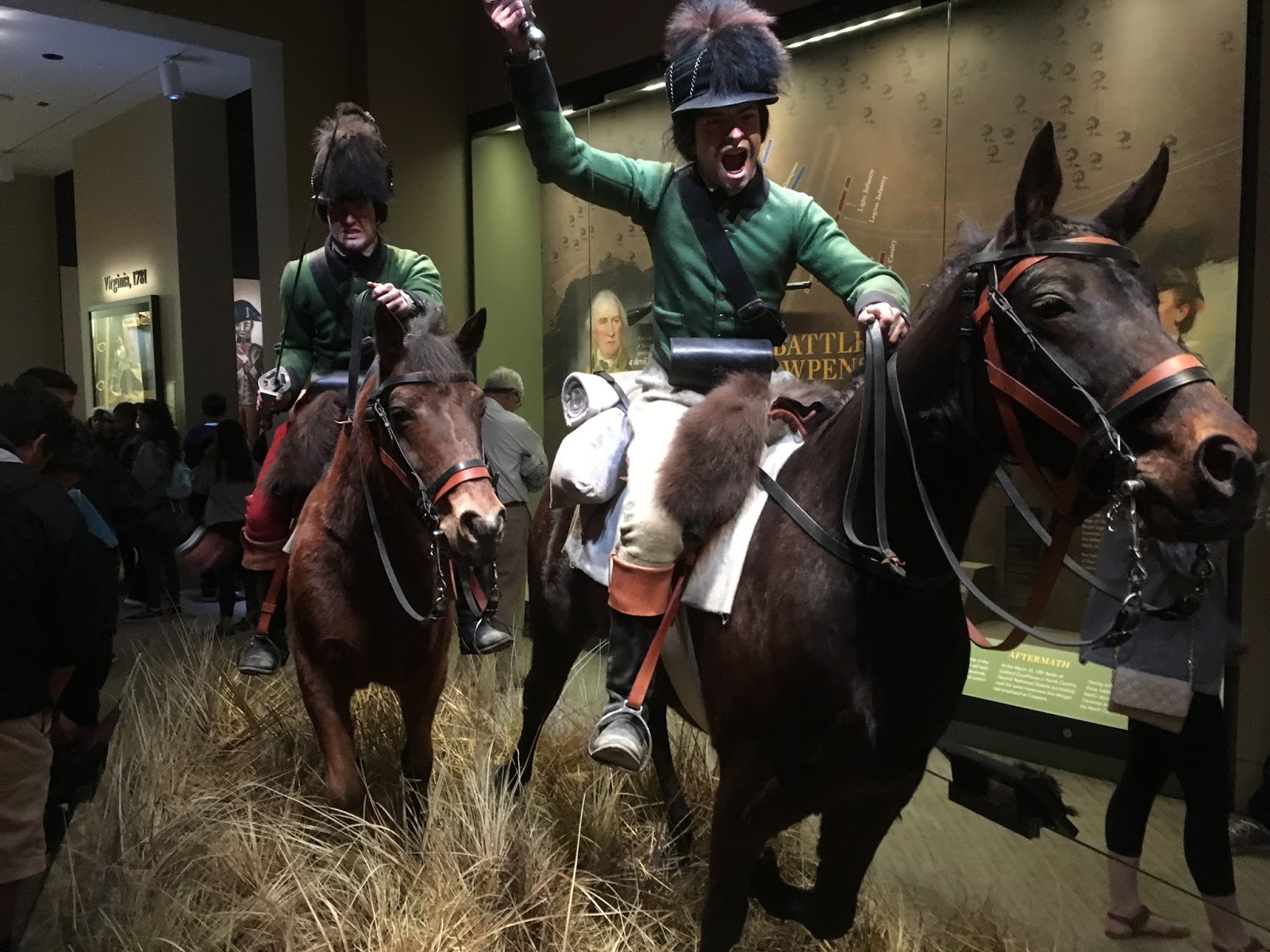
I loved the museum.  Open only a month, the exhibits were a mix of traditional glass cases, three-dimensional vignettes, and interactive digital screens. I could imagine the excited volley of ideas in the brainstorming sessions that led to an entire room dominated by a full-size privateer ship, available for bow to stern clambering; a movie immersion in the Battle of Brandywine where smoke and the smell of sulfur filtered into the room as we “charged” through tall grasses with a battalion; wall-sized time-lines on which the touch of a finger to an event or document generated a blow-up and history of that item; and two real stuffed horses, mounted by British dragoons, frozen in their race.  Dramatic as it was, several visitors wondered aloud how those horses died.  A nice lady assured us that the horses lived a full life on a lovely farm and died a natural death.  Mom and I would have liked to know their names.


Slavery, the “peculiar institution” that Lincoln abolished and that troubled our Founding Fathers’ consciences (clearly, not enough) was highlighted throughout, more than I expected given the usual coverage of the Revolutionary period. The historians who planned this museum wished visitors to contemplate the enigma of those who fought for their own equality and unalienable rights while holding others’ enslaved.


One of the interactive screens provided images of a number of historic people and events and asked viewers to consider “What would you do?”  In one case, Eve, a slave for the wealthy Randolph family of Williamsburg, feared her son George would be sold, so mother and son fled to the British lines in search of the freedom they promised. They arrived to find the British camp infested with smallpox.  Eve was confronted with a terrible choice: stay and chance disease, or return to the Randolphs where punishment, enslavement, and the possible sale of her boy awaited. 

What would you do?

I stood before the lighted panel and pondered.  I‘d learned about Eve when Dave and I visited Williamsburg two years ago.  I tried to conjure this flesh-and-blood woman whose life was unpredictable and beyond her control.  I thought about being owned… owned by a master who could sell my son.  Eve was so respected in the Randolph household that she carried the keys to almost every lock in the house, but she could be sold like a bureau or table if the master wished. I pushed the button marked “Stay in the British camp.”

In a flash, the screen told me my choice matched Eve’s.  But the British lost the Battle of Yorktown… and Eve was returned to slavery.

Several years ago, the Fairfield Museum hosted a traveling exhibit about Abraham Lincoln.  A pen used by the Great Emancipator to sign the document that freed the slaves was in a lighted glass case, low to the ground.  In awe, I sank tearfully to my knees – again, the case was low, but still, the actual pen once held by that extraordinary man and employed to such purpose?  Praise God and thank you, Mr. Lincoln. I respect General Washington, and enjoyed seeing his blue sash, leather duffle, and war tent, but Lincoln holds my heart. 


In 1776, Thomas Jefferson wrote of equality, rights, liberty, and the pursuit of happiness while owning his fellow humans.  Just shy of 100 years later, Lincoln took a step toward upholding those assertions.  To this day, we falter in living them.  The Revolution is behind us, its principles touted and enshrined, but abroad and at home, Americans continue to fight.  Peace, respect, tolerance, and compassion are sacrificed because of distrust… oh, and for oil, money, and power. I ache at our willingness to kill and be killed for such things.

Mom had marched ahead of me, her hike complete, and was waiting on a bench in the hall. As I exited the final gallery to meet her, I passed through a wall of mirrors with a sweeping sign in large gold letters:  MEET THE FUTURE OF THE AMERICAN REVOLUTION.  The founders wrote often of their responsibility to posterity; we must give more thought to the generations ahead whose well-being depends so fully on what we do now.

Or, what will they have to say of us?