Showing posts with label Thomas Jefferson. Show all posts

Monday, November 24, 2025

What Would His Father Think?

Dave was enjoying his wine in front of a cozy fire when I returned to our table in the Tap Room of The Dorset Inn.

“Check this out,” I said, handing him a card I’d selected from the display in the hall outside the ladies room.  

He glanced at the photograph of a sprawling stucco mansion and flipped the card over. “Hildene,” he read, “the former home of Robert Lincoln, Mary and Abraham’s son,” the only Lincoln child to survive into adulthood. 

History has portrayed Mary as desirous of luxury and fine clothes, but her husband as retaining the air of his humble beginnings. I’d never envisioned a mansion such as Hildene in connection with the Lincolns, but Mary would have loved it, and I wanted to see it.  We decided to visit the next day, on Tuesday.

Since we are Sylvestros, it was not surprising to find a gate barring our entrance and Hildene closed. A Google inquiry in advance of our visit would have been wise, but my belated search reassured us; we could try again on Wednesday. Instead, we spent the afternoon strolling among The Departed in Dellwood, an expansive cemetery of rolling hills, ponds, 19th century gravestones, and trees spooky -bare or Autumn-glorious. 

*

Well. Young Robert did well for himself. As we stood out front in the shadow of the mansion listening to a docent’s introduction, that was clear. Having heard in the past that Robert had his mother committed because of her erratic behavior, however, my sense of him was tarnished. Mary had endured the death of three young sons, her husband’s assassination, debilitating migraines, and her share of political smear campaigns.  After all that, my behavior would have been erratic too. So, after the docent filled us in on Robert’s impressive career, his rise from lawyer to Secretary of War, to ambassador, to President of the Pullman Train Company, I waited beneath the entrance portico  to ask my question until the clutch of eager visitors had headed inside.

“So. Was Robert a good guy?” 

The docent was tall and sturdy with the pale skin and ginger hair of the Irish. He paused, choosing his words seemingly with care, then said, “Yes. Yes. I think he was. Because I work here, immersed in his life and legacy, I have certain feelings about him. Mary was hard. She was unstable. You might not know this, and I think you’d say it was a good thing; she had the right to contest the case against her. That’s sort of surprising given the times when women had few rights.”

I agreed it was a good thing, and I have often wondered, especially when I was in the throes of menopause myself – irritable, depressed, weepy, and yes, erratic as hell - how many women similarly afflicted were committed to institutions by frustrated men. Many things raise my feminist hackles these days, and I was feeling protective of Mary Lincoln.

The docent went on. “You’ll be glad to know, she won her case and was released.” 

There you go. Predictably enough, the whole, sad mess upended her relationship with her son. Still, I was eager to visit his home.  

And grand as it is, Hildene does feel like a home. Unlike Mount Vernon and Monticello where reclaiming the dispersed or sold personal items of the Washingtons and Jeffersons is an ongoing project, when the 16th president’s last surviving descendant, Peggy Lincoln Beckwith, died, everything in the house was left in place. In 1978, the “Friends of Hildene, Inc.” took over preservation and maintenance of the house and 412 acres of grounds.

The foyer of Hildene is airy and welcoming, dominated by a pipe organ that periodically activates, playing a sweeping waltz that echoes throughout the home. In life, Robert’s wife, also named Mary, was the organist, and whenever that music wrapped around me, I felt she was with us.

There is an aura at Hildene that the family might simply be out for a stroll before lunch. A blanket is thrown casually over the loveseat in the parlor, a book of sheet music left open on the hassock. Wood is piled ready in the fireplace. Pictures of Abraham and Mary – Dad and Mom - are displayed on an end table just as they are in many homes.


I knew Robert was not out playing golf because his spikes and clubs are still in the corner of his closet. In her studio, granddaughter Peggy’s paints lie waiting near her easel. In a child’s room, several dolls sit against the pillow ready to be snuggled at bedtime. And the library/office? I would be happy to spend hours there with some of those books.  


Upstairs, several rooms are dedicated to Abraham Lincoln. When I was a sixth grader in Pennsylvania, my history teacher downplayed the role of slavery and emphasized that the Southern battle for states’ rights led to the Civil War. I have learned otherwise in the years since, and in his second inaugural address, stenciled along the top of the walls, Lincoln makes clear slavery’s role as the cause of the war, his grief in its continuation, and his commitment to the Union of the states. "Fondly do we hope, fervently do we pray, that this mighty scourge of war may speedily pass away. Yet, if God wills that it continue until all the wealth piled by the bondsman’s two hundred and fifty years of unrequited toil shall be sunk, and until every drop of blood drawn with the lash shall be paid by another drawn with the sword as was said three thousand years ago, so still it must be said, ‘The judgments of the Lord are true and righteous altogether.’”Nearby, a bust of Lincoln gazes askance at Jefferson and the hypocrisy of that slaveowner's actions despite his declaration that "all men are created equal."                                             


Around the corner, I stopped. Stopped before a black stove pipe hat displayed beneath a large oval mirror. Believe me, my hand went to my heart to see it. A woman supported by crutches stood beside me, her wispy gray ponytail peeking from beneath her baseball cap. A docent approached us and said, “That mirror hung in the White House and might have reflected Lincoln’s last glimpse of his image as he prepared to head to Ford’s Theater.” 

Deep breath. Prickles in my nose. 

“I feel teary,” said the woman next to me. “So much of this makes me teary… especially given what’s happening in the country. To read these words… to think of the blood spilled for America’s ideals… and now…”

“I know. I feel the same way,” I said. “Are you going to the No Kings protest on the 18th?”

“Oh yeah. Crutches or not, I’ll be there.” 

As were we. A week after we left Hildene, Dave and I drove to Troy, New York and joined thousands in loud, but peaceful, protest. Speakers and individuals spelled each other in leading chants as we marched over a bridge spanning the Hudson River. 

For a time – until his voice grew hoarse - a boy of ten or so with long black hair and swarthy skin led people within earshot in roaring, “Tell me what democracy looks like!”

“THIS is what democracy looks like!”  

I have to think President Lincoln would have approved. 


Friday, June 30, 2017

Expressway to Revolution

Perhaps it’s the popularity of the Broadway show “Hamilton,” or whispers from the spirits slipping unseen through our 1780’s house. Or… maybe it’s my despair at the frailty of the Constitution’s checks and balances in fending off the maelstrom of policies of an administration of aging white men unconcerned about the morale of the country or the health of the planet.  Yeah.  That might be it.  Whatever the causes, lately I have fled to history and the refuge of events resolved. Washington, Jefferson, Hamilton, and Lincoln have been my between-the-pages companions.

So, when I learned that a Museum of the American Revolution had opened in Philadelphia, I was eager to visit.  While home with my mother, I asked if she’d be willing to check it out with me.  Trudging brightly lighted galleries flanked with glass cases can tire anyone, and I know Mom’s not a fan of lengthy excursions, but she must have detected the plea in my voice, and trooper that she is, she agreed.

She held her concerns about hiking those halls to herself, and I kept quiet about my own worry:  city driving.  My experiences behind the wheel in big cities are limited, and have occurred only under duress.  The first, 24 years ago, was when my friend Carey was in the hospital in NYC for an emergency operation.  I was navigating those New York streets pretty well, feeling a little cocky, in fact, as I maneuvered my car, flinching only slightly at honking horns and aggressive drivers.  When I neared the hospital, I thought I had it nailed.  Confidently, I took a left turn… onto a one–way street.  OMG!!!  Cars were coming straight at me!  There was no place to go but the sidewalk!  Yes!  The sidewalk!  And that’s what I did!  Like some crazy cabbie told “Follow that car!” I cut the wheel and did a U-Turn… onto the sidewalk!  Good lord.  You understand my current reluctance…

But this was a trade-off:  a morning hike through the museum for my mom, and Lea as chauffeur through the narrow streets of Philadelphia.

Both WAZE and MOM were my guides.  We wanted to beat the tourist crowds at the museum and so, headed in just after rush hour.  The Schuylkill Expressway is a beautiful route along the river, but traffic-wise, it is no treat no matter the time.  I programmed the GPS to help us once we needed it, but we took back roads for as long as possible.  Unaware of our plan, the WAZE lady with her calm, authoritative British voice tried to convince us to take the Expressway… and Mom contradicted her every direction.

“Go left,” said the WAZE lady.

“Not yet,” said Mom.  “Go straight.”

“Go left,” said the WAZE lady.

“No,” said Mom.  “I think you’ll want the second light up ahead.”

“This one?”

“No.  Not yet.”

“Go left,” urged the WAZE lady.

I felt like an eager, over-anxious schoolgirl perched well forward in my seat, both hands gripping the wheel, posture erect, hoping to please everyone, but given those competing commands, unable to.

Once we reached “town,” as my parents call Philadelphia, we gave WAZE lady the lead. I thought I discerned a smug satisfaction in her tone as she led us unerringly to a parking lot a block from the museum.  “You have reached your destination!” she announced.

With the help of my two guides, I safely delivered us to the heart of early America, so my burden was lifted.  Mom’s museum march still lay ahead. 

We walked down a lane flanked by centuries-old brick buildings.  I noted an inviting tavern and filed it away as a future possibility. Several blocks ahead, I spied Independence Hall and, having not crossed its threshold since a field trip in fifth grade, felt a tug of yearning.  That stop, and the tavern, would have to wait. 

Acquiring our entrance tickets had been another minor challenge.  For years, I had taken pride in being one of the last people on the planet to carry a flip phone and gave in only when my grandson was born.  With its text, phone, GPS, and photo components, my iPhone has opened a new world.  I had no need for its other fancy capabilities, thank you very much, until it was suggested that museum tickets be purchased in advance. The day before our visit, therefore, I called Dave in Connecticut and he talked me through the process using Safari and Google. Neophyte that I was, I was wary, and as it turned out, rightly so. 

While the Viator ticket site assured me, “Your booking is paid for and confirmed,” no voucher appeared when I tapped “View Voucher,” nor when I checked my emails. After several convivial chats with Ella at the museum, Tamara at Visa, and Sarah at Viator, I was assured two tickets would be waiting for us at the will-call desk.  And Alleluia, they were.  Another potential problem overcome.

Tickets clutched tight, we turned to see a stately, but formidable, twisting staircase to the second floor galleries.  “There has to be an elevator, Mom.  There are people in wheelchairs waiting in line.”

“I know, but this will be fine.”  At 85, few things daunt my silver-haired mother, and when they do, she’s determined to best the circumstances.  She took hold of the bannister and, resolute, climbed right up. 

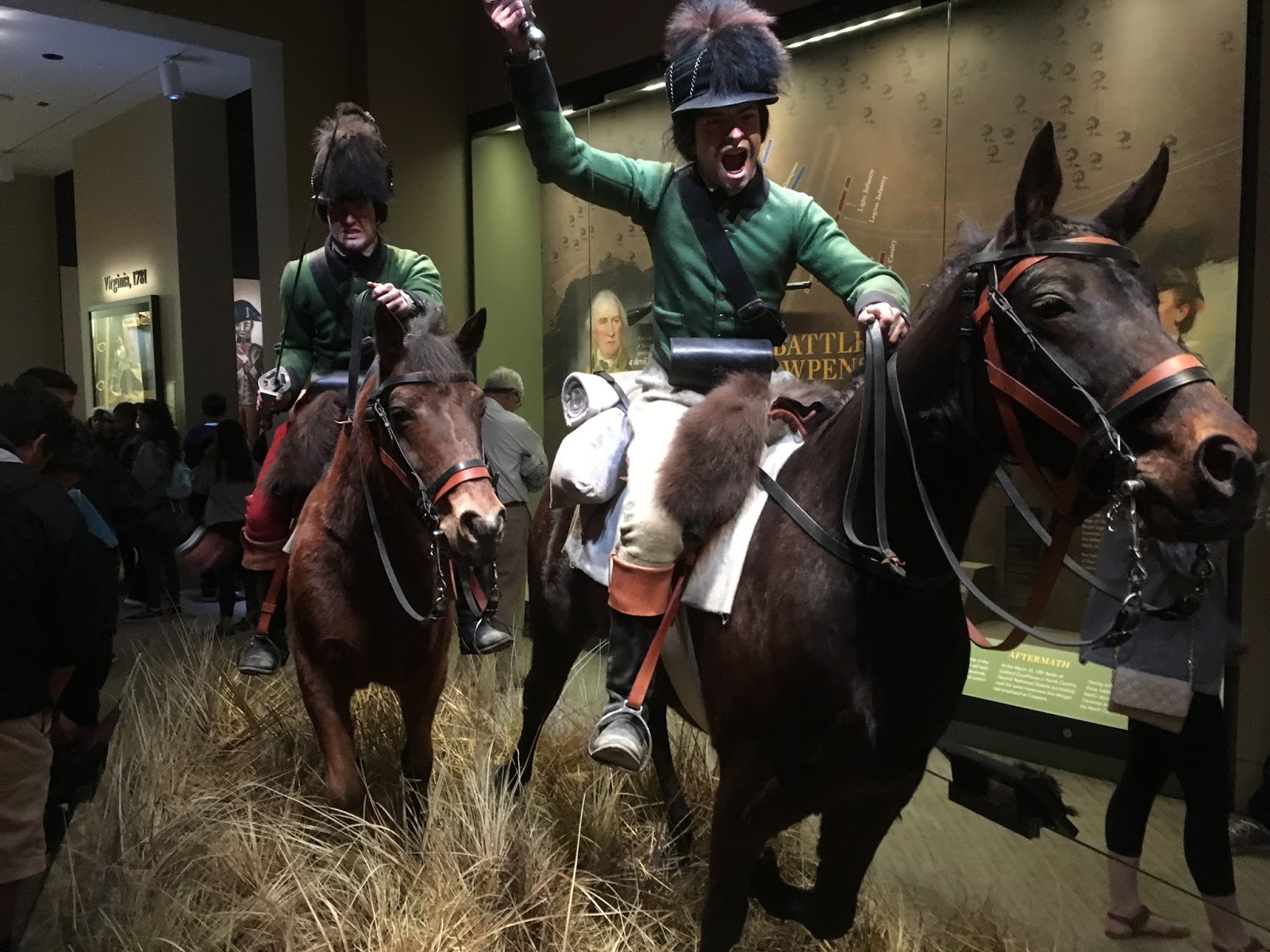
I loved the museum.  Open only a month, the exhibits were a mix of traditional glass cases, three-dimensional vignettes, and interactive digital screens. I could imagine the excited volley of ideas in the brainstorming sessions that led to an entire room dominated by a full-size privateer ship, available for bow to stern clambering; a movie immersion in the Battle of Brandywine where smoke and the smell of sulfur filtered into the room as we “charged” through tall grasses with a battalion; wall-sized time-lines on which the touch of a finger to an event or document generated a blow-up and history of that item; and two real stuffed horses, mounted by British dragoons, frozen in their race.  Dramatic as it was, several visitors wondered aloud how those horses died.  A nice lady assured us that the horses lived a full life on a lovely farm and died a natural death.  Mom and I would have liked to know their names.


Slavery, the “peculiar institution” that Lincoln abolished and that troubled our Founding Fathers’ consciences (clearly, not enough) was highlighted throughout, more than I expected given the usual coverage of the Revolutionary period. The historians who planned this museum wished visitors to contemplate the enigma of those who fought for their own equality and unalienable rights while holding others’ enslaved.


One of the interactive screens provided images of a number of historic people and events and asked viewers to consider “What would you do?”  In one case, Eve, a slave for the wealthy Randolph family of Williamsburg, feared her son George would be sold, so mother and son fled to the British lines in search of the freedom they promised. They arrived to find the British camp infested with smallpox.  Eve was confronted with a terrible choice: stay and chance disease, or return to the Randolphs where punishment, enslavement, and the possible sale of her boy awaited. 

What would you do?

I stood before the lighted panel and pondered.  I‘d learned about Eve when Dave and I visited Williamsburg two years ago.  I tried to conjure this flesh-and-blood woman whose life was unpredictable and beyond her control.  I thought about being owned… owned by a master who could sell my son.  Eve was so respected in the Randolph household that she carried the keys to almost every lock in the house, but she could be sold like a bureau or table if the master wished. I pushed the button marked “Stay in the British camp.”

In a flash, the screen told me my choice matched Eve’s.  But the British lost the Battle of Yorktown… and Eve was returned to slavery.

Several years ago, the Fairfield Museum hosted a traveling exhibit about Abraham Lincoln.  A pen used by the Great Emancipator to sign the document that freed the slaves was in a lighted glass case, low to the ground.  In awe, I sank tearfully to my knees – again, the case was low, but still, the actual pen once held by that extraordinary man and employed to such purpose?  Praise God and thank you, Mr. Lincoln. I respect General Washington, and enjoyed seeing his blue sash, leather duffle, and war tent, but Lincoln holds my heart. 


In 1776, Thomas Jefferson wrote of equality, rights, liberty, and the pursuit of happiness while owning his fellow humans.  Just shy of 100 years later, Lincoln took a step toward upholding those assertions.  To this day, we falter in living them.  The Revolution is behind us, its principles touted and enshrined, but abroad and at home, Americans continue to fight.  Peace, respect, tolerance, and compassion are sacrificed because of distrust… oh, and for oil, money, and power. I ache at our willingness to kill and be killed for such things.

Mom had marched ahead of me, her hike complete, and was waiting on a bench in the hall. As I exited the final gallery to meet her, I passed through a wall of mirrors with a sweeping sign in large gold letters:  MEET THE FUTURE OF THE AMERICAN REVOLUTION.  The founders wrote often of their responsibility to posterity; we must give more thought to the generations ahead whose well-being depends so fully on what we do now.

Or, what will they have to say of us?


Tuesday, September 15, 2015

Liberty for All?

The guide for our tour through the Randolph House in Williamsburg is sturdy and middle-aged.   Delia is African-American, her skin a pale cocoa.  Her close-cropped hair is graying and wrapped in a striped kerchief.  She wears a loose white muslin dress, tied at the waist with an apron.  She is good-natured and funny, and cracks up when I say Dave is my first husband.  Awkward.  Don’t even know why it came out that way, but she thinks it’s hysterical, and she smiles and shakes her head every time she glances my way. 

It is sweltering hot and those of us gathered beneath a shade tree in the yard of this stately eighteenth century house are grateful for the chance to rest and fan ourselves while sitting on rough wooden benches awaiting the start of our tour.   “Finish up your snacks and drinks now,” says Delia.   “Don’t want any spills inside.”

A young woman in red sneakers sips from a plastic cup.  “Can I bring it in if I’m really careful?  I just bought it.”

Delia shakes her head.  “Finish it up.  I don’t think any of these folks will mind if we sit a bit longer.”  She’s right: a visit to Williamsburg involves much weary walking and standing.   Once the woman chugs down her beverage, we rise regretfully from our perches and follow Delia through the entrance.

She is intelligent and knowledgeable, and I wonder if she is a history teacher when not impersonating a slave.  For that is her role.  Like every African-American interpreter in this colonial town, she represents one of the enslaved persons that made up 52% of the town’s population in the 1780’s.  “Enslaved persons” is Delia’s preferred term as it emphasizes the state of enslavement and the fact that this individual is not just property, but a person.  A person who has been wronged.  Our guide wants to be sure her charges understand this:  “There was no ‘good’ slavery.”

As we wind past the fine furniture, porcelain ornaments, and china that belonged to the privileged Randolph family, Delia tells us about those who performed the polishing, cleaning, cooking, and laundry.  Johnny and Eve were Mr. and Mrs. Randolph’s personal servants, so trusted they carried the house keys and supervised other workers.  Yet, when the Randolphs died and their wills were read, Johnny and Eve were items to be disbursed along with the bureaus and beds. “Life was hard work,” says Delia,  “and it was also uncertain.  An enslaved person could be given as a birthday present or to settle a debt.”

Later in the afternoon, Dave and I trudge down the hot brick sidewalk to the Charlton Stage, plotting our route from the shade of one tree to that of the next.  While tourists strive to stay cool in skimpy sundresses, shorts, and sandals, the interpreters we encounter are dressed in multiple layers.  I pity the men especially, in their long–sleeved shirts, waistcoats, overcoats, breeches, and woolen stockings.  Woolen stockings!  I shudder.    

We had arrived in Williamsburg the night before our tour and ate dinner at the Dog Street Pub.  Dave loved the beer and the heavy earthenware mug in which it was served.  I loved the creamy Welsh rarebit: a rich cheese sauce with a trace of stone ground mustard poured over a thick slice of toast.  I had eyed a gentleman sitting with his lady two tables over.  Although dressed in a shirt and slacks much like Dave’s, the man was regal.  Something about the angles of his face, the proud nose, and gray hair.  I whispered to Dave,” Bet you anything he’s Thomas Jefferson.”

Dave checked him out.  “Could be…”

Dave and I had prepared for this trip.  He finished Nathaniel Philbrick’s Bunker Hill a few weeks ago, and at Mercy Learning Center, I’ve been studying the Revolutionary War, Declaration of Independence, and Constitution with my students, Taiwo and Nicole.  In our discussions of the founding fathers’ efforts to plan for posterity, to plan for us, I have at times become teary at their foresight, even as Taiwo and Nicole have been wide-eyed with admiration.  So, Mr. Jefferson has been on my mind.   

Upon reaching Charlton Stage, Dave and I inch down the rows of low wooden benches to take our seats in the shade.  Soon Thomas Jefferson – indeed, it is my Mr. Jefferson from the pub – strides down a narrow walkway to the stage.  Seemingly impervious to the heat, he wears a tri-corn hat, white ruffled shirt, blue coat, brown breeches, and riding boots.

The stately Virginian slave-owner opens with references to the Declaration, and the self-evident truths of equality and the unalienable right to Life, Liberty, and the Pursuit of Happiness.  He asks us, “Consider, if you will, how do you feel when you do good?” 

“Happy,” we, the multitude, dutifully respond.

“And how do you feel if you do something deceitful, something you know not to be right?”

Most mumble the obvious, “bad,” but one thoughtful soul, breaking boldly from group-speak, suggests, “uncomfortable?”

“Indeed,” says Mr. Jefferson.  “Uncomfortable.  Such acts might keep us awake at night.”  And then he makes clear his case that in doing good lies the happiness of which he wrote. 

Our speaker asks for questions and parries concerns about a populace that does not bother to vote despite the right to do so, and a government seemingly in the power of a wealthy few.  In answering, he swivels on one booted heel and sweeps his arm, hand out, palm raised, in a gesture to encompass us all. “Is this not a government of the people?  It is to the people to hold that right and that responsibility firmly.  Speak out!  Just as you are doing here today.” 

I imagine the collective flurry of thoughts as each of us mentally composes letters to our congressmen demanding change as directed by Thomas Jefferson.  For to those of us sitting on these wooden benches in this town of centuries old clapboard and brick homes - having visited coopers and brickmakers, weavers and gunsmiths, having witnessed soldiers recruited for the upcoming battle of Yorktown, and having questioned the quandary of a fight for liberty by those served by slaves - the statesman before us is the Declaration’s author.

Jefferson invites Robert, a young boy of ten or so, to join him on the stage.  Robert has embraced the spirit of this visit to 1781 and wears breeches, stockings, and a tri-corn hat.  His mouth slightly open, his eyes wide, it is hard to say if he is star-struck or nervous as he stands before us, face-to-face with Mr. Jefferson. But there is no mistaking his look of lust when Jefferson draws a sword from its scabbard and hands it to him. 

“While not known as a soldier, I have had some success with the pen,” Jefferson says with a self-deprecating grace that draws a chuckle from the crowd.  He then places a quill in the boy’s other hand.  Predictably, he asks, “Master Robert.  Which do you suppose to be mightier? Pen or sword?”

The boy pauses and I wonder, would a child this age know the expected response?  And much as we Americans have been drilled in that concept and long for its truth, does it still hold in this world rent by war and driven by money?

As one, the audience holds its breath, leans forward, and wills young Robert to respond.

“The pen?”  His response is hesitant, a question really, but we burst into relieved applause.  Huzzah!

Jefferson smiles and nods, then reaches to retrieve the sword – gleaming, impressive, and undeniably mighty.  Robert’s expression is wistful as it disappears into its scabbard, and he is left with the pen.  Jefferson pats the child’s shoulder and the rest of us clap as the boy returns to his seat, proud owner of a new feather quill. 

Will Robert remember this moment, the regal man and his powerful words peppered with “lest we forget” and “forthwith”?  Later, as Dave and I muse at the extremes of inspiration and polarization represented in Williamsburg’s history, I wish I’d asked Mr. Jefferson where his plantation worked by slaves, no, enslaved persons, fits into his concept of liberty.