Showing posts with label breast cancer. Show all posts

Friday, September 19, 2025

Bar Chatter

Two strangers walked into a Newport bar. They scanned the room. Any empty seats? It was a September evening, still warm with a cheerful, summer vibe. Overall, the crowd was young, the women dressed in a mix of stylish stove-pipe jeans and crop tops or sundresses short enough for a flash of undies. The guys were in uniform, well, so universal were their outfits it seemed like a uniform – Oxford shirts, jeans, and All Birds.  

An attractive blond woman with a cascade of faux pearls dangling from her ears waved the strangers over and gestured to two free seats overlooking the harbor. 

The sun was low, glinting on pewter water visible between the boats docked at parallel wharves. The lightest of breezes rocked the boats and caressed bare cheeks, shoulders, and midriffs. 

The strangers settled in and were greeted by an older couple tucked close to the wall – a quieter spot perfect for people-watching. “We’re the oldest ones in the place,” said the man who introduced himself as Kostas. His face was lined, yes, but he was tan, strong, and handsome. His wife, April, was martini-happy, and giggled when Kostas mentioned ages.  

“I bet we have you beat,” said the male stranger.

“I don’t think so! We’re 80!” announced Kostas practically crowing with pride; he knew how good he looked. April put her hand to her mouth and giggled again.   

“No way!” said the strangers… and they were being honest. April, perhaps, had had a bit of “work” done, but they both looked amazing. 

Drinks were ordered and served  - Dark and Stormies with muddled mint - as conversations covered home locations, children, and travel. No politics. One never knows.

As the sky darkened, the bar party ebbed and flowed like the waters in the harbor beyond. When Gus and April stood to leave, Marty and Jim, thrilled at the openings in this crowded restaurant, eased into their stools.

Jim’s dark brows arched over sparkling eyes that spoke of a kind soul. It was not surprising to learn he worked on behalf of others researching rare cancers. Marty, his wife, hale and athletic, ran a foundation, and was, like me, a cancer survivor. With that revelation, the uncomfortable skin of being strangers was shed, and the four of us raised glasses in a toast: “To good health!”

I asked Jim if continued funding was a concern and, his expression rueful, he nodded. Marty and I locked eyes. We knew the role medical research had played in our being together that night at the bar.    

It was time for dinner, so we perused the menus, but a restaurant regular mentioned an unlisted dish: lobster ravioli with morel mushrooms in a champagne sauce… and four orders were submitted to the kitchen.  

Meanwhile, between sips of sauvignon blanc, talk turned to Marty and Jim’s weekend plans: a wedding and their son’s beach volleyball match. We contributed news of our granddaughter’s loose tooth, mastery of her two-wheeler, and our son’s family life in Switzerland. Phones were pulled from pockets and photographs shared amid hoots of laughter and coos of admiration. 

Once our dishes arrived, there was appreciative silence as delectable bites of tender ravioli, creamy sauce, and generous chunks of lobster were sampled. 

After dinner, it was time to part – this group was not one to stay late over drinks. We hugged our good-byes, grateful for this chance connection, those empty seats at the bar, and the glimpse into the fullness of every stranger’s life.  


Friday, April 28, 2017

Without Science, I'd Be...

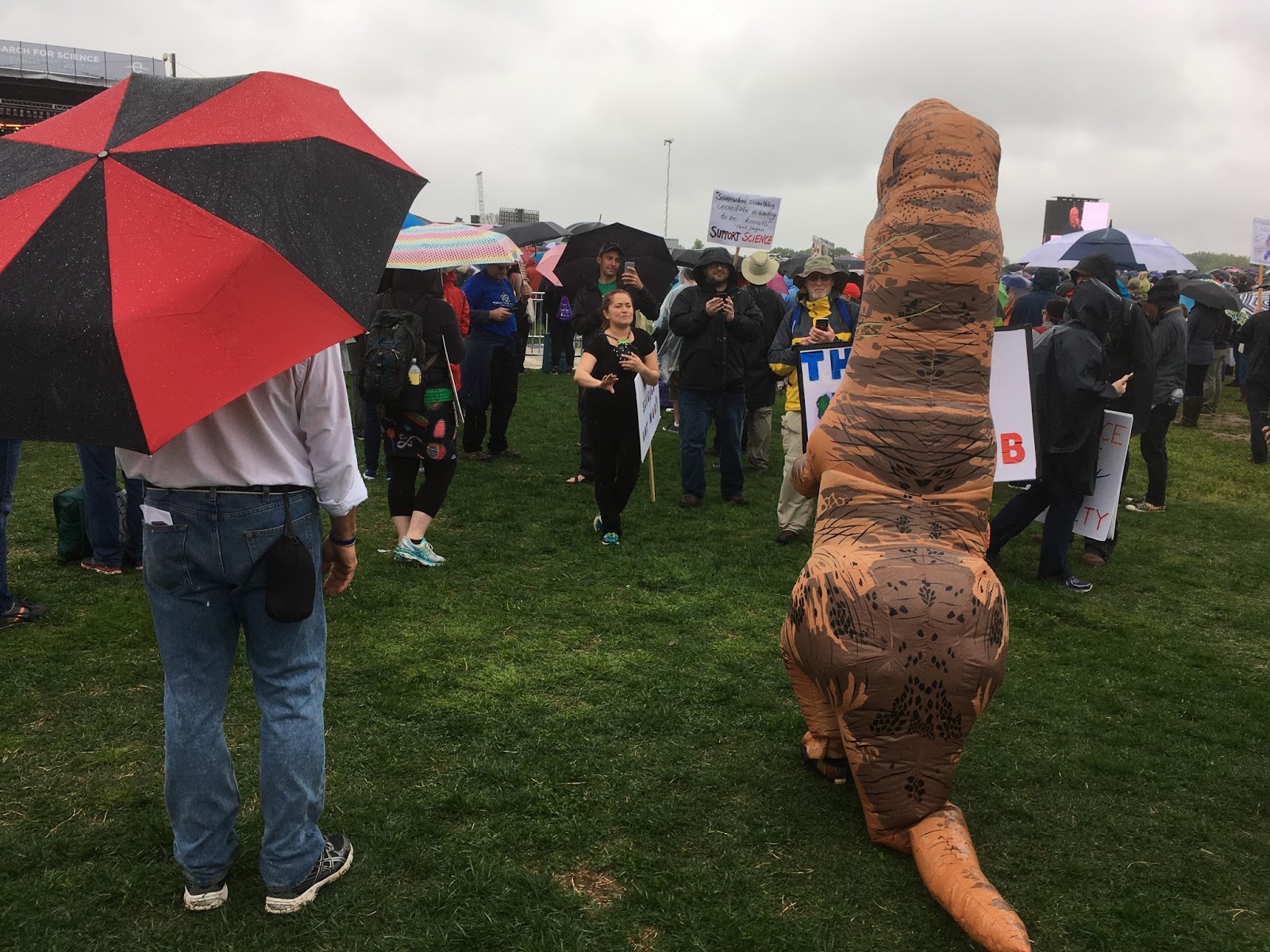
Rain dripped from sodden umbrellas and streamed off cheap plastic ponchos hastily purchased from vendors along the march route.  It was cold, yet the woman wearing the red cape, star spangled shorts, crimson bustier, tight blue leggings, and gold tiara of DC Comics’ Wonder Woman seemed still to brim with energy.  As those marching for Science on this wet Earth Day 2017 wearily reached their destination in the plaza before the Capitol, Wonder Woman leapt onto a retaining wall to take a selfie with her friend. 

Dave and I had spotted a number of full-bodied tyrannosaurus costumes and bushy white Einstein wigs, their connection to science clear, but a comic book super-heroine?  Not so much. Still, part of the Science March experience lay in appreciating people’s creativity and cleverness in conveying whatever message compelled them to come to the nation’s capital this day. So I asked Dave to hold my poster and umbrella, and darted over to the wall to take a picture of Wonder Woman.  Then, Dave and I trudged off in search of the nearest Metro stop. 

Once on the train, blissfully warm and dry among other tired marchers still clutching signs with ink now weeping, Dave and I pulled out our phones, and like those around us, began to swipe, swipe, swipe through our photos, re-living the day.  Only then did I look closely at the photo of Wonder Woman and thought to enlarge the picture so I could read her poster.  “Breast Cancer tried to kill me, but Science…”

Saved her.  Made her strong again.  And made her Wonder Woman in the eyes of those who loved her… just as science gave my doctors - Mary Pronovost, Anke Ott-Young, and Barry Boyd – the tools and knowledge to save and restore me.  


During these times when government support of climate science is of major concern, I hadn’t given much thought to the sweep of science… and to its direct, life-saving impact on me. Science is not separate and abstract. The people in lab coats hunching over microscopes have helped us learn what makes us function, what makes Earth function, and what it requires to ensure that our individual and planetary systems thrive. Why, in 2017, would those in power choose to deny and underfund these?  

The day before the march, Dave and I had arrived in Washington leaving enough time to tour the monuments and memorials on the National Mall.  We scanned the seemingly endless lists of names of those lost etched in the Viet Nam Memorial.  Read the words of Nimitz and Truman inscribed on the wall of the WW II Memorial. Observed the haunting figures of shrouded soldiers drifting past ghostly images of departed service people gazing from a polished granite wall at the Korean War Memorial.  So many sons, fathers, daughters, mothers, and brothers – cherished loved ones – sacrificed in war after war after war.

At the exhibit below the Lincoln Memorial, I spotted a woman, apparently bald, wearing a scarf.  I approached her and asked if she was going through chemo treatments, and she said yes.  Briefly, we shared our experiences and found that Herceptin was part of both our regimens.  When I had breast cancer in 2009, Herceptin had been available for only eighteen months.  From my understanding, this drug made all the difference in my prognosis.  I hope science will help this woman, too, evolve from a scarf-lady to Wonder Woman.     

After a wonderful overnight visit with my cousin and her husband, Dave and I arrived on the mall at the Washington Monument Saturday morning. We had passed through the security checkpoint, jumped over puddles, and gingerly tip-toed through swaths of mud to join the umbrella-sheltered throng before the stage.  “Can you believe this?” said Dave.  “It’s 2017, and we have to march to support Science?  What the hell?”

What the hell.  But the Trump administration has proposed massive cuts in jobs and funding at the Environmental Protection Agency (EPA) and National Institutes of Health (NIH), so march we must.


The first Earth Day in 1970 targeted pollution and led to the regulations that have cleaned our air and water and protected endangered species.  Since then, April 22 has been a day for concerts, school-organized clean-ups, and reminders to recycle.  It has been a celebration of strides made and incitements to improve.  This Earth Day was different, dire, and much like 1970, a warning that failure to act – or worse, to reverse gains made – will threaten the future.

Dave and I stood beside a tyrannosaurus to watch videos of polar bears, penguins, and whales gracefully diving deep below murky blue waters.  


We listened to Bill Nye, the Science Guy, who concluded his talk with a stirring call for “informed science.” Astronaut Mae Jemison spoke of the power and beauty of seeing Earth from space.  Maya Lin, designer of the Viet Nam War memorial, described her next project, “What is Missing?” which she said would be a “wake up call and call to action… we must balance our needs with those of the rest of the species on this wondrous planet.” Denis Hayes, organizer of the first Earth Day in 1970 and founder of the Earth Day Network, warned, “If we lose this fight, we will pass on a desolate, impoverished planet to future generations.”  As numerous posters stated, “There is no Planet B.” 

Jamie Rappaport, president of Defenders of Wildlife, reminded us, “Extinction is forever.”  Because of the Endangered Species Act, itself endangered under this administration, the bald eagle and manatee have been saved.  “Without science,” said Rappaport, “there will be no Monarch butterflies, no polar bears, no red wolves.  Science, for these, is literally a matter of life and death.” Opening with, “I am a patriot.  I fight for spacious skies and purple mountain’s majesties,” James Balog stated, “I am a photographer and scientist, and I have photographed the visual evidence of epic changes…  I have seen it…  Nature isn’t natural anymore.”  

Christina Figueres, Executive Secretary of the UN Framework Convention on Climate Change, said, “Did you know that in Kentucky, they just put the largest solar farm in the world on top of a coal mine?  We are getting there!  We just need a collective intentionality to curb carbon emissions by 2020.  Can we do that?  Of course we can, because we don’t have another option.” She spoke of a vision she has had of hundreds of eyes staring at her and asking, “what did you do?”  She added, “This is a question for all of us.  The answer must be that we work together to do everything we know that is necessary.  In that lies the future of mankind.”

The future.  The future was a drumbeat conjured, portrayed, and agonized over. Many speakers spoke of their children and grandchildren.  Climate change is not in question; it is here.  And while the Great Law of the Iroquois urges consideration of the effect of all decisions even unto the seventh generation out, current plans to curb environmental regulations will affect not only our unknown descendants, it will affect those we know and love… our littlest ones - baby Paul, Ava, Rob, Hazel, Miles, Bennett, Isabel, Sam, Finley, Lily, Lila, Henry, Victoria, Jake, and all children, many of them attending the march.  Some slept on parents’ shoulders, sheltered under umbrellas.  Others peered curiously from beneath stroller canopies.  Still others stood rain-spattered and proud, holding their own hand-lettered signs. 

Many scientists, science teachers, and science students attended the event, and the tone and subject of chants and posters reflected that. There were proud cries about democracy in action, but also calls and responses of: 

“What do we want?”  

“Evidence-based science!”  

“When do we want it?”  

“After peer-review!”  


The pink pussy hats of January’s Women’s March were few, replaced with artfully crocheted caps of twisting coils of gray brain matter.  Posters bore renderings of formulas, graphs, and charts that left Dave and me scratching our heads.  Geologists proclaimed “Geology rocks!” Researchers and doctors demanded, “Fund the NIH!”  Molecular biologists wore elaborate spindly constructions on their heads that we took to be models of molecules, but like I said, we were out of our league in this group.

Like Wonder Woman, many attendees held posters thanking science for cures or listing torments science has consigned to the past.   “Got Polio?  Me neither!  Thank science!” and the more expansive, “Thank a scientist for: antibiotics, polio vaccine, chemotherapy, clean air, clean water.”  Countless posters held images of our beautiful Earth, some with an arrow pointing at the planet, stating, “I’m with her!”   


Humor helps power a message without a finger wag, and Dave and I chuckled often as we wandered about to read signs and keep warm:  

“It’s not rocket science…well, actually, some of it is…”  

“I’m a Mad Scientist”

“What do you call a massive solar energy spill?  A nice day!”  


“Girls just want to have fun…ding for scientific research”


A man and woman standing side-by side held Dave’s favorites.  Her poster read, “Science saved our relationship;”  his said, “Without Science, I’d be bald and flaccid.”  


The presenters onstage were an organized and disciplined lot.  They kept their words succinct and focused, and when the scheduled march time  - 2:00 PM - drew near, they wrapped things up. At the last minute, the moderator announced a final send-off and blessing: a tweet from Pope Francis.  A tweet of all things, praying, “Lord, bring healing to our lives, that we may protect the world and not prey on it, that we may sow beauty, not pollution and destruction.”

With cheers for the Pope, chants of “E.P.A.!  E.P.A.!,” and a rousing chorus of trumpets and saxophones, the crowd surged forward.  We lifted our rain-wilted posters and flowed from the green by the monument down to Constitution Avenue… hoping that those in the domed and columned buildings within sight were watching and listening.


Tuesday, September 23, 2014

Waiting with My Sisters for My Mom

I am grateful I have two sisters to wait with as we sit in the Green Room of Bryn Mawr Hospital.  Francie, the youngest, is intent on her iPad, sliding her fingers over the screen as she surveys a cartoon town, Springfield, home of the Simpsons.  Through a game called “Tapped Out” she has added houses, shrubs, sidewalks, and stores, as well as an amusement park and castle.  “I’m trying to make it as realistic as possible, but I probably overthink it.  I still haven’t put in stop signs.”  I comment that, given her goal of realism, this is a key feature to omit.  “Yeah, but all the cars are parked, so it’s okay.”

Rita, the middle child, in fact and personality as she is quick to point out, is playing solitaire.  There is not an actual card in sight, for she, too, is frowning at an iPad.  I am the oldest daughter and I don’t own an iPad.  I brought my book and Yankee Magazine and have not glanced at either one.  Actually, I am enthralled by Francie’s game.  “I put in all the flowers and vendors: it was a blank field when I started,” she says.  I'd no idea my sister had such city-planner skills. 

“Damn, someone just wrecked my castle,” she grouses and sighs.  “It’s okay.  I can rebuild it. “

Across from us, an old gentleman in heavy orthotic shoes snoozes, chin to chest, his hands clasped across his belly.  His walker is parked at his side.  A stately Asian woman sits alone in the corner, her back erect, her calming deep breaths so forceful as to be audible.  I hope everything works out all right for her and whomever she is here for.

My sisters and I are awaiting word of our mother.  She discovered a lump three weeks ago when we were on vacation.  She is stoic and didn’t want to interrupt or worry us, so by the time we’d all returned from our jaunts and she told us her news, she’d already had the necessary appointments and biopsy.  When the time came to deliver the lines she had practiced, Mom began her spiel with, “Before I say anything, I want you to know that everything is fine and under control.”

At 82, my mother is blessed with a busy schedule, good spirits, and great health… and she rarely, rarely, goes to doctors.  She drives her physician crazy.  “Oh, he wants me to get all kinds of tests, a colonoscopy, things like that, but I just tell him, ‘no thanks.’”  So my sisters and I consider ourselves lucky that she took the steps she did and agreed to this lumpectomy.

We are also lucky that she is a friend of the head of the hospital’s breast cancer department, a surgeon sought after by patients nationwide.   Mom has full confidence in him and to all appearances, has been totally relaxed about this procedure.   In fact, when I arrived from Connecticut last night, she was so chatty and cheery in her welcome that I said, “Clever of you to arrange this reason for us all to get together, Mom.”

The worst part for her, other than the biopsy and diagnosis, was last night’s shower with anti-bacterial soap.  Where I think showers are one of God’s great gifts, Mom is a bath kind of girl.  As she struggled not to slip on the wet tiles of the shower stall, she grumbled, “Never again.” 

So, free of bacteria and squeaky clean, Mom and I met my sisters at the hospital at 6:00 AM this morning.  She was bustled off for prep by a friendly nurse, and when we were guided to her side shortly after, she was dressed in the same blue-diamonds-on-white johnny I’ve worn for colonoscopies and mastectomies alike.  Who is the design genius now reaping big bucks off that pattern, I wonder?

Mom seemed at ease as she rested with one arm crooked behind her head, a pink plastic bracelet encircling her wrist, a needle access ready in the back of her hand.  A flat neon line ran across the screen of a monitor mounted behind her.  She laughed aloud when someone said, “Oops.  Too bad, Mom.  Apparently you’re dead.”

We were introduced to several nurses and the anesthesiologist, each of whom checked Mom’s bracelet and confirmed who she was and what she was in for.  The anesthesiologist observed that, according to his records, Mom had had a tonsillectomy.  “Well, yes, when I was four.  Seems a long time ago to be of any interest now.”   But there again, given her healthy history – and lack of doctors’ appointments – there was nothing else for the poor man to note.  Clearly he felt he had to say something. 

When the surgeon arrived, Mom said to him, “Everyone sends their love.  Can’t possibly remember all the people who told me to pass that along when they heard you were doing my procedure.  So there you are.  You are beloved.” 

He laughed modestly, then told Rita, Francie, and me to plan on about an hour’s wait.  A nurse gave Mom a shiny foil shower cap, which she slipped over her silver-white hair, tucking in a few errant tendrils.  She smiled brightly as we kissed her, and said, “see you soon!”  

It’s been forty-five minutes or so since we left her.  I go to the restroom and when I return, my sisters, in whispered giggles, give me a hard time because my flip-flops, true to their name, flipped and flopped so loudly I woke up the old man in orthotic shoes.  I sit down and study our three sets of painted toes, mushroom brown (Francie), eggplant (me), and neon midnight blue (Rita).  Not so long ago, Mom and Dad would have raised an eyebrow at painted toenails and told us they were tacky.   

Soon after, the surgeon enters the Green Room. He smiles reassuringly, nods, and indicates that we should follow him to a private adjoining room.  The surgery went perfectly.  He pulls out a pen and lined sheet of paper to draw a sketch of a torso, a breast, and a dotted incision line.  “Once it’s healed, it won’t look much different.  She’s in recovery and Joyce, at the desk, will let you know when you can see her.”  Francie picks up the drawing, folds it, and slips it into her purse.

Back to the Green Room, giddy we go.  The old man has fallen asleep again and the elegant Asian woman is gone.  Last week, Mom had told the three of us to Google “shoe ruins family picture.” “It’s in terrible taste,” Mom had said, “but it’s hysterical.”   We’d never gotten around to it, so now is the time.

Francie types it in on her iPad, scrolls through a few possibilities, and clicks on a likely choice, a group of tan, handsome, happy, twenty-somethings.  In the front row, a blond guy with the look of a surfer stands with legs planted wide, wide enough that the beige pump of the girl behind him appears to dangle, penis-like, between his legs. 

My sisters and I erupt in laughter desperately suppressed so as not to seem inappropriate or bother others.  From there, it’s an easy leap to YouTube videos of pooping dogs ruining family pictures.  Then Francie suggests we hold our breaths to see who can last longest; it’s been just under fifty years since last we held such a contest in our neighbor’s pool.  The seconds pass as we lock eyes and press our respective lips tight.  Rita’s hand goes up first as she inhales deeply, and ultimately, I win.  Not bad for the oldest.

As we’re taking a few breaths to recoup, Joyce comes to fetch us.

Mom is in Room #363.  We leave the green carpeting and sponge-painted geraniums in the Green Room to walk down the corridor under glaring white lights.  A nurse at the desk smiles as we pass, and we check out the numbers of each door along our way.  “363.  Here we are,” says Rita.

Francie knocks on the door and pushes it ajar.  “It’s your girls,” she says as we enter.   


Monday, September 30, 2013

Circle Unbroken

We heard their laughter and the lyrical rhythm of island accents before we saw them.   Two women - one with red lipstick and long hair, the other with corn rows tight against her scalp, both with cocoa skin - had struggled to sit atop a massive boulder on the lawn below the lighthouse and above the sea. Their male companion stood before them, holding a camera at arm’s length. Happy people on a glorious day, I thought and smiled to myself at their joy.

 “Would you like a picture of the three of you?’  Dave asked.  Naturally, they were delighted by his offer.

After they’d checked out Dave’s shots from their perch on the rock, the woman in cornrows, Ann-Marie, I soon learned, twisted toward me and said, “Is he a photographer?  Just has a way….”

Her friend, Maxine, slid to the ground and strolled over to where I sat nearby on the grass. “We have reason to celebrate,” she volunteered.  She nodded toward Ann-Marie and said quietly, “A year ago, I was with her when she had surgery.”

A few years back, I would have left it at that, but since I’ve had cancer and Ann-Marie is a woman, I said, “What kind of surgery?”  Given the statistics, it was almost a formality.

“Breast cancer,” she replied, and the sadness is, I wasn’t surprised.

When Ann-Marie joined us, I told her of our bond and hailed her as a sister.  Her nice-stranger-smile deepened to one of connection, and she hugged me tight, a hug infused with shared fear, relief, hope, and gratitude, then she settled to the grass next to me, just barely loosening her hold. 

I was half in her lap, my hand in hers, as the five of us spoke for close to an hour.  “During diagnosis and treatments, it was the circle of love that kept me going,” Ann-Marie said as she smiled at Maxine.  “The circle of love is essential.”  With our hands still clasped, her eyes locked on mine, she added, “There is no coincidence in our being here, together, in this place.”  And I knew she drew strength from our companionship in cancer, just as I had from Joanne, Dede, and Wendy.  The disease and fear might have been ours to fight as individuals, but we were not alone.

Nor were Dave and I alone this weekend; we had a date on the hill above New Harbor, so it was time to mount up.  Dave took group pictures, we exchanged emails and hugs, our three new friends headed to the lighthouse for a tour, and Dave and I retrieved our bikes for the ride back to the hill.


 For over a decade, our September Block Island gathering has served as escape and celebration. In 2008, the route to Point Judith was tagged with evacuation signs and cars, countless cars, heading the opposite direction as a hurricane blew in.  Did we postpone?  No!  Otie and Janet made the trip from Pittsburgh a day early just in case, and our Connecticut contingent barreled ahead, thrilled at the prospect of howling winds and pounding surf.  There was one brief moment on the way up, after we’d passed the third evacuation sign, when I thought, are we being stupid about this?  Forget about it!  All aboard!

In 2009, the weekend fell during my second round of chemo-loser days.  I’d just lost my hair and felt logy and sad, plus it was windy and rainy and I worried about errant gusts stealing my scarf.  Dave had thrown out his back and we were a gimpy, pathetic pair – not our usual BI selves.  The Friday ferries were cancelled, so we made the crossing on Saturday; the rest of the group – Hallie, Buck, Steve, Deb, Len, Mary, Otie, Janet, and Joan – had taken an earlier boat.  They met us at the dock, a receiving line of loving friends.  They relieved us of our backpacks, and Dave and I rented a mo-ped, a motorized means to free-wheeling, so we could keep up.

Every year, on the Friday of departure, there’s the ordeal of the white-knuckled drive down I-95, zipping along at 15 mph through rush hour traffic to make the last ferry.  Once that ferry pulls from the pier, however, there is water between us and …everything else.  Water between us and worry.  Water between us and doctors.  Water between us and the ability to take care of to-dos, commitments, and concerns. Through Steve’s diagnosis, Colombo’s strokes, hurricanes, and my cancer, Block Island has been gloriously and blessedly AWAY.

I hesitate to speak to my Sylvestros of God, but this weekend, that of Steve and Debby’s 40th anniversary, I sensed His hand in the brilliance of the sun, meadows of golden rod glowing yellow, sapphire seas, and blue skies swirled with playful wisps of clouds, a setting fit to honor four decades of marriage.  

By the time Dave and I pedaled up, most of the others were on the hill, spreading blankets on the grass, hauling a ponderous picnic table to a level spot, opening bags of chips - tortilla and potato - and the requisite containers of hummus.  While mudslides – a frozen chocolate/coffee/rum confection– are always the drink of choice, Hallie was also chilling champagne.

What would be the afternoon’s format?  No one was sure.  While this time together on the hill was a given, the anniversary layer was uncertain.  A few weeks before, Deb mentioned to a few of us her wish to renew her wedding vows.  “When we got married, I said the words I was supposed to say, but I was a kid. I didn’t get it.  Now I do.  It’s not always easy.  You have to work things through.  It really is ‘in sickness and in health.’ After forty years, I know about commitment.  I’ve lived what I vowed.”

Steve, I’d heard, was not so sure about the renewal of vows piece, but he’d bought Deb – forty years later – an engagement ring, and today, he would present it. 

Others had planned their own presentations.  Moo had flown in from New Mexico, her first trip to the Block.  She’d done some research on traditional 40th anniversary gifts and had something hidden under a sweatshirt in her bike basket.  Nelson and his wife Ann had also joined us, and Nelson had worked with the island to create an appropriate gift. 

Steve and Deb’s son, Trevor, had thought the celebration was the next day.  Oops.  So, as the rest of us chatted and sipped mudslides, Trevor sat eyes and fingers to phone, working on his toast while his wife, Lisa, and soon-to-be-three daughter, Ava, spilled packets of colorful sand on paper, preparing a bee-u-ti-ful picture. 

Because Dave is an online-ordained minister of the Church of Spiritual Humanism, a justice of the peace, and Steve’s brother, he was chosen to orchestrate events, whatever those events might be.  After Ava changed into a pale blue princess gown and donned long pink gloves with the help of two young courtiers enlisted at the playground, Dave rose to chorale our attention. 

Until he spoke, we were scattered, small groups on blankets facing this way and that, but when Dave began to speak, we naturally formed a circle, a circle of love.  Deb and Steve were the focus, at the head of the circle, but in a circle, actually, there is no head, so all the words spoken of lasting love and friendship were spoken for all of us, everyone in that circle. 

Steve’s white mane, Deb’s river of blond hair, a circle of sunglasses, a circle of soul-deep smiles that have beamed at each other and at these two people for most of those four decades.  There have been losses, hospitals, worry and nursing homes, but there’s been traying at Trinity, cheering at races, work at Eagle Hill, hunkering down for hurricanes, dancing at Captain Nick’s, trips home for the holidays, weddings, Trevor and Christopher’s concerts, strumming guitars, playing with Ava, and this shared weekend on the Block.  How does that translate into words?

We tried… with laughter, stories, tears, and hands to hearts.  We spoke of Steve and Deb’s love, their courage, their example, and their role in bringing us all together.  Dave, who accompanied Steve and Deb on most of their dates and followed Steve to high school, college, and Eagle Hill, relayed a dream in which Carolyn, our recently departed friend, told Dave “True love is a gift,” thus giving him his message for this day.  With great ceremony, Moo unwrapped her offering: an eggplant engraved with “Happy 40th Anniversary.”  Nelson unveiled a rock-solid symbol of love, a rock, in fact, found on the beach, shaped like a heart, and signed by each person in the circle. 

Trevor waited until everyone else had said their piece, then mused aloud, “How do I say thank you for all the love and caring over the years?  How do I repay all the sporting events, girlfriend advice and all the hours you lost when I was late coming home (or would fail even to come home)? What can I give you for all the times you supported me in my triumphs, and provided a shoulder when there were losses? What present is there for all the times we just sat together and shared…whatever? How do I thank you for the guidance when I was unsure of my way, and your restraint to allow me to find it myself? You nurtured my growth, yet allowed me my independence. So… what gift is enough for two kickass parents?

The answer came to me today. And no box can hold it, no wrapping can cover it.  No store had it on a shelf. My gift is not to you, it is to my little girl. I promise to care for her the same way you did for me.
              
And someday, just maybe she'll say, ‘How can I thank you -- for all you've done for me?’
              
Hopefully I get the chance to tell her, ‘Don't thank me. Thank your Mimi and Poppy. Because I'm the product of their love.’”

Whooshhhhhh.  Tears.  Tears around the circle.  Every one of us wiping eyes and cheeks as Steve and Deb reached out to their boy for hugs.  And then, thank God, Deb requested a bathroom break before the boys brought out guitars to sing.  Trevor called his brother Christopher, in Arizona, who spoke to his parents and sang along via speakerphone, as Otie, Dave, and Trevor played the Wedding Song, as it had been played at the marriage forty years before. 

And that would be a good place to end, a moving place, but Nelson emptied and upended a beige plastic ice bucket, now a drum, and joined the musicians.  Steve whipped out his harmonica and Len scrolled through words on his cell for round two of the festivities: Sloop John B, The Boxer, and Shanty.  A gleeful blond princess whirled to the music, arms outstretched as her own kickass parents looked on.


Wednesday, August 28, 2013

Summer Reflections Part I - Ripples

Sunlight glinted on choppy wavelets tinted neon blue through my sunglasses.  My fingers were curled tightly around a strap across my seat.  Soul light, I leaned close to Joanne as we zipped, jolting and smacking, across the water.  Over the buzz of the Jetski’s engine, I yelled, “Look at us!  You and me and our four fake boobs!”

With her long white hair twisted into a loose knot on her head, joy emanating from her face, she grinned back over her shoulder and called back, “Survivors!”


It had been years since Dave and I spent time with Charlie and Joanne.  We’d met in 1988 when our sons Tucker and Jake became friends.  Back then, Joanne wrote a column for the Greenwich Time and was re-decorating her house.  I was into quilting, crafts, and animal rights.  Our husbands loved playing guitars together, two aging hippies strumming Rolling Stones and Beatles songs.  Hm.  I say “aging,” yet we were still in our thirties.  Ah well. 


A lot has happened in the intervening years.

Dave and I moved to Easton.  Terrorism took out the Twin Towers.  Joanne got breast cancer.  Charlie had a heart attack.  Our kids grew up and moved on to their own lives.  I got breast cancer.  Joanne and Charlie moved to New Hampshire.  And finally, over the 4th of July, we were able to accept their invitation to visit them in their now not-so-new home.

One afternoon during our stay, I sat on the dock with Jake.  His cousin Lauren was eager to rent a stand-up paddleboard.  “You better try it early on,” he said, “before the boats and Jetskis make it too rough.”

I scanned the crests and troughs of  water circled by pine-fringed shores and the mountains beyond.  A few boats dotted the lake, but surely not enough to stir the surface to this degree.  “But those boats are so far away…” I said.

“Yes.  But you know how it is when you drop a pebble in still water,” Jake said.  “The ripples just keep on going.”

Ripples.  I have always loved the possibilities, literal or not: a line in a book that resonates and leads to a new direction.  A random observation that sparks an idea and generates invention.  Small acts of kindness or valor that change lives or a world.  My friend Joanne, struck with cancer, coming through it, and helping me make it through my own…and now the two of us, jubilant together, sending ripples cascading in our Jetski’s wake.

On the morning of the 4th of July parade, along with Charlie and Joanne, their kids, their kids’ spouses, their adorable granddaughter Abbey, and assorted siblings and cousins, we staked out spots with blankets and chairs under a spreading maple on the lawn of an antique colonial.  Nearby, an old retriever, the coppery fur of her muzzle gone to white, panted in the scant shade cast by her human companion’s beach chair.  


Vintage cars, fire engines, farmers on John Deere tractors, a troop of little girls in gauzy skirts and fairy wings, and, on roller skates, an aging majorette in spangled attire, glided past, some tossing candy to the small children who scampered to the road with hands outstretched.  

A skinny scrap of a guy in a straw boater and patriotic vest stood among his fellow WW II vets on a float draped in red, white and blue bunting, and lip-synced Jimmy Durante songs.  With the cock and shake of his head and a distinctive fake nose, he had Jimmy nailed. 

A convoy of vintage WW II vehicles rolled by followed by a float bearing the old men who’d once driven them.  I thought of Uncle Jack who, during his service in North Africa, drove an ambulance much like the one cruising past.  Dave’s father, Colombo, served in Italy in that war, and the third brother, Uncle Phil, was posted in the Pacific.  Miraculously, they all came home, but Cam, their sister, said of Jack, “He was too sensitive for war.  He never spoke about it when he returned, and he was never the same.”


“Always remember the soldiers,” Colombo once said to my daughter Casey.

With pride and a tug in my heart, I ran to the roadside to take pictures knowing the three brothers would have gotten a kick out of this day, and out of the role they played in giving us this opportunity to celebrate; extraordinary ripples from the sacrifices of brave old men - once brave young servicemen – waving as their floats drove by.


Wednesday, February 10, 2010

Done... Right?

At this point, I thought there was nothing the oncologist could say that would disturb me. I’m in the final stretch, after all. A month ago, perusing the mail, much less responding to emails, was overwhelming. My to-do list was a reproach on paper, for I had not the energy to visit the attic, much less sift through old paperwork, organize shelves and haul bags of cast-offs to Goodwill. I would make it through my workday and head home exhausted; running errands or attending a meeting afterwards was not a possibility.

Gone now the lethargy of those chemo days. I’ve straightened the attic and made that Goodwill run, relishing the pleasure of pounding feet and powerful legs with each dash up the stairs. After a day of work followed by a trip to the dry cleaners and the grocery store, I can’t help but smile when I arrive home, sling my purse over my shoulder, grab a shopping bag in one hand and a full complement of clean shirts in the other, then nudge the car door shut with my hip.

But for my edgy-lesbian butch hairdo, I’m back.

This busy, competent Lea is a much-missed old friend and oh, I welcome her! My chemo treatments ended in November, thank god, and the Herceptin drips, which will continue until August, have no side effects. I feel great and, to all intents and purposes, I am done with this cancer.

So I thought.

During my last visit, Dr. Lawden called me from the infusion room into his office for a consultation. I sat in a beige chair, my IV stand with its bag of fluid tethered to my chest by a thin plastic tube. The doctor asked about neuropathy, or numbness of the hands and feet, which I was delighted to report, was not an issue. “Still active?” he asked as if perhaps, despite his directive that I exercise forty-five minutes a day, I’d opted for indolence. I nodded, masking a mental eye-roll.

We discussed diet and sleep patterns and he checked my fingernails. I haven’t bitten my nails since I was a kid, but another charming chemo manifestation is wavy, peeling nails. Who knew? I find myself gnawing away like some anxious teen and my nails look awful. “Part of post-chemo recuperation,” he said.

With mutual smiles and the closing of a manila file, we wrapped up. I was on my way down the hall, pushing the IV stand before me, when he called, “Lea! Wait! I forgot to discuss the main purpose of our consultation.”

I had no reason to be suspicious.

“We need to talk about hormone therapy once your treatments are over,” he said.

“Hormone therapy?”

“Yes. Chemo is generally followed by a course of Tamoxifen.”

I’d heard of this drug, but it had nothing to do with me. I was done. I thought that after surgery and chemo any cancer that had a chance in hell of causing a problem was banished. I should have learned from all of this, however, that nothing is certain.

I am not one to talk back or question, and certainly not to a doctor, but I’d had enough of bad news and flattened spirits. “No one mentioned further treatments,” I said, my arms crossed defiantly across my chest.

My tone must have given him pause, for he said, “I thought I’d covered it; sorry if I didn’t. You’ve had a lot to absorb. I’m going to research your case some more. Weigh the risks and benefits…”

“Risks?” I cut in.

“Yes, well. As I said, I’m going to study your case and then we’ll review the specifics of maintenance.”

Maintenance? Damn.

Tuesday, November 3, 2009

Glad I Had That Mammogram

It’s been a week since my surgery. I feel so good as I strut in for my follow-up appointment with Dr. Philipson that I practically high-five the receptionist. Theresa, the doctor’s nurse, sticks her head out into the hallway and I zip over to give her a hug. I am all smiles and she is warm and calm as always. Maybe she seems a little sedate, in fact, but I write it off as her way.

Dave and I take a seat in the waiting room and I beam at the women who are flipping through magazines, glancing up at the approach of footsteps, fingering the clasp of a pocketbook, each with her own fear and story. In my near-giddy state as one who has made it through surgery and is healing like a champ, I want to assure them that they’ll be fine. That they’re in the best hands possible and that the anesthesia cocktail is a dream. That recuperation hurts a bit, but the medications soften the edge. And that, if their people are anything like mine, they’ll be cared for with unbounded love.

Speaking of my people, Mom and Dad are coming for the weekend. They’ll probably beat us home in fact. Phone assurances have been inadequate; they want to see me for themselves. Like Dave, Mom has said, “I wish I could do this in your place,” but she will see that I don’t need a surrogate; I’m great and she needn’t worry.

When my name is called, Dave and I hop from our seats and saunter down the corridor to Dr. Philipson’s office. I give her a hug too, but her eyes do not reflect my jubilation. We sit across from her and I don’t really follow what she is saying about “micro-invasive cells.” I’m still smiling because the significance does not register. My lymph nodes were clear. The cancer is out. What more is there?

Apparently, the pathology on the breast tissue revealed something else. Cells that could send out seedlings. Cells that require preventative action. “The good news is that a drug, Herceptin, has been made available within the last two years that targets these specific cells,” says Dr. Philipson.

Wait. She’s saying it doesn’t end here. She’s talking about chemo. Scarier than cancer. Chemo.

“You did the right thing in having the double mastectomy,” she concludes. “but I know this is not what you expected. I’m so sorry.”

I am slow to process her words. I think about what might have happened if I’d not had that mammogram. What might have happened if I’d not gone for the double. What might have happened if the medical world had not continued to paw through my breast tissue in some lab somewhere even after removal.

I could have died.

But I don’t feel relieved. I’m thinking about chemo. And I’m thinking about Mom and Dad waiting at home for me to come dancing through the back door, maybe minus a drain or two, to be doted on. Again, I must tell them hard news.

We leave the office and I call my parents by cell phone. I tell them about Herceptin – so new, so specific to my case – and remind them that all of the other good stuff still holds true – early stages and clear lymph nodes and margins.

Mom and Dad rush out of the house as our car pulls up. They are somber, but glad to hold me, to see me. To see that I’m the same, minus a few body parts.

For lunch, we sit on the back porch and pick at a platter of tuna chunks, olive tapenade, roasted peppers, artichoke hearts, cheese and Italian bread. The food tastes fresh and tangy, but it’s hard to sit still. I restrain myself through the meal, then say,” I’ve gotta make a few calls.”

I fly upstairs to call Wendy. She had a double mastectomy two years ago and has been a voice of experience and comfort since I was diagnosed. She did not have chemo herself, but says, “Lea, I know many women who are going through treatments now. We still walk together; they go to work, they feel okay. There’s some fatigue, but they’re not sick. They look great. This is a disappointment, but you’re going to be fine and chemo will make sure of that.”

Okay. Good. Thanks. Breathe. Breathe.

I call Joanne.

Joanne had a double mastectomy thirteen years ago. She did have chemo. And she has a spirit that barrels through that phone line to hug me and lift me up.

“You want this, Lea. Believe me. You don’t want little cells floating around making trouble. Chemo’s so different now. You won’t throw up. I know you won’t. You’ll be tired maybe, and then you’ll be through this and you’ll be fine. You want this.”

I want this. Well, not exactly, but Wendy and Joanne have said the right things and I can breathe again. I am fortified. And I can go back to the porch and tell Dave and my parents what my two friends said and I can say it with cheer and confidence. And they will believe me as I believe Wendy and Joanne.